In today’s article, we’re clearing up a very common confusion: microgreens, sprouts, and baby leaves. And yes, they are not the same, even though all three are eaten in similar ways and mostly consumed raw.
The difference isn’t just aesthetic. Their growth stage, production method, microbiological risks, and shelf life all vary.
So let’s break it down, ready? Let’s go.
What is each one and when is it harvested?
An easy way to understand it is to think about “how much the plant has grown” and which part you’re eating.
Sprouts
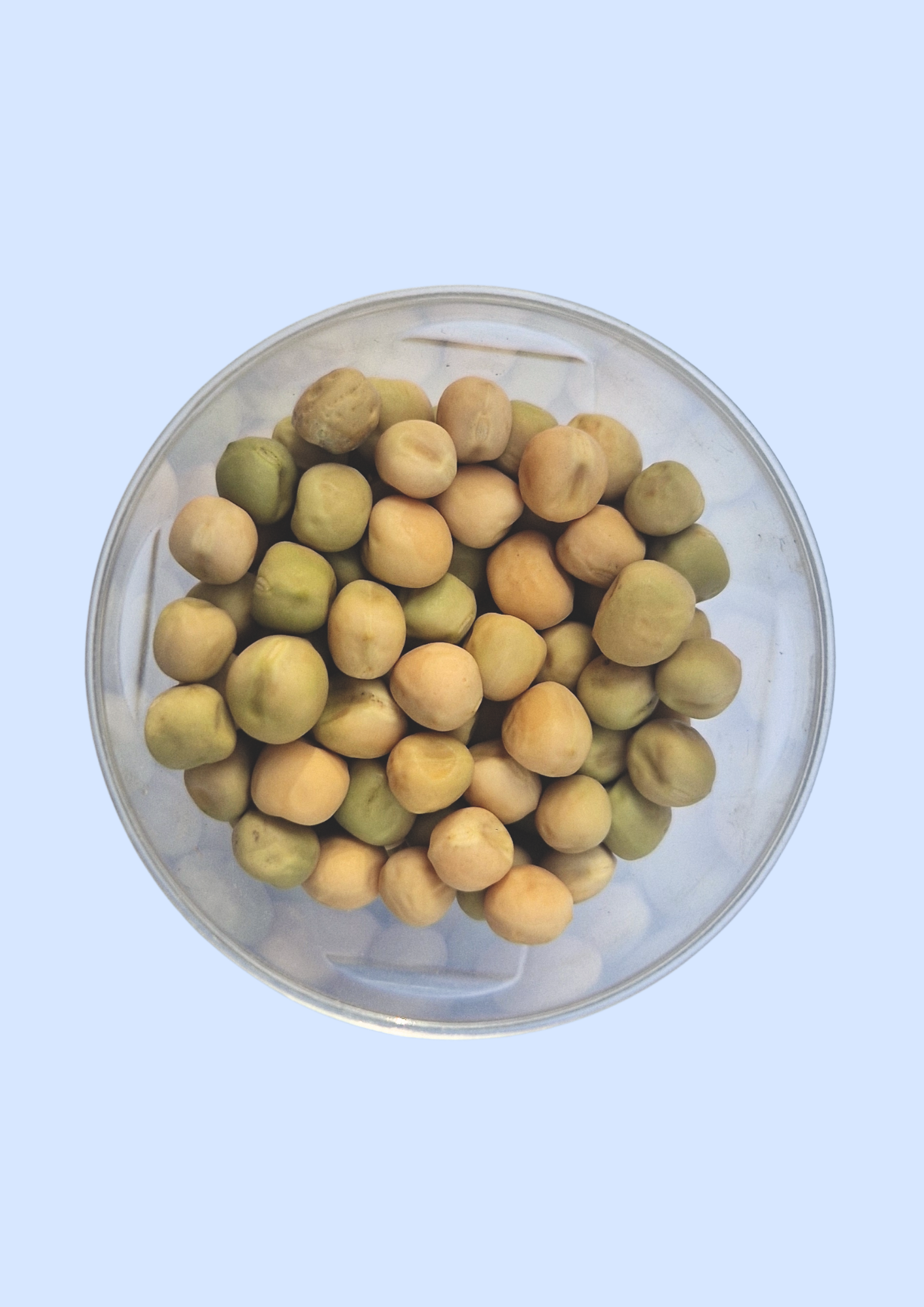
Sprouts are germinated seeds that are consumed very early, usually within just a few days.
- They are typically grown in very humid conditions.
- Often produced without substrate and with little or no light (depending on the method used).
- The entire seed, root, and shoot are eaten.
Microgreens
We’ll explain them, although by now we’re already experts, right?
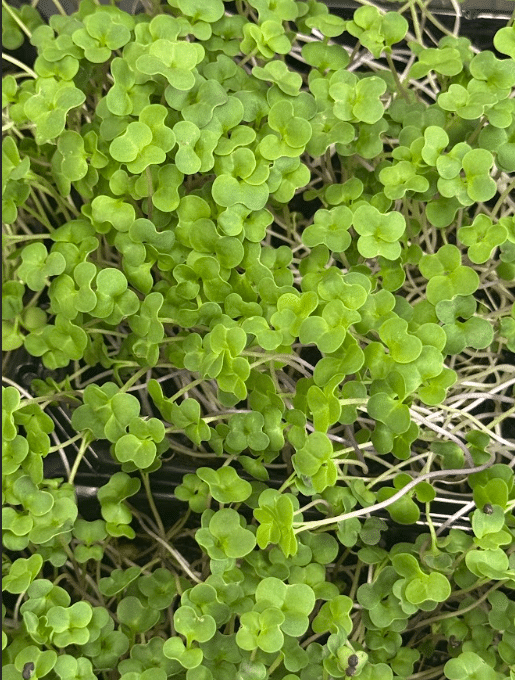
- They are young seedlings, harvested once they have developed cotyledons and sometimes the first pair of true leaves (depending on the species and the grower).
- They are usually grown with light and on a substrate (soil, coco coir, or growing mats).
- Only the stem and leaves are harvested, not the root.
Baby leaves (Baby leafy greens / Baby greens)
- These are more developed than microgreens. At this stage, it’s no longer a seedling but a young leaf, like a “mini salad leaf.”
- They require a longer growing period.
- Post harvest handling is similar to ready to eat salad mixes
Culinary uses: not just “decoration”
Each one serves a different purpose in the kitchen.
- Sprouts: Add crunch and freshness. Common in sandwiches, salads, and bowls.
- Microgreens: Widely used as a finishing touch. They add aroma, vibrant color, and an intense burst of flavor without adding bulk. Many varieties are bold, spicy, mustard like, or herbaceous.
- Baby leaves: Often used as the base of a salad (baby arugula, baby spinach, mesclun mix). They provide volume and structure.
Risks: why sprouts have a “health history”
This is the sensitive point. All three are often eaten raw, so, as we’ve discussed in previous articles, hygiene and production processes matter. However, sprouts have been particularly highlighted by health authorities.
The European Food Safety Authority has explained that outbreaks linked to sprouted seeds are frequently associated with Salmonella and pathogenic E. coli (including STEC). Even very low levels of contamination in seeds intended for sprouting can trigger outbreaks.
This is not meant to alarm, but to explain why the conversation around sprouts focuses heavily on:
- Seed sanitary quality
- Water control
- Conditions that favor bacterial growth
That’s why specific hygiene guidelines exist, such as those from the European Sprouted Seeds Association, which focus on the safe production of sprouts and seeds intended for sprouting.
And what about microgreens, is it “zero risk”?
No. But the risk profile is different because:
- They are usually grown with light and in a different medium.
- Post harvest handling and cutting introduce other risks (recontamination, cold chain management, harvest area hygiene).
So while sprouts require especially strict controls due to their history and production method, microgreens are managed under good practices similar to other fresh ready to eat produce.
Approximate prices…
A) Time and production system
- Sprouts are fast growing but require strong sanitary controls.
- Microgreens take longer than sprouts and require trays, lighting, space, and manual harvesting.
- Baby leaves take even longer and are handled like salad crops, washing, drying, refrigeration, and more complex retail logistics.
B) Sales format (and packaging)
Are we selling trays to restaurants or packaged products to consumers? It’s not the same.
At this point, we can conclude that:
- Microgreens operate as a high value, gourmet crop. The format and post-harvest handling significantly influence the final price.
- Sprouts and baby leaves target a broader, more accessible market.
Overall:
- Microgreens tend to be more expensive than baby leaves because they are more labor intensive and often positioned as premium products.
- Sprouts may have a lower direct production cost but carry a heavier sanitary control burden.
- Baby leaves compete primarily on volume.
And you, did you already know the differences between microgreens, sprouts, and baby leaves? Have you tried them all? Would you still choose our friends the microgreens despite the price difference?
We’d love to hear your opinion, don’t forget to follow us on social media.
See you next time!
Carlota
Sources
Co Produce Safety Partnership. (2020, August 31). Sprouts, microgreens and leafy greens: Characteristics of sprouts, microgreens and leafy greens. https://coproducesafety.org/wp-content/uploads/2022/01/Sprouts-Microgreens-and-Leafy-Greens.pdf
Cornell Cooperative Extension Monroe County. (2026, February 23). Sprouts and microgreens. https://monroe.cce.cornell.edu/agriculture/seasonal-produce-highlights/sprouts-and-microgreens
Di Gioia, F. (2024). The ABCs of microgreens. Penn State Extension. https://extension.psu.edu/the-abcs-of-microgreens
European Commission. (2017). Guidance on food safety: Sprouts and sedes. https://food.ec.europa.eu/system/files/2017-12/biosafety_fh_guidance_essa_sprouts-and-seeds_en.pdf
European Food Safety Authority. (2011, November 15). EFSA assesses the public health risk of seeds and sprouted seeds. https://www.efsa.europa.eu/en/press/news/111115
Food Standards Agency. Sprouts and seeds intended for sprouting: Q&A guidance on the package of EU regulations for food business operators and local authorities. https://www.food.gov.uk/sites/default/files/media/document/sprouts-and-seeds-sprouting-guidance.pdf.pdf
Morton, D., & Stretch, C. (2018). Commercial microgreens: Production and best practices (Agdex 268/18-1). Alberta Agriculture and Forestry. https://www1.agric.gov.ab.ca/%24department/deptdocs.nsf/all/agdex15965/%24file/268_18-1.pdf
Wiedenfeld, D., & Aulakh, J. Microgreens [PDF]. University of Arizona Cooperative Extension. https://extension.arizona.edu/sites/extension.arizona.edu/files/attachment/Microgreens.pdf