Get in touch
Questions about growing, workshops, the cooperative or partnerships? Send us a message and we will reply by email.
Prefer email? Write to erasmus@evec.org.gr
EVEC Microgreens
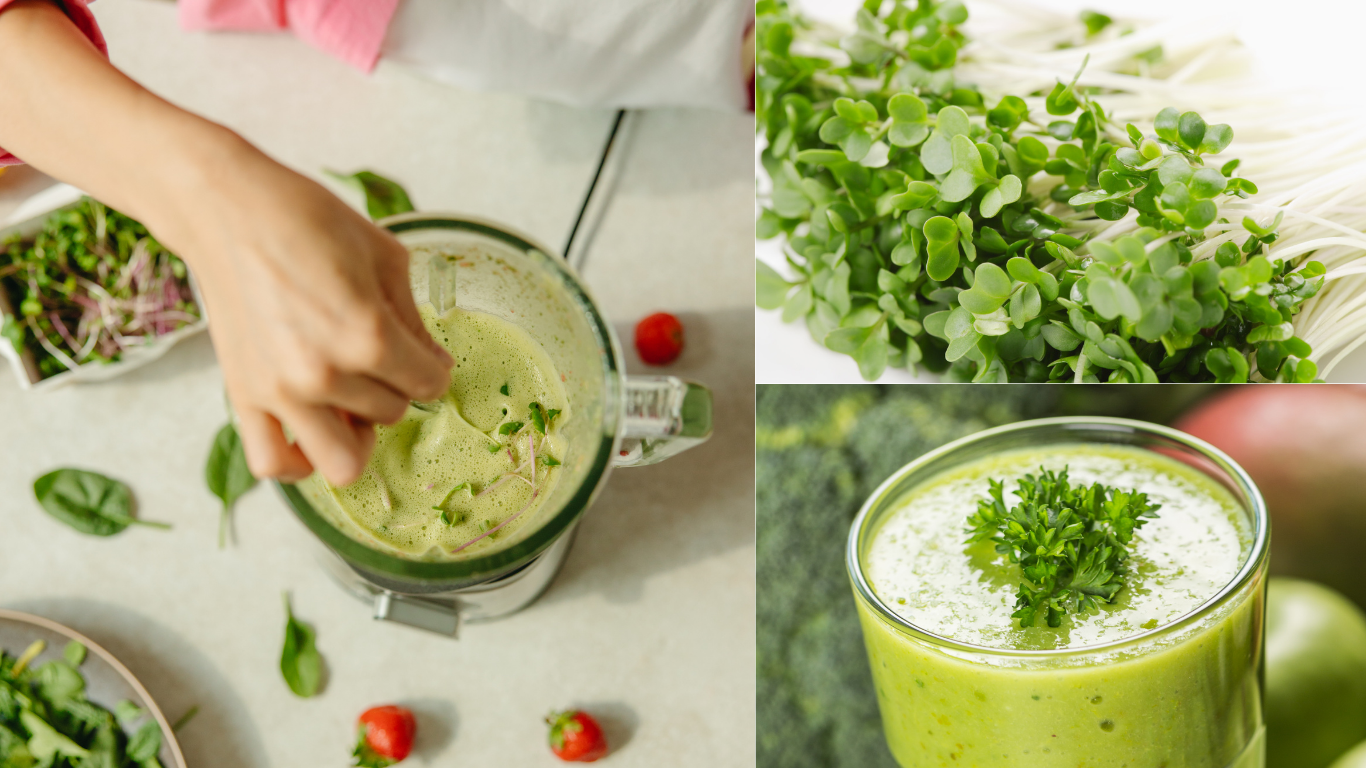
Five microgreens smoothie recipes — three found online, one from a shop, one of our own. No cooking involved: the greens go in raw with fruit, ice or yogurt.
Smoothies are one of the simplest ways to get microgreens into a daily diet, since they need no cooking and the greens go in raw.
We went looking on social media and on specialist sites for combinations that people actually make, rather than inventing our own from scratch. Below are the most interesting ones we found, and at the end our own recipe.
On TikTok we came across a Spanish-speaking nutritionist who shares a smoothie recipe with microgreens — her profile is @minutohealthy, and it is worth a look. She uses:
Blend everything together and it is ready. She describes it herself as a “nutrient bomb.”
The same account suggests a different combination. This one starts with ice to make it extra refreshing, and includes:
This one has no dairy in it at all — the body comes from the nuts:
This one comes from the Instagram account @bienverdes, which is dedicated to microgreens.
From a site that specialises in selling microgreens — also dairy-free, blended with water:
We are fond of berry smoothies, so we put together a pink — or purple, depending on the berries — version of our own:
We used cinnamon basil. To match the colour you could add red amaranth or red radish microgreens instead.
What all five have in common is narrower than it looks: the microgreens go in raw and unheated, blended with fruit. Everything else varies — two of the five have no dairy or plant milk at all, and the liquid is just water and ice. That is the useful part. Once you know the greens are never cooked, the rest of the recipe is a matter of taste rather than method. Four more dishes from our own team work on the same principle, and the greens themselves come from a tray on a windowsill — see how to grow microgreens at home.
We hope you give these combinations a try and let us know what you think on our social media @evec.microgreens
We’ve already tested them all and it’s clear to us: we love them!
What about you? Which one is your favorite?
Carlota
This article is part of the free knowledge portal of EVEC Microgreens. Wherever you are on your microgreens journey, there is a path for you:
Co-funded by the European Union.
This portal presents the microgreens methodology; the organisation behind it is EVEC Athens — the European Voluntary and Educational Center (evec.org.gr). Views and opinions expressed are those of the author(s) only and do not necessarily reflect those of the European Union or the European Commission. Neither the European Union nor the granting authority can be held responsible for them.
Open licence. Except where stated otherwise, the educational materials on this portal are licensed under CC BY 4.0 — free to use, adapt and share, including commercially, with credit. See the licence terms.
Accessibility. We aim for WCAG 2.1 AA and publish what does and does not yet meet it — see the accessibility statement. If anything here blocks you, tell us and we will send the material in a format that works for you.




[…] Shake your world with microgreens smoothie Original and healthy recipes with microgreens: six ideas to enjoy […]