Get in touch
Questions about growing, workshops, the cooperative or partnerships? Send us a message and we will reply by email.
Prefer email? Write to erasmus@evec.org.gr
EVEC Microgreens
You are writing an Erasmus+ or Solidarity Corps project — and it is not about plants. It is about cooking, or electronics, or bullying, or integration. This page exists to show you the hook anyway: the microgreens methodology works for almost any vocation, any age and any topic, because a tray of seeds is a lab, a kitchen, a business, a team and a story at the same time. Below are microgreens project ideas for 18 fields and themes — find yours and steal the idea.
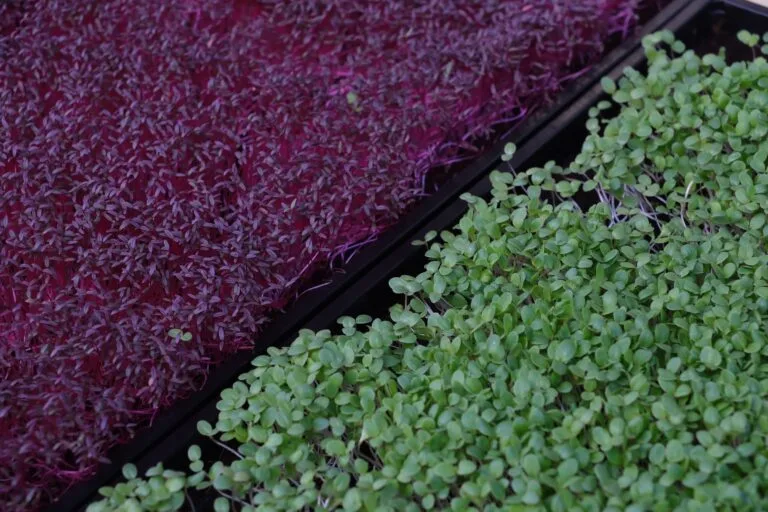
Vocational education is where the methodology is most literal: one growing cycle is a complete work-based learning unit — sow, grow, harvest, cost, price, sell — in 7 to 14 days, on a classroom budget. Whatever trade you teach, the tray has a job for it.
Your students plate garnishes they harvested that morning. Menu development with a living ingredient, plate-cost calculations on a crop they grew themselves, flavour work across 26 crop guides from pea shoots to shiso — and a tested open cookbook to start from. Cooperation idea: a joint “from tray to plate” module — your students grow three crops, develop three dishes each, and publish them in the cookbook with their names on them.
A crop with a shelf life measured in days is the perfect teaching product: hygiene, washing, storage temperature, labelling and spoilage become visible within one school week, not one semester. Cooperation idea: co-develop the food-handling unit of our 10-Day Growing Guide with your specialists — your class pilots it, both names go on the final open resource.
The direct hook: soilless systems, germination rates, substrate comparisons and yield data — fast enough that students run several full trials per term, indoors, in any season. Cooperation idea: comparative growing trials between partner schools in different countries, same seed, different conditions, results published in the open Varieties database.
A micro-enterprise with a ten-day cash cycle: seed cost in, revenue out, margin visible before the month ends. Costing, pricing, customer discovery and pitching — with a free bootcamp course already live to build on. Cooperation idea: international student companies grow the same crop in different markets and compare unit economics across countries — a business lesson no textbook can print.
Branding a real product beats branding an imaginary one: naming, label design, product photography and social content for a living tray of greens, with real customers reacting. Cooperation idea: a multi-country student branding challenge — the winning identity is actually used by the microgreens cooperative in Athens.
A tray is a bio-lab for IoT: humidity, temperature and light sensors, timelapse rigs, growth dashboards — code meets a living system that punishes bad data within days. Our hydroponics-and-sensors toolkit draft is the starting point. Cooperation idea: your students build and program the monitoring kit, learners in Athens grow with it, and both sides publish the shared dataset openly.
A product that lives for days, not months, turns supply-chain theory into a stopwatch problem: harvest windows, cold chain, stock rotation and last-mile delivery to restaurants. Cooperation idea: a delivery-challenge unit where student teams plan and cost the route from tray to table before the crop wilts.
Farm-to-table is a story guests pay for — and a growing shelf in the breakfast room is the smallest farm that can tell it. Cooperation idea: pilot a “living kitchen garden” guest experience: students design it, run it and script the storytelling around it.
Nutrition education with sources you can check: our Science Library rewrites peer-reviewed microgreens research in plain language, linking every original study. Cooperation idea: your students co-create plain-language nutrition materials for patients or older adults, reviewed against the library and published openly.
Somebody has to build the farm: growing racks, light frames, irrigation trays — real workshop products with a daily user waiting for them. Cooperation idea: your workshop designs and builds a growing wall; the methodology fills it with life; the build plans join the open toolkits so any school can copy it.
Youth projects are rarely about a subject — they are about a group. That is exactly where a tray of living greens earns its place: it gives any group, whatever brought it together, a shared thing to care for that visibly responds within days.
A tray fails if the group fails it. Shared care for a living thing gives a group a common project where cooperation — and its absence — becomes visible in days, without anyone being singled out. The harvest meal at the end is a ritual the whole group earned together. Cooperation idea: co-design a 10-day group-building cycle where the crop’s progress mirrors the group’s, with your youth workers shaping the reflection sessions.
Sowing needs no vocabulary. On day one everyone plants the same seed; by harvest, the group is sharing recipes from every kitchen it came from. Food is the one language nobody has to learn. Cooperation idea: intercultural harvest dinners as a recurring format, and a recipe chapter from your community published in the open cookbook.
A garden takes no sides. Growing together is a neutral, hands-on activity where belonging forms around the work itself, not around labels — and the shared table at harvest is a safe-space format that needs no explaining. Cooperation idea: build your safe-space programme around a growing cycle, with the methodology carrying the structure and your organisation carrying the community expertise.
For a young person whom school failed, the first win matters most — and this one arrives in seven days, green and edible and undeniable. Then come costing, selling and a portfolio: the bootcamp course is free, and the growing space in Athens costs nothing to use. Cooperation idea: an employability strand where every participant leaves with a harvested crop, a costed business sheet and a published contribution.
Daily watering is structure; visible growth is feedback; harvest is completion. A growing routine offers green care without clinical framing — nobody is a patient at a growing bench. Cooperation idea: co-design a wellbeing cycle with your psychologists or youth workers, where the methodology provides the rhythm and your team provides the support around it.
Growing at table height: no field, no heavy tools, no weather. Tasks scale from scattering seeds to managing a sensor dashboard, so every participant works at their own edge — and every sense gets something to do. Cooperation idea: adapt one of our open toolkits into an accessible version with your specialists, published openly as its own result.
The green transition on a windowsill: soilless growing, zero food miles, water and waste you can weigh — and data young people collect themselves instead of reading about. Cooperation idea: a youth exchange where every group grows, measures and presents its own sustainability numbers, feeding a shared open dataset.
The tray as a miniature parliament: the group decides what to grow, how to price it and what happens to the proceeds — cooperative governance small enough to practise and real enough to sting. Cooperation idea: a decision-making curriculum wrapped around a growing cycle, tested against the real cooperative model running in Athens.
Schools: one tray crosses the curriculum — germination in biology, yield and price in maths, nutrients in chemistry, a recipe written in the foreign language, a label designed in art. The schools page and two classroom toolkits carry the detail. Adult education: nutrition and healthy ageing, family learning, numeracy through real costing, integration courses where language practice happens over a shared harvest — see microgreens in adult education. Researchers: households growing the same crop and reporting their data is citizen science waiting to happen — see the Horizon Europe page.
Even better — it means the hook for your project has not been written yet, and writing it together is the most natural way to start a partnership. The pattern is always the same: your topic + microgreens = a hands-on activity your participants will remember, and a concrete, fundable added value in your application. Hairdressing academies, driving schools, choirs — we have yet to meet the field where the pattern fails.
One paragraph about your project to erasmus@evec.org.gr. Three concrete ideas back. That is the deal.
The methodology: this portal is the home of the microgreens methodology — one hands-on way of learning that works for any vocation and any age, running since 2025.
The organisation behind it: EVEC Athens (European Voluntary and Educational Center), an accredited Greek NGO working in European projects since 2017 · OID E10172681 · PIC 909448430 · Erasmus+ Youth accreditation 2023-1-EL02-KA150-YOU-000188397 · ESC Quality Label 2023-1-EL02-ESC50-QLA-000195138 — both valid until 2027. Verify in the EU organisation registry (search for OID E10172681), see the track record, or visit the organisation at evec.org.gr.
One paragraph about your project. Three concrete ways the methodology can add value to it, by reply. erasmus@evec.org.gr reaches the whole team.
Co-funded by the European Union.
This portal presents the microgreens methodology; the organisation behind it is EVEC Athens — the European Voluntary and Educational Center (evec.org.gr). Views and opinions expressed are those of the author(s) only and do not necessarily reflect those of the European Union or the European Commission. Neither the European Union nor the granting authority can be held responsible for them.
Open licence. Except where stated otherwise, the educational materials on this portal are licensed under CC BY 4.0 — free to use, adapt and share, including commercially, with credit. See the licence terms.
Accessibility. We aim for WCAG 2.1 AA and publish what does and does not yet meet it — see the accessibility statement. If anything here blocks you, tell us and we will send the material in a format that works for you.