Get in touch
Questions about growing, workshops, the cooperative or partnerships? Send us a message and we will reply by email.
Prefer email? Write to erasmus@evec.org.gr
EVEC Microgreens
The microgreens methodology was born inside a European Solidarity Corps project and is still run by international volunteers. Come and join them: ESC volunteering in Athens means growing real food, running real workshops and publishing work that stays online long after your placement ends.
This page is written for two readers. If you are aged 18 to 30 and considering a European Solidarity Corps volunteering placement or internship abroad, it shows what your days with us would actually contain. If you are an ESC coordinator or a sending organisation assessing us as a hosting environment, it shows the working infrastructure and the published output your participants would join.
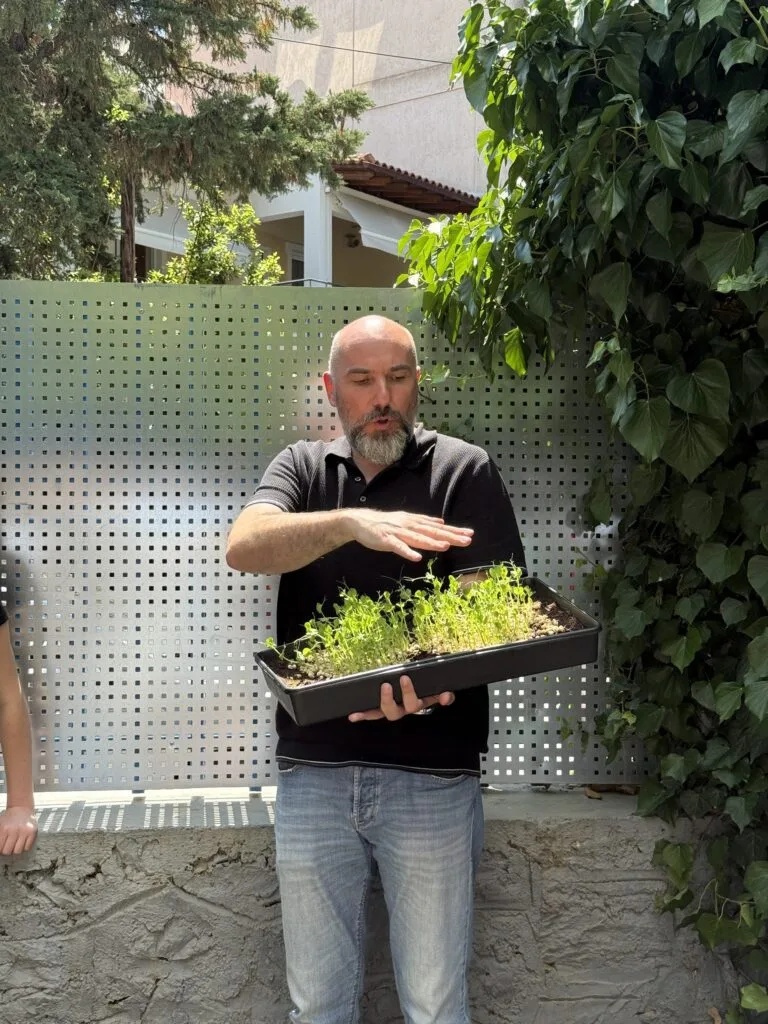
Volunteers run our growing space in Athens: sowing, watering, harvesting and record keeping through a real production cycle, not a demonstration corner. You also help plan and deliver workshops on growing in the city, harvesting at home and cooking with microgreens.
This portal is built and run by international volunteers. You research and write articles for a site read by real audiences, develop and test recipes for the cookbook, and contribute to educational toolkits. You leave with a public, permanent portfolio, which is a rare thing to take home from a placement.
You join a small international team hosted by EVEC Athens, the organisation behind the methodology — an Athens non-governmental organisation working in European projects since 2017. Daily life mixes hands-on growing, writing and workshop practice with everything a large Mediterranean capital offers.
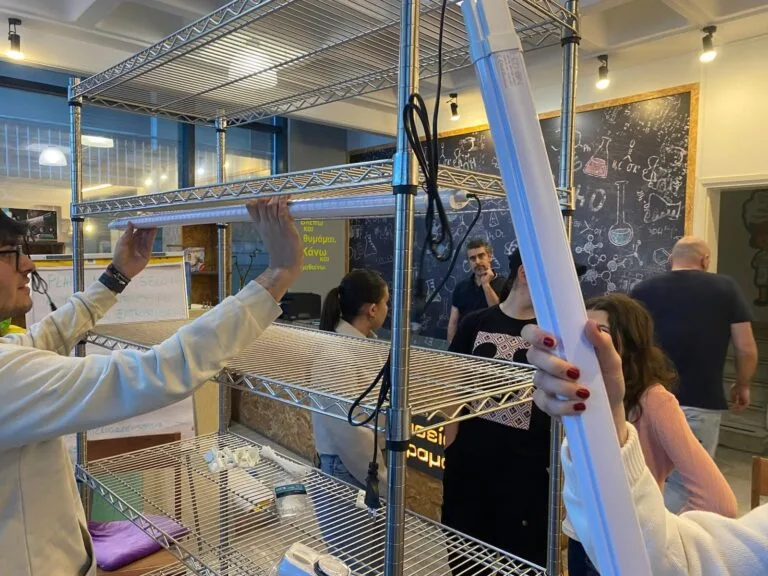
A typical week mixes three kinds of work. In the growing space you carry real production tasks through complete crop cycles, from sowing and watering to harvest and record keeping, in the same space we offer free to young entrepreneurs through our cooperative. In workshops you move from assisting to co-facilitating: preparing materials, running a station and, in time, leading sessions with the team beside you. At the desk you research and write for this portal, from articles and recipes to contributions to the open toolkit drafts, and what you publish stays online under your name.
All of this sits inside the European Solidarity Corps framework: mentorship, a learning agreement and structured support are arranged according to ESC requirements together with your sending organisation, so your learning is planned and documented rather than left to chance. The methodology itself is ESC-born and has been running since 2025, and the published work of its volunteers is visible across this portal; the blog is the quickest way to sample it.

Everything below is on this site today, built by the team and its international volunteers. The knowledge library and the cookbook are live and in daily use; the four toolkits are open drafts you would help finish.
More than 110 free articles: crop guides, grow-at-home guides, business articles and a Science Library that rewrites open-access research in plain language. Volunteers research, write and edit them. Browse the library →
A collection of easy, mostly vegan-friendly microgreens recipes, developed and tested in Athens by the team and volunteers. If you enjoy cooking, your own recipes can join it. Open the cookbook →
Four educational toolkits for schools, youth and young entrepreneurs, built with volunteer input. All four are open drafts published for community feedback, so you would join work in progress. Read the open drafts →
See everything we have built →
Recent articles from the team give a fair picture of the work volunteers publish here.
Fennel microgreens bring a sweet, delicate aniseed flavour to the plate. Learn to soak, sow, grow and harvest this slow, chef-favourite herb…
Corn shoots (popcorn shoots) microgreens grow entirely in the dark for sweet, tender yellow shoots. Learn how to soak, sow, keep dark…
Buckwheat microgreens grow fast from soaked seed, taste bright and lemony, and are easy for beginners — here is how to sow,…
The full library, from crop guides to the Science Library, lives on the blog.
A note for sending organisations and ESC coordinators: EVEC holds the ESC Quality Label 2023-1-EL02-ESC50-QLA-000195138, valid until 2027, and hosts international volunteers under it — the microgreens methodology itself runs on ESC hosting projects 2024-1-EL02-ESC51-VTJ-000225260 and 2025-1-EL02-ESC51-VTJ-000345995. EVEC welcomes partnership enquiries, from co-writing a solidarity project to building a long-term hosting partnership, and the team will gladly walk you through the space, the daily tasks, the support provided and how a placement can be matched to a participant’s learning goals.
Writing a solidarity project on another theme? Integration, wellbeing, environment, participation — every theme has a microgreens hook. Find yours and send us your idea.
The methodology: this portal is the home of the microgreens methodology — one hands-on way of learning that works for any vocation and any age, running since 2025.
The organisation behind it: EVEC Athens (European Voluntary and Educational Center), an accredited Greek NGO working in European projects since 2017 · OID E10172681 · PIC 909448430 · Erasmus+ Youth accreditation 2023-1-EL02-KA150-YOU-000188397 · ESC Quality Label 2023-1-EL02-ESC50-QLA-000195138 — both valid until 2027. Verify in the EU organisation registry (search for OID E10172681), see the track record, or visit the organisation at evec.org.gr.
Tell us what you are planning and we will reply by email. One message to erasmus@evec.org.gr reaches the whole team.
Co-funded by the European Union.
This portal presents the microgreens methodology; the organisation behind it is EVEC Athens — the European Voluntary and Educational Center (evec.org.gr). Views and opinions expressed are those of the author(s) only and do not necessarily reflect those of the European Union or the European Commission. Neither the European Union nor the granting authority can be held responsible for them.
Open licence. Except where stated otherwise, the educational materials on this portal are licensed under CC BY 4.0 — free to use, adapt and share, including commercially, with credit. See the licence terms.
Accessibility. We aim for WCAG 2.1 AA and publish what does and does not yet meet it — see the accessibility statement. If anything here blocks you, tell us and we will send the material in a format that works for you.