Get in touch
Questions about growing, workshops, the cooperative or partnerships? Send us a message and we will reply by email.
Prefer email? Write to erasmus@evec.org.gr
EVEC Microgreens
A tray of seeds becomes a shared responsibility, a daily lesson in observation and a harvest the whole group cooks and eats together, all inside ten days and on any youth centre budget.
You are a youth worker looking for a hands-on non-formal education activity that actually holds attention: a living project with real responsibility, change you can see every day, and green transition, healthy living and employability themes carried without a classroom feel. Or you run a youth organisation shaping an Erasmus+ youth project, an exchange or a capacity-building partnership around a concrete, replicable method. Either way, this page shows you the method in full — the toolkits, the cycle and the results.
Our track record, honestly stated in two layers: the microgreens methodology was born inside European Solidarity Corps project 2024-1-EL02-ESC51-VTJ-000225260 and has been running since 2025. Behind it stands the organisation EVEC Athens (evec.org.gr), accredited for Erasmus+ Youth (2023-1-EL02-KA150-YOU-000188397) and working in European projects since 2017, with 20+ Erasmus+ and ESC projects delivered. The workshops in Athens are facilitated by our team together with international ESC volunteers, and this portal, live since January 2026, is where everything they help build stays public and free.
Our 10-Day Growing Guide, from seed to harvest, gives any session plan a living centre: young people water, measure, record and harvest something real. Published as an open draft for feedback.
Teams build a small hydroponic system with sensors and collect their own data, connecting biology, sustainability and technology in one project. Also published as an open draft.
A ten-day bootcamp joining growing with business planning, finance, marketing and pitching, built for the employability strand of a youth project. Also an open draft.
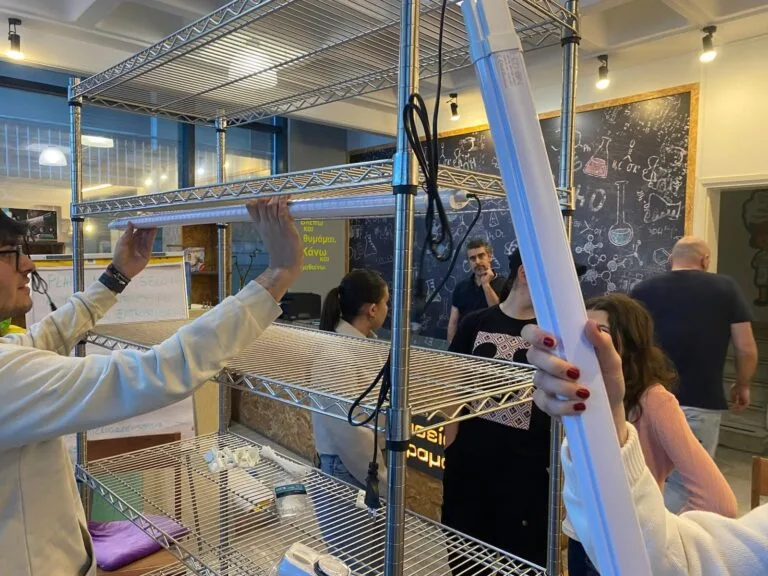
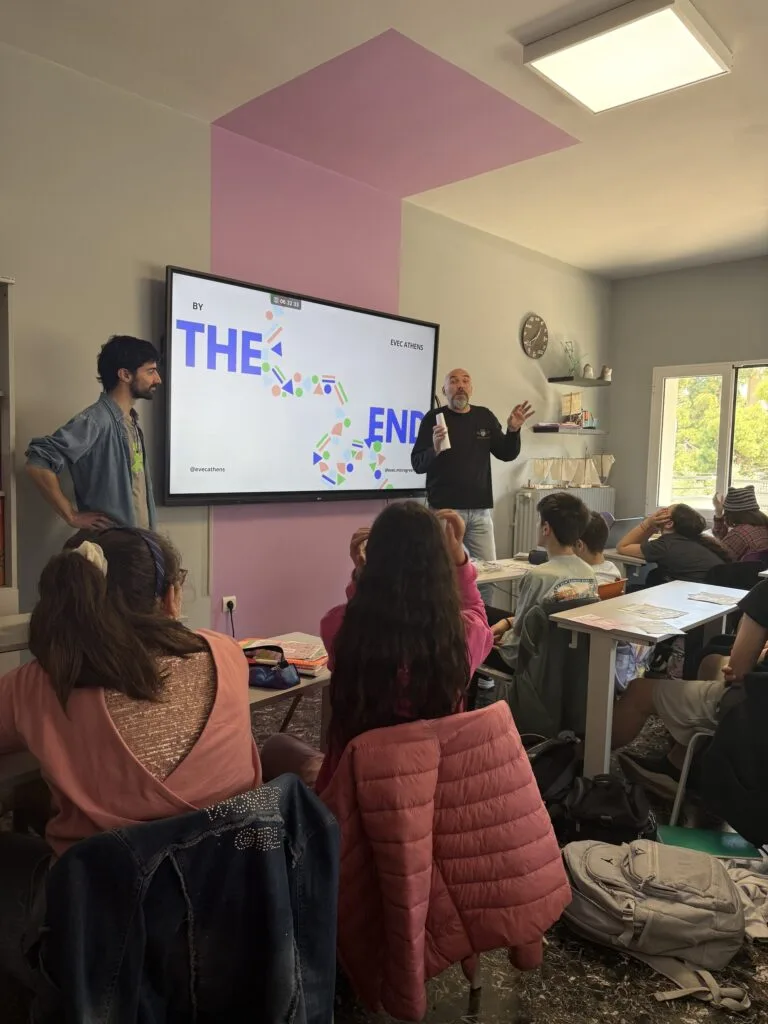
Our international volunteers run workshops in Athens on growing microgreens in the city, harvesting at home and cooking them, and we share that facilitation experience with partners.
We work from a physical growing space in Athens, the same space we offer free to young entrepreneurs through our cooperative.
This portal carries more than 110 free articles and keeps project results visible and usable after funding ends, which is what sustainability of results looks like in practice.
An illustrative programme idea, not a fixed plan: the full growing cycle fits inside a single youth exchange. In a KA152 activity of 5 to 21 days, sow the trays on day two, rotate watering and measurement duties through the middle days, then harvest and cook together near the end, so the exchange closes with a meal the group grew itself.
The cycle also leaves a paper trail of learning: germination logs, growth measurements, harvest notes and, in the 18-to-30 track, a costed mini business plan. These are documentable learning outcomes participants can reflect on in their Youthpass certificates, particularly under the entrepreneurship and the personal, social and learning-to-learn key competences. We certify nothing ourselves; the method simply gives young people something specific to write about.

Two tiers, honestly labelled. The cookbook below, the Academy courses and the rest of this portal are live and in daily use; the two toolkits are open drafts your consortium can help finish. Piloting a draft with your own young people, then feeding back what worked, is a legitimate, fundable project activity — and finishing a toolkit is a ready-made work package.
A team-based journey where young people build a hydroponic system, run it with sensors and analyse the data they collect. Open draft, feedback welcome. Read the draft
Ten days that pair growing skills with business planning, finance, marketing and a final pitch. Open draft, feedback welcome. Read the draft
Live and in use today: easy, mostly vegan-friendly recipes developed and tested by our team and volunteers, made for the group cooking session that closes a growing cycle. Open the cookbook
See everything we have built →
Three free, self-paced courses are live and complete as v1 open educational resources — take them yourself or use them with your group. For youth workers, the natural starting point is the free educators course, which walks a facilitator through running the growing cycle with a group and is ready to use in session planning today. This list updates as new courses are published.
A free, self-paced course for teachers and youth workers: run one growing cycle yourself, pick the right toolkit for your group, plan…
A free, self-paced course for aspiring microgreens entrepreneurs: master production, run the 10-day bootcamp, cost a tray honestly, find customers — and…
All courses live in the EVEC Microgreens Academy.
Fresh reading for youth workers, drawn automatically from our latest articles.
A 10-day project for ages 15–19: teams build a small hydroponic system with sensors, collect data and connect biology, sustainability and technology.…
A structured 10-day classroom journey from seed to harvest for learners aged 13–14, combining science, nutrition, sustainability and teamwork. Open draft, feedback…
Classroom activities for preschool and primary teachers: a mini garden, light and seed experiments, growth charts in math, tastings. Results in 7…
Browse the full library of guides, recipes and research on our blog.
This portal is where the method lives; Erasmus+ youth partnerships and exchanges are arranged with EVEC Athens at evec.org.gr. Read the toolkit drafts to see which age group and themes fit your concept, decide the role you would like EVEC to play — method partner, host for activities in Athens, content development, or dissemination through this portal — and bring the idea to EVEC to shape learning outcomes, activities and follow-up together.
An illustrative example, not a fixed offer — the real shape depends on your project. In a youth partnership, EVEC Athens, the organisation behind the methodology, could act as method partner and lead the finalisation of one toolkit:
Two deliverables come out of that role: the finalised open educational resource (v1.0) and a pilot report documenting how the method performed across partner countries.
Your theme is not named on this page? Bullying prevention, integration, LGBTQ+ inclusion, mental health, NEET employability — every youth topic has a microgreens hook. Find yours, then take the idea to EVEC.
The methodology: this portal is the home of the microgreens methodology — one hands-on way of learning that works for any vocation and any age, running since 2025.
The organisation behind it: EVEC Athens (European Voluntary and Educational Center), an accredited Greek NGO working in European projects since 2017 · OID E10172681 · PIC 909448430 · Erasmus+ Youth accreditation 2023-1-EL02-KA150-YOU-000188397 · ESC Quality Label 2023-1-EL02-ESC50-QLA-000195138 — both valid until 2027. Verify in the EU organisation registry (search for OID E10172681), see the track record, or visit the organisation at evec.org.gr.
The methodology lives here on the portal; Erasmus+ youth partnerships are arranged with EVEC Athens. Send us one paragraph about your project — the priority, the young people, the gap you are closing — and you will get three concrete ways the methodology can add value to it. A real reply from the people who built the method, not an autoresponder.
Co-funded by the European Union.
This portal presents the microgreens methodology; the organisation behind it is EVEC Athens — the European Voluntary and Educational Center (evec.org.gr). Views and opinions expressed are those of the author(s) only and do not necessarily reflect those of the European Union or the European Commission. Neither the European Union nor the granting authority can be held responsible for them.
Open licence. Except where stated otherwise, the educational materials on this portal are licensed under CC BY 4.0 — free to use, adapt and share, including commercially, with credit. See the licence terms.
Accessibility. We aim for WCAG 2.1 AA and publish what does and does not yet meet it — see the accessibility statement. If anything here blocks you, tell us and we will send the material in a format that works for you.