Get in touch
Questions about growing, workshops, the cooperative or partnerships? Send us a message and we will reply by email.
Prefer email? Write to erasmus@evec.org.gr
EVEC Microgreens
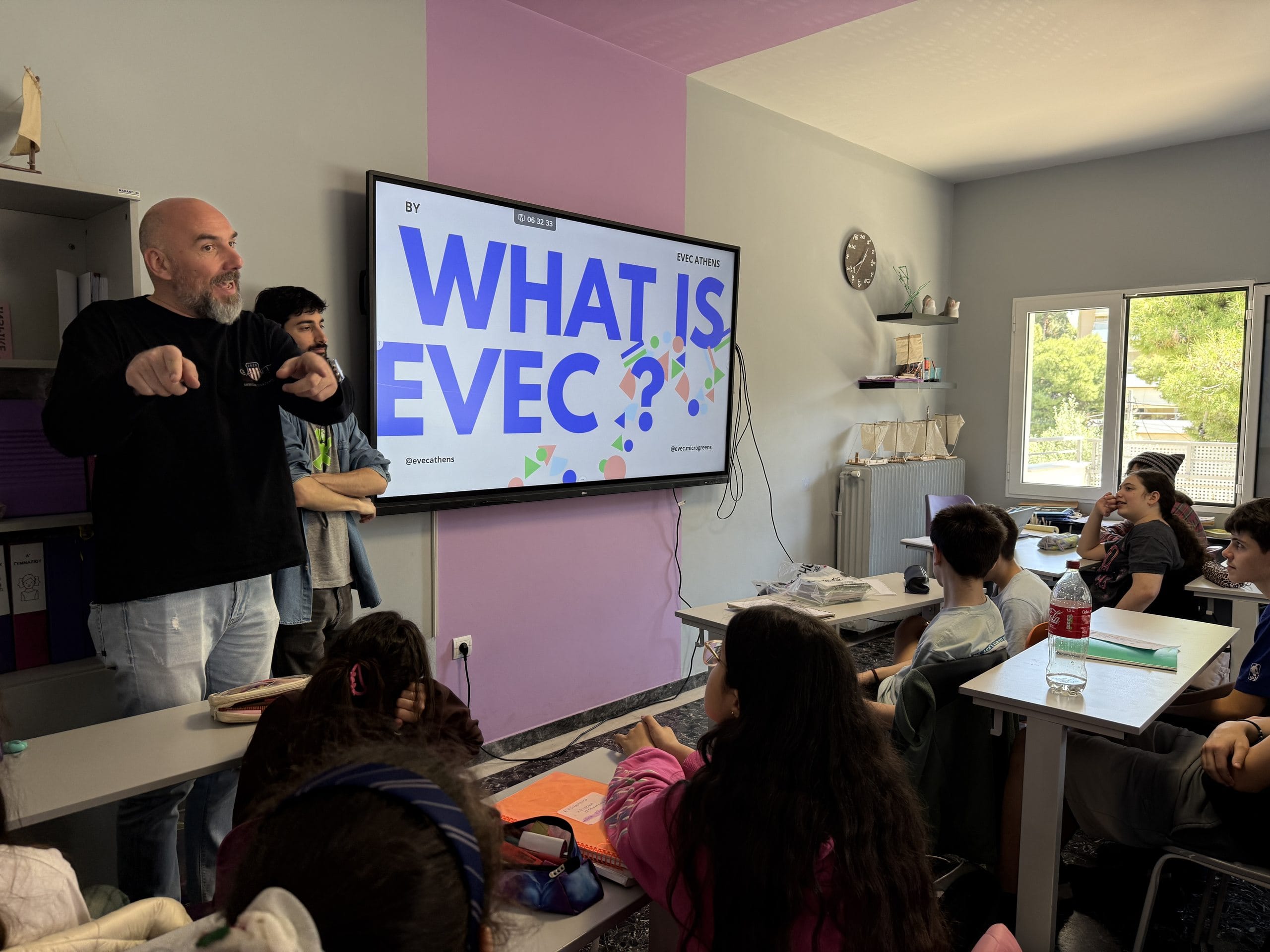
A free, self-paced course for teachers and youth workers: run one growing cycle yourself, pick the right toolkit for your group, plan ten school days and turn harvest day into the lesson.
Type: Self-paced online course · Audience: Teachers, youth workers, non-formal educators · Time: about 2 hours of reading plus one 10-day cycle before class · Cost: Free · Status: Pilot version, feedback welcome
Teach with microgreens and a single tray becomes a complete cross-curricular unit: biology, measurement and data, nutrition, sustainability and teamwork, with visible results inside ten school days and a budget any classroom can afford. This course prepares you to run it with confidence — by growing once yourself before your learners do.
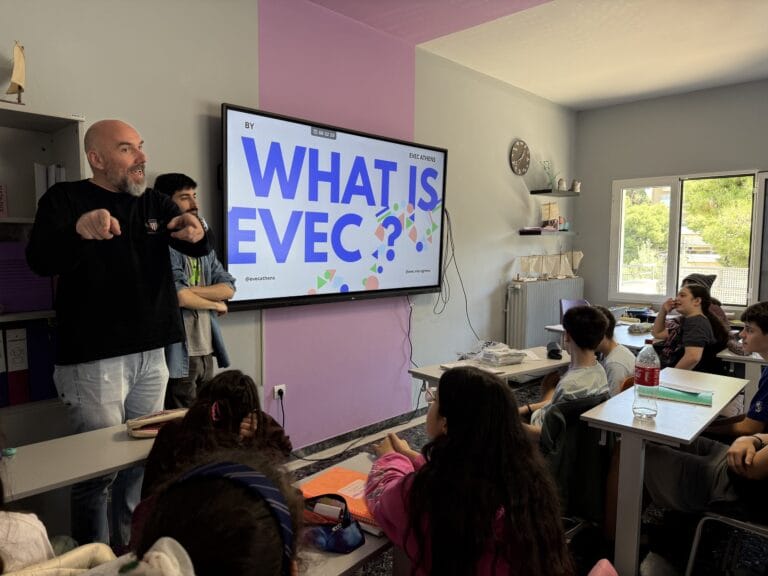
See what microgreens can carry in a classroom or youth centre: daily observable change, real responsibility, and themes from germination to food systems — without a classroom feel. Read how other educators frame it before you design your own version.
Materials: Microgreens in schools · Microgreens in youth work · the classroom library
You are done when you can name the three subjects your tray will teach and the age group you are planning for.
The teacher who has already rescued an over-watered tray teaches differently. Before your group sows anything, run one full cycle at home with the 10-Day Guide — every problem you meet now is a question you can answer later in front of the class.
Materials: the 10-Day Growing Guide (open draft) and a fast, forgiving crop from the Varieties database — radish or garden cress
You are done when you have harvested your own tray and written down the two mistakes you will warn your learners about.
Two ready programmes exist, both structured as ten-day journeys. For younger learners (13–14): games, experiment journals and printable sheets. For teens (15–19): teams build a small hydroponic system with sensors and collect real data. Read the one that fits your group; skim the other for ideas.
Materials: Primary School toolkit (13–14) · High School Youth toolkit (15–19) — both open drafts with feedback forms
You are done when you have chosen your toolkit and know which of its activities you will keep, adapt or skip.
Map the toolkit onto your real timetable: where the sowing lesson lands, who waters on the weekend, where the data lesson fits, and what happens if germination runs a day late. A one-page day plan now saves five improvised minutes every morning later.
Materials: your chosen toolkit’s day structure + your school or centre calendar
You are done when each of the ten days has a lesson goal, an owner for watering, and a plan B.
Harvest is not the end of the project; it is the payoff lesson. Cut together, weigh and record the yield, cook something simple together, and let the group present what they grew and learned — eating your own data is pedagogy no worksheet matches.
Materials: the Microgreens Cookbook (pick two easy recipes in advance)
You are done when your group has eaten what it grew and presented one thing it learned.
The toolkits are open drafts, and educators who run them are exactly who we build them for — your feedback goes straight into the next version. And if you want to go further, EVEC Athens (evec.org.gr), the organisation behind the methodology, partners with schools and youth organisations across Europe on Erasmus+ projects: ready content, real practice, and a portal that keeps results visible.
Materials: the feedback form under your toolkit on the toolkits page · Partner with us · Contact us
You are done when you have sent us one paragraph about how it went — and started planning the next cycle.
This course is an openly licensed (CC BY 4.0) educational resource of the microgreens methodology. The organisation behind the methodology is EVEC Athens (evec.org.gr). Schools, youth organisations and adult educators are welcome to use and adapt it. See all courses.
This article is part of the free knowledge portal of EVEC Microgreens. Wherever you are on your microgreens journey, there is a path for you:
Co-funded by the European Union.
This portal presents the microgreens methodology; the organisation behind it is EVEC Athens — the European Voluntary and Educational Center (evec.org.gr). Views and opinions expressed are those of the author(s) only and do not necessarily reflect those of the European Union or the European Commission. Neither the European Union nor the granting authority can be held responsible for them.
Open licence. Except where stated otherwise, the educational materials on this portal are licensed under CC BY 4.0 — free to use, adapt and share, including commercially, with credit. See the licence terms.
Accessibility. We aim for WCAG 2.1 AA and publish what does and does not yet meet it — see the accessibility statement. If anything here blocks you, tell us and we will send the material in a format that works for you.