Get in touch
Questions about growing, workshops, the cooperative or partnerships? Send us a message and we will reply by email.
Prefer email? Write to erasmus@evec.org.gr
EVEC Microgreens

Red cabbage microgreens lowered "bad" LDL cholesterol in mice on a fatty diet, but the only daily-eating trial in people found no change in body weight, waist size or blood pressure after two weeks. Here is what the studies actually say.
“How to lower cholesterol” is one of the most-asked health questions on Google, and microgreens often show up in the answers. So is there a real link between microgreens and cholesterol, or between microgreens and weight loss? The EVEC science library holds animal studies, one human trial and a review of human trials on a related compound. Here is what they actually say.
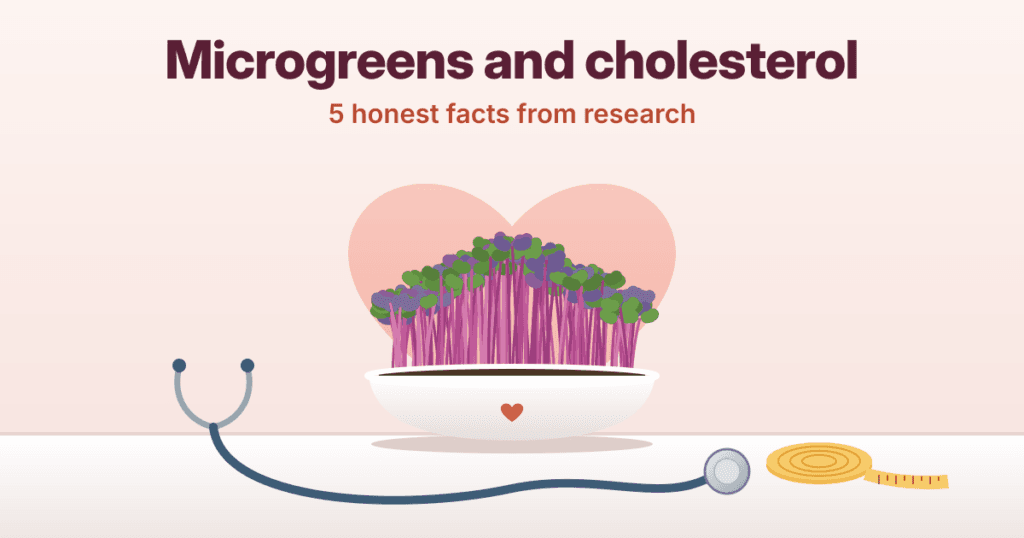
Red cabbage. At the US Department of Agriculture, 60 mice ate a low-fat or high-fat diet for eight weeks, with or without red cabbage. On the high-fat diet, mice eating red cabbage microgreens gained less weight and had lower LDL (“bad”) cholesterol. They also had less cholesterol and fat stored in the liver, and fewer signs of liver inflammation (Huang et al., 2016). Mature red cabbage also reduced weight gain and liver cholesterol.
Kale. The same team later found that both kale microgreens and mature kale limited weight gain in mice on a high-fat diet, and both changed their gut bacteria, more so with microgreens. This was presented at a 2023 conference, and the scientists said more experiments are needed to see whether people would benefit (American Chemical Society, 2023).
Rats. In an Egyptian study, rats were made diabetic and fed a high-fat diet. In some groups, 10% of their food was dried barley microgreen powder. In the poisoned (aflatoxin) rats fed barley microgreens, the blood fat profile went almost back to normal (Khattab et al., 2022).
Why this is not proof for people: these animals were given very fatty diets or made ill on purpose, and the microgreens were usually dried and mixed into their food every day. A mouse is also not a person.
You may see a rat study on “parsley” quoted as microgreen evidence. It tested extracts of parsley seeds and carob in rats with high cholesterol, not microgreens (El Rabey et al., 2017). Always check what was actually eaten.
In 2025, Colorado State University ran the first trial in which people ate microgreens every day. Twenty-four healthy adults aged 45–70 ate about 2 cups (28–30 g) a day of beet or red cabbage microgreens, two weeks each. They managed it well, eating 95.6% of their portions. But body weight, BMI, waist size and blood pressure did not change (Lee et al., 2025).
That is not surprising: the people were healthy and two weeks is short. The trial was designed to test whether daily eating is possible, not to lower cholesterol. The authors say studies of health effects are still needed.
Broccoli microgreens contain glucoraphanin, which turns into sulforaphane when you chew. A 2025 review of human trials found that sulforaphane, mostly from broccoli sprouts or supplements, may improve some metabolic and heart-related outcomes. It improved blood sugar control in people with type 2 diabetes but did not help high blood pressure. Many trials were small, and about half of the finished trials were never published (Saito et al., 2025).

Microgreens are light food. Fourteen microgreens grown in Thailand had only 20–53 kcal and less than 1 g of fat per 100 g (Kowitcharoen et al., 2021). Adding a big handful to a sandwich, wrap or salad adds crunch, colour and vegetables with very few calories ⚠️ (our suggestion, not a tested diet).
If you or a family member have high cholesterol, the most reliable steps are the ones a doctor recommends, such as diet changes, exercise and, when needed, medicine ⚠️. Microgreens can be part of a healthy plate, not a replacement for medical advice.
Microgreens and cholesterol is a promising story in mice, but not yet in people. Red cabbage microgreens lowered LDL in mice on a fatty diet, and mature vegetables often helped too. The only human trial found no change in weight after two weeks. Until longer trials exist, enjoy microgreens as a tasty, low-calorie vegetable, and be careful with anyone who promises they will melt fat or fix cholesterol.
Why does this matter? Health myths spread fastest when they sound scientific. Checking whether a study used mice or people is one of the easiest ways to spot hype.
Want to try them? Start with our research-based guides to radish or broccoli microgreens, or read the studies in the library of 374 microgreens research papers.
Papers 3–7 are in the EVEC science library.
This article is part of the free knowledge portal of EVEC Microgreens. Wherever you are on your microgreens journey, there is a path for you:
Co-funded by the European Union.
This portal presents the microgreens methodology; the organisation behind it is EVEC Athens — the European Voluntary and Educational Center (evec.org.gr). Views and opinions expressed are those of the author(s) only and do not necessarily reflect those of the European Union or the European Commission. Neither the European Union nor the granting authority can be held responsible for them.
Open licence. Except where stated otherwise, the educational materials on this portal are licensed under CC BY 4.0 — free to use, adapt and share, including commercially, with credit. See the licence terms.
Accessibility. We aim for WCAG 2.1 AA and publish what does and does not yet meet it — see the accessibility statement. If anything here blocks you, tell us and we will send the material in a format that works for you.