Get in touch
Questions about growing, workshops, the cooperative or partnerships? Send us a message and we will reply by email.
Prefer email? Write to erasmus@evec.org.gr

EVEC Microgreens
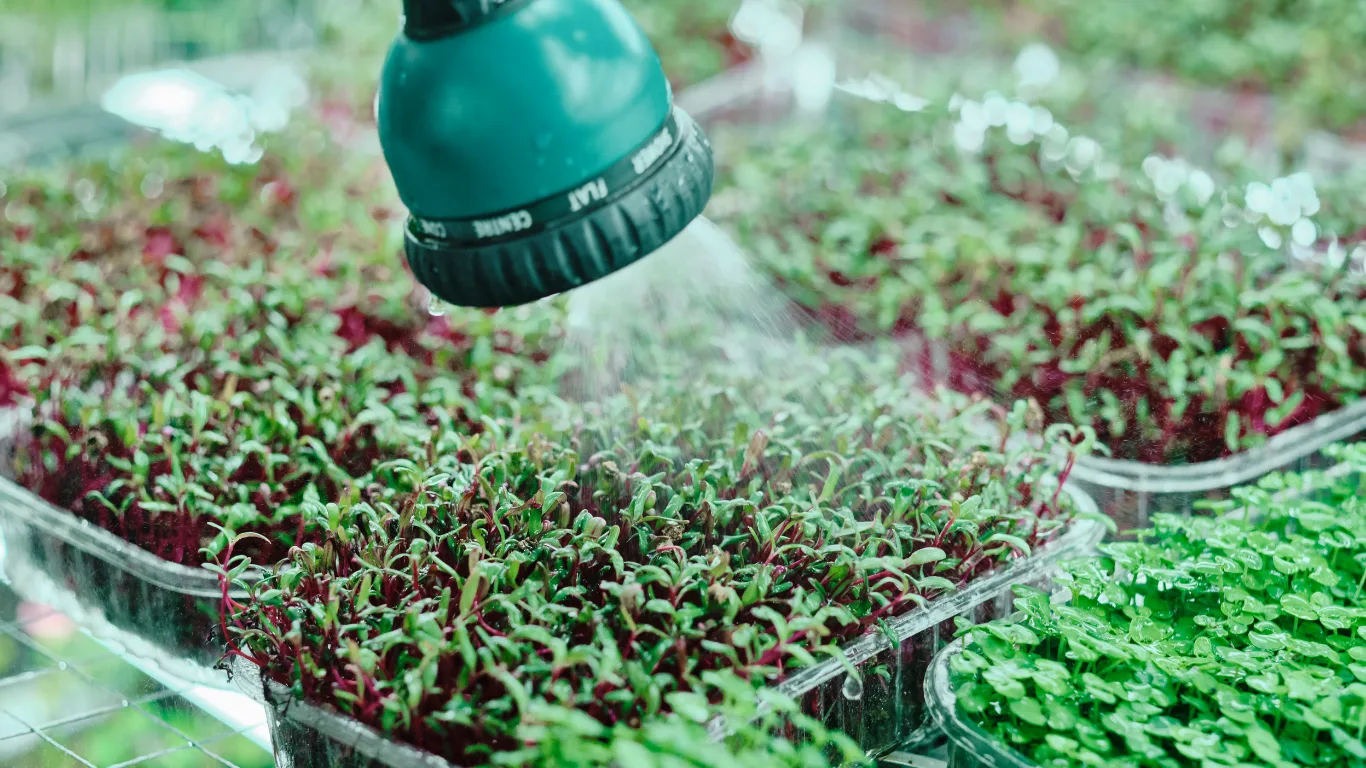
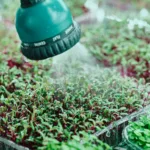
How to water microgreens correctly, step by step. Bottom vs top watering, how much and how often — the single skill that saves most beginners' first trays.
How you water microgreens is the step that most often decides whether a tray succeeds. It matters because the way you water your microgreens will make the difference between a healthy crop and one with problems such as mold, fungus, or weak growth.
From our experience growing microgreens, we’ve learned that watering is extremely delicate, you need to find the perfect balance between keeping the moisture and avoiding excess water.
In previous articles, we’ve already shared some tips on how to water different species of microgreens, but in this article, we’ll go into detail on this subject.
In summary, watering microgreens isn’t complicated, but it does require attention and careful observation. If you master this step, you’ve got almost everything covered.
Where to go next: overwatering is the usual route to mould, so pair this with our guide to preventing mould. Each crop has its own tolerance for wet — the Varieties database lists soaking and harvest timings for every one we grow. If you are setting up your first tray, start at Grow microgreens at home.
We hope you enjoyed, and most importantly, found value, in this article. See you in the next one! The microgreens adventure continues.
Carlota
This article is part of the free knowledge portal of EVEC Microgreens. Wherever you are on your microgreens journey, there is a path for you:
Co-funded by the European Union.
This portal presents the microgreens methodology; the organisation behind it is EVEC Athens — the European Voluntary and Educational Center (evec.org.gr). Views and opinions expressed are those of the author(s) only and do not necessarily reflect those of the European Union or the European Commission. Neither the European Union nor the granting authority can be held responsible for them.
Open licence. Except where stated otherwise, the educational materials on this portal are licensed under CC BY 4.0 — free to use, adapt and share, including commercially, with credit. See the licence terms.
Accessibility. We aim for WCAG 2.1 AA and publish what does and does not yet meet it — see the accessibility statement. If anything here blocks you, tell us and we will send the material in a format that works for you.




[…] Next: how to water microgreens correctly — the step most beginners get […]
[…] or add a little water to a lower reservoir tray. Once the seedlings are established, switch to bottom watering to keep the leaves dry and cut the risk of […]
[…] soggy. Bottom-watering keeps the leaves dry and is the single best habit for this crop — see our watering guide if you are new to […]
[…] from below and keep the medium evenly moist but never soggy, with good airflow around the tray. Our watering guide and mould-prevention guide are worth reading, as fennel is fussier about wet than most […]