Get in touch
Questions about growing, workshops, the cooperative or partnerships? Send us a message and we will reply by email.
Prefer email? Write to erasmus@evec.org.gr
EVEC Microgreens
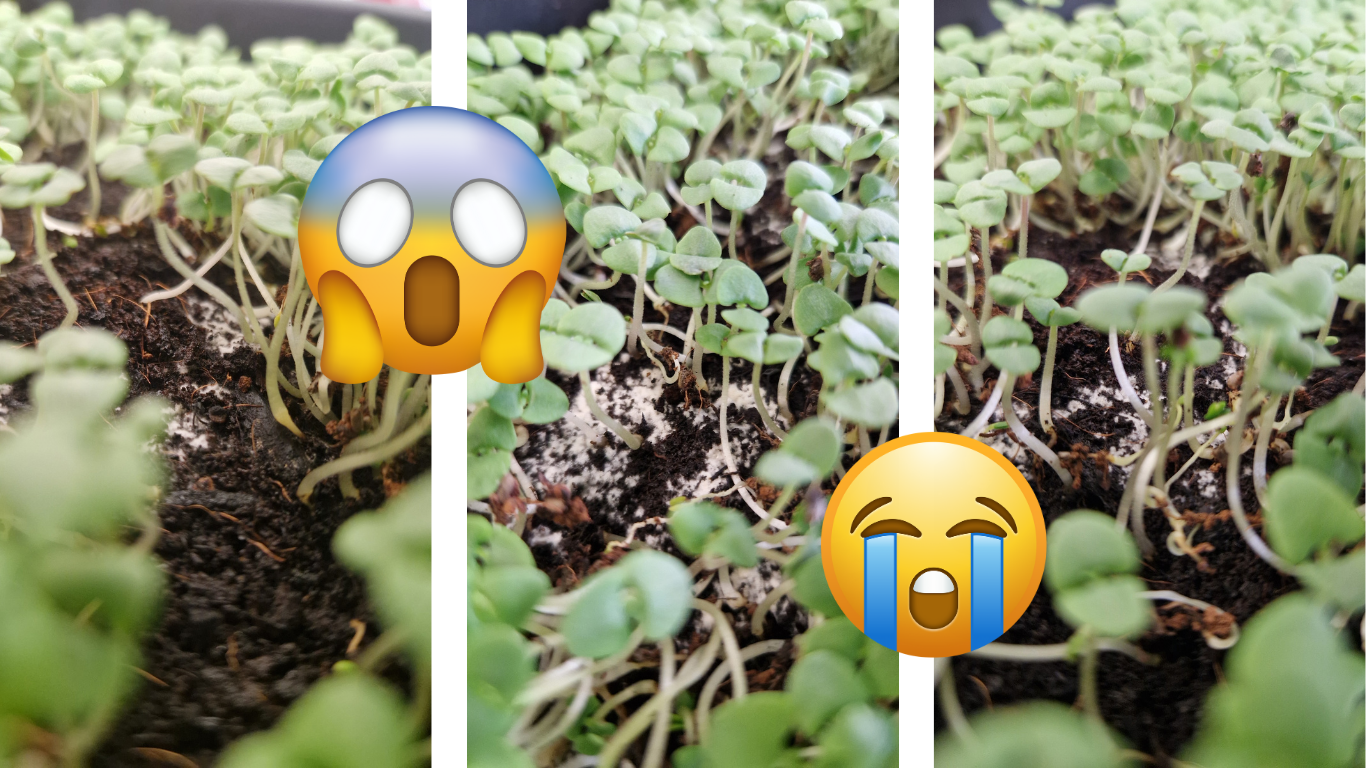
White fuzz that disappears when you mist it is usually root hairs and is fine. Real mold growing on the seedlings is a different story: no study has shown that a moldy tray, even a treated one, is safe to eat.
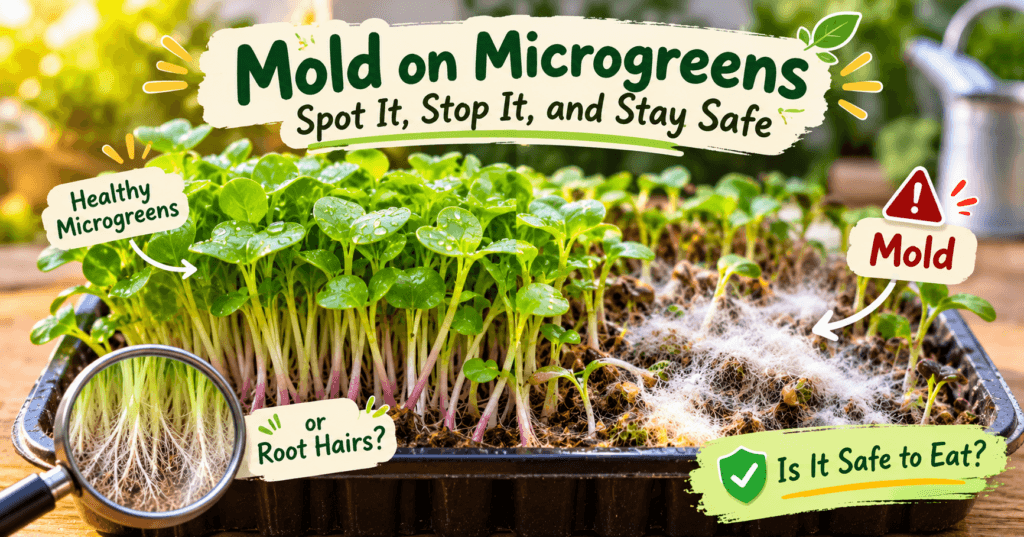
Every grower meets it sooner or later: a white, fluffy patch in the tray. Is it mold on microgreens, or something harmless? And if a small spot of mold appeared, or you treated it and it disappeared, can you still eat the rest? This article answers these questions with the help of 9 studies from the EVEC science library and two official sources, the US food-safety agency (USDA FSIS) and the University of Minnesota Extension. As always, ✅ means a study or official source says it and ⚠️ means it is an estimate.
The short answer: white fuzz that disappears when you mist it is usually root hairs and is fine. Real mold growing on the seedlings is a different story: no study has shown that a moldy tray, even a treated one, is safe to eat, and official advice for soft, moist foods is to throw them away ✅ / ⚠️.
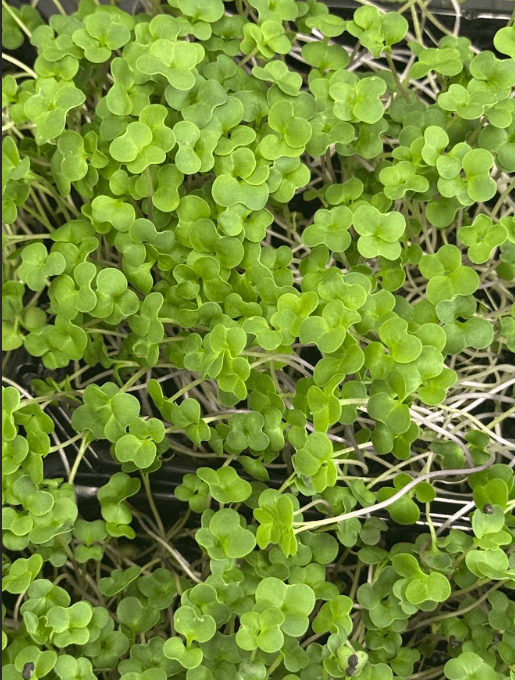
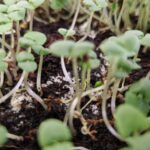
Young roots grow very fine white hairs to drink water. On a tray, where the roots are not hidden under soil, they look like white fluff ⚠️.
| Root hairs (fine) | Mold (a problem) | |
|---|---|---|
| Where | Only on the roots, around the base of each seedling | On seed hulls, stems, leaves or across the surface like a cobweb |
| Mist test | Collapse and almost disappear when you spray them with water | Stay, or clump into wet strands |
| Smell | Fresh | Often musty |
| Colour later | Stay white | May turn grey, green, black or show tiny dark dots |
The mist test and these signs are common grower practice, not tested in a study ⚠️.
Damping-off is different again. Seedlings suddenly fall over because the stem has rotted thin at the soil line. It is caused by fungi and water molds such as Pythium, Rhizoctonia and Fusarium, and seedlings that get it rarely survive. Whole sections or whole trays are often lost (University of Minnesota Extension) ✅.
Good to know: not every microbe means mold on microgreens. Even healthy microgreens carry invisible yeasts and molds. Fresh radish and sunflower microgreens had about 1,000 per gram (about 3 log CFU/g) in a 2026 study (Işık et al., 2026) ✅. That is normal for fresh produce. The problem is mold that has grown large enough to see ⚠️.
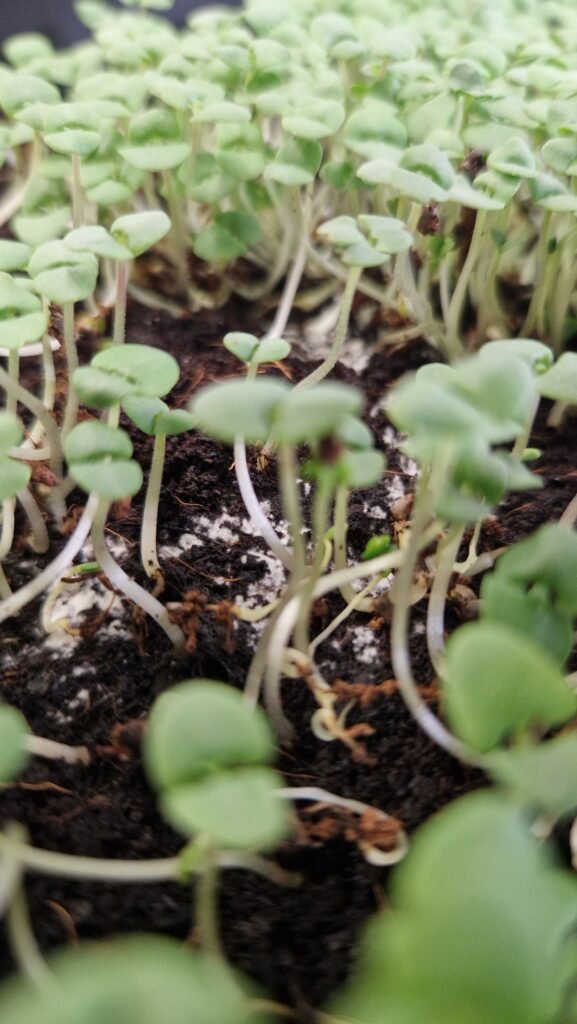
Mold on microgreens is not only a soil problem. Hydroponic trays have no soil, but they are wet all the time, so the same fungi and water molds can still grow ⚠️.
Because mold on microgreens often comes with the seed, cleaning seeds helps ✅ / ⚠️.
These were lab methods. At home, buy seeds sold for microgreens or sprouting, and let an adult handle hydrogen peroxide ⚠️.
This is the question growers ask most, so here is an honest answer.
What science knows. We found no study on mold on microgreens that tested what happens to people who eat microgreens from a tray with a small patch of mold ⚠️. What we do know comes from general food-safety science:
What this means for microgreens. Microgreens are soft, very moist and grow packed together, touching the same wet mat or soil. So we apply the USDA advice for soft produce: if real mold grew on the seedlings, do not eat that tray, even if the mold covered only a small part ⚠️ (our application of official advice). Do not try to cut away the moldy corner and harvest the rest ⚠️.
“But I already ate some.” Don’t panic. A small amount of mold eaten once by a healthy person usually causes no illness, but some people may get an upset stomach or an allergic reaction ⚠️. Get medical advice if you have vomiting, diarrhoea, a rash, swelling or breathing problems, and be extra careful with young children, pregnant women, older people and anyone with a weak immune system or a mold allergy ⚠️. Do not sniff moldy food: breathing in spores can cause breathing trouble (USDA FSIS) ✅.
When they find mold on microgreens, many growers spray diluted hydrogen peroxide, vinegar or other products, and the white fluff disappears. That does not prove the microgreens are safe ✅ / ⚠️:
Bottom line: for mold on microgreens, use treatments to protect the next crop, not to rescue a moldy one for eating. If real mold appeared on the plants, compost the tray (if your compost is not used for growing microgreens), clean everything, and start again ⚠️. The exception is fuzz that passes the mist test: that is root hairs, and the microgreens are fine to eat ✅ / ⚠️.
| What you see | What to do | Evidence |
|---|---|---|
| White fuzz only at the roots that vanishes when misted | Root hairs: carry on, harvest as normal | ⚠️ |
| Cobweb-like growth on hulls, stems or leaves, or a musty smell | Do not eat the tray; bag it and throw it away or compost it; clean the tray and area | ✅ / ⚠️ |
| Seedlings collapsing at the soil line (damping-off) | Throw the tray away; next time use new mix and a bleached tray | ✅ |
| Mold sprayed and gone | Still do not eat it; fix the cause for the next tray | ✅ / ⚠️ |
| Mold on stored microgreens in the fridge | Throw the box away | ✅ / ⚠️ |
More practical tips: how to prevent mold when growing microgreens and soil, hydroponics and coconut fibre for microgreens.
Mold on microgreens is mostly a growing problem that you can prevent: clean seeds, fresh mix or mats, clean trays, fewer seeds, less water and more air. When prevention fails, the safe choice is simple. One lost tray costs a few euros of seed; a moldy meal is not worth the risk.
Read the studies yourself in the library of 374 microgreens research papers.
Sources 1–9 are open-access papers in the EVEC science library. Sources 10–11 are official food-safety and extension pages.
This article is part of the free knowledge portal of EVEC Microgreens. Wherever you are on your microgreens journey, there is a path for you:
Co-funded by the European Union.
This portal presents the microgreens methodology; the organisation behind it is EVEC Athens — the European Voluntary and Educational Center (evec.org.gr). Views and opinions expressed are those of the author(s) only and do not necessarily reflect those of the European Union or the European Commission. Neither the European Union nor the granting authority can be held responsible for them.
Open licence. Except where stated otherwise, the educational materials on this portal are licensed under CC BY 4.0 — free to use, adapt and share, including commercially, with credit. See the licence terms.
Accessibility. We aim for WCAG 2.1 AA and publish what does and does not yet meet it — see the accessibility statement. If anything here blocks you, tell us and we will send the material in a format that works for you.