Get in touch
Questions about growing, workshops, the cooperative or partnerships? Send us a message and we will reply by email.
Prefer email? Write to erasmus@evec.org.gr
EVEC Microgreens
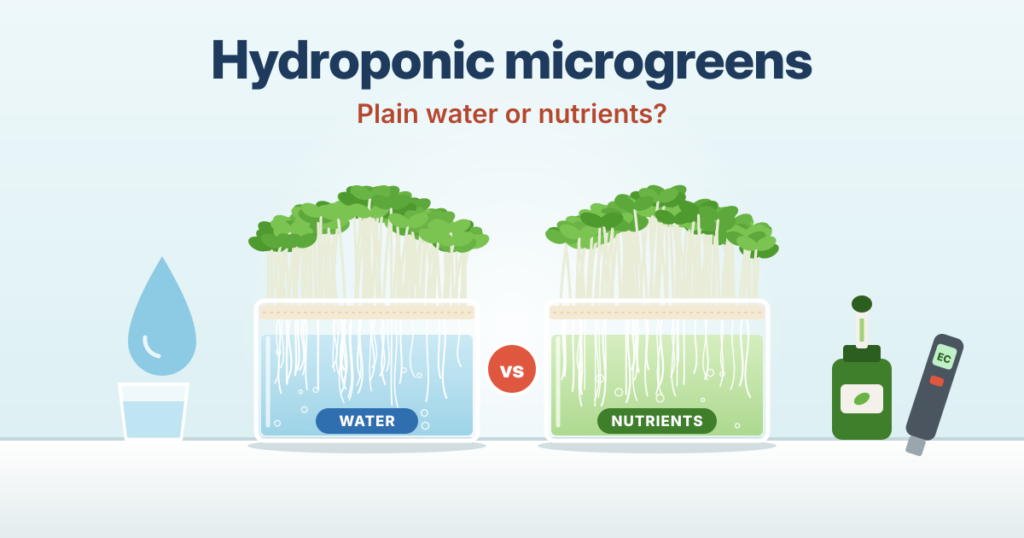
Plain water works, but a weak, complete nutrient solution gives a clearly bigger harvest. What 19 studies show about nutrient strength, EC, pH, a plain-water finish to lower nitrate, and whether tap water is good enough for hydroponic microgreens.
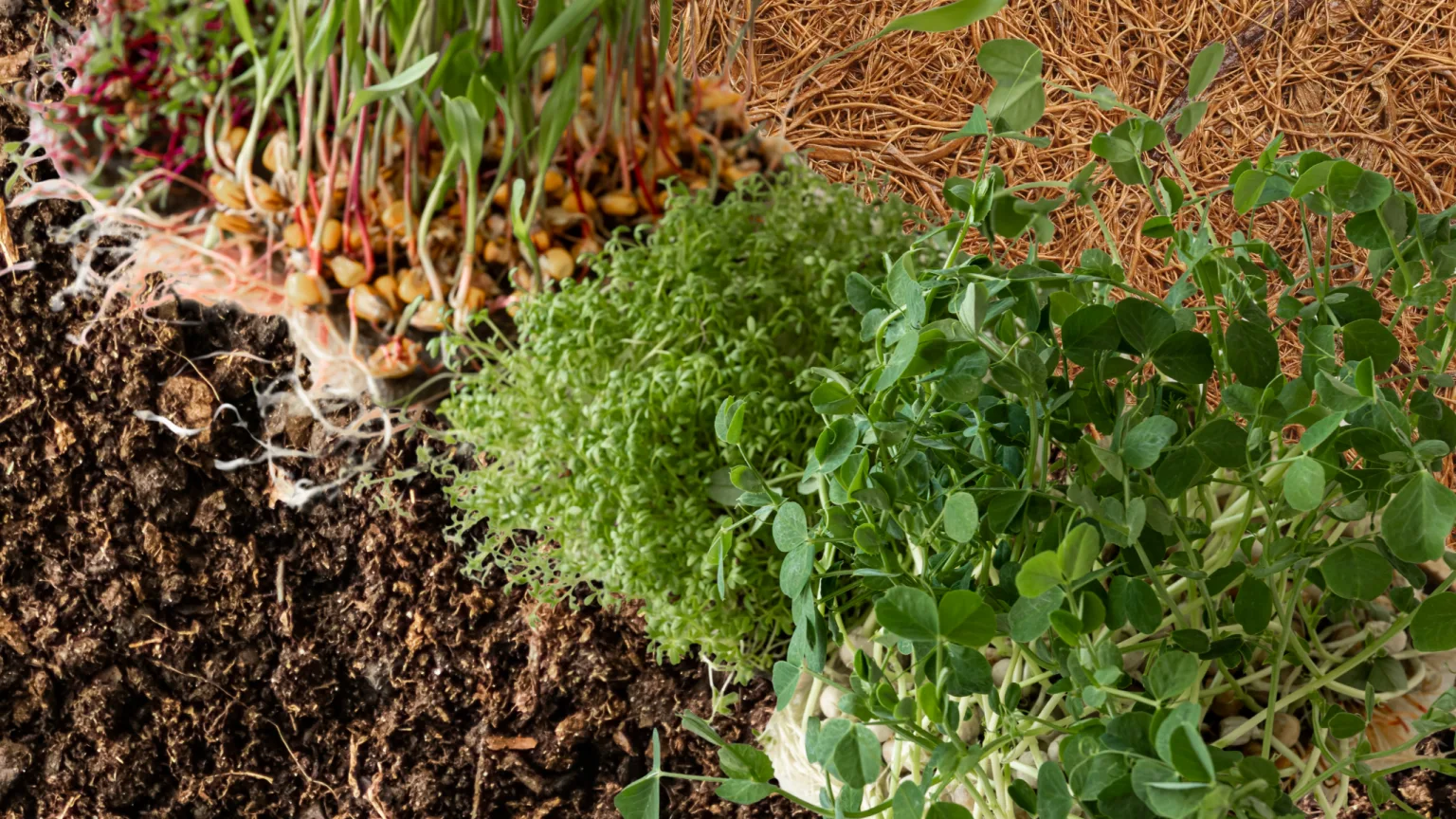
Hydroponic microgreens grow without soil: on a fibre mat, a hemp or jute pad, coconut fibre or a floating tray, fed only by water. That raises three questions every grower asks. Is plain water enough? If not, what should go into the water, and how much? And can the water come straight from the tap?
We checked these questions against 19 studies from the EVEC science library. As always, ✅ means a study measured it and ⚠️ means it is an estimate.
The short answer: plain water works, but a weak, complete nutrient solution gives a clearly bigger harvest. Half the usual strength is enough, and switching back to plain water for the last few days keeps nitrate low. Most tap water is fine if it is not salty and its pH is adjusted ✅ / ⚠️.
Yes. Seeds carry their own food store, so microgreens grow even on plain water ⚠️. But almost every study found that a little food in the water helps:
For a kitchen windowsill, an Austrian study concluded that tap water alone is a good compromise for garden cress, while radish cress did better with a weak (25%) nutrient solution. Tasters also liked the cress most when the water had the most minerals (Keutgen et al., 2021) ✅.
For hydroponic microgreens, weaker than you might think. Most studies use “Hoagland solution”, a classic plant recipe, and dilute it.
Recommendation: feed hydroponic microgreens a complete hydroponic fertiliser at about half strength, giving an EC of about 0.8–1.5 mS/cm and roughly 100–150 mg of nitrogen per litre ✅ / ⚠️ (our range from several studies).
Use a complete fertiliser made for hydroponics, not just one ingredient ⚠️. As an example, the half-strength Hoagland solution used in an Italian 2026 study contained, per litre (Di Cuia et al., 2026) ✅:
| Nutrient | mg per litre | What it does |
|---|---|---|
| Nitrogen (N) | 112 | Leaf growth |
| Potassium (K) | 117.5 | Water balance, sturdier shoots |
| Calcium (Ca) | 80 | Strong cell walls |
| Phosphorus (P) | 31 | Energy and roots |
| Sulphur (S) | 16 | Proteins and the “peppery” compounds of the cabbage family |
| Magnesium (Mg) | 12 | Green colour (chlorophyll) |
| Iron (Fe) | 0.56 | Green colour |
| Zinc, manganese, boron, copper, molybdenum | 0.016–0.135 | Small amounts for growth |
The “What it does” column is general plant science, simplified ⚠️.
Nitrate or ammonium? For hydroponic microgreens, most of the nitrogen should be nitrate. In the Italian broccoli study, using 5%, 15% or 25% of the nitrogen as ammonium did not change the harvest (Palmitessa et al., 2020) ✅.
When to start feeding? Many studies watered with plain water while the seeds sprouted and started the nutrient solution once the seedlings stood up, around day 3–4. Examples: from day 4 (Shibaeva et al., 2022) and from day 3 (Di Gioia et al., 2019) ✅ / ⚠️.
Nutrient water can push nitrate up. In a US study of 17 microgreens grown on mats with nutrient solution, 11 had “very high” nitrate. They were still within EU limits, but the authors say the solution probably gave more nitrogen than the plants needed (Di Gioia et al., 2023) ✅.
Recommendation: feed from day 3–4, then switch to plain water for the last 3–6 days, especially for rocket, mustard and other leafy greens ✅ / ⚠️.
Usually yes, and several studies did ✅. The Austrian study used Vienna tap water (EC 0.22–0.30 mS/cm, pH 8.0–8.2) (Keutgen et al., 2021), and the Brazilian amaranth study used tap water with EC 0.3 dS/m (da Silva et al., 2025) ✅. Check four things first:
A US study notes that many tap-water sources are above the US EPA guideline of 500 mg of dissolved salts per litre. When the researchers added salt at levels found in tap water (up to 1.5 dS/m), broccoli and purslane microgreen harvests did not change, but broccoli lost vitamin C as salt went up (Plocek et al., 2023) ✅. Salty water also slows sprouting: rocket and radish seeds sprouted less as water got saltier (Toscano et al., 2025) ✅.
Recommendation: measure the EC of your tap water with a cheap meter. Below about 0.5 mS/cm is ideal; between about 0.5 and 1.0 is usable if you add less fertiliser; above about 1.0, consider filtered or reverse-osmosis water mixed with tap water ⚠️. Your water company also publishes its analysis online ⚠️.
Tap water is often alkaline: Vienna’s was 8.0–8.2 (Keutgen et al., 2021) ✅. Nutrient solutions in the studies were set to pH 6.0–6.5 (Cowden et al., 2024; Palmitessa et al., 2020; El-Nakhel et al., 2021) ✅. Recommendation: after adding fertiliser, bring the solution to about pH 5.8–6.5 with a “pH down” product ✅ / ⚠️. Cowden et al. used nitric acid; home growers should use a ready-made pH-down liquid and gloves ⚠️.
This is the most important point. In a US study, Salmonella and E. coli O157:H7 that entered through the irrigation water were still on daikon microgreens after 14 days, and survived best on a fibre growing pad (Chen et al., 2023) ✅. Germs in a growing mat also passed onto sunflower and pea microgreens (Deng et al., 2021) ✅.
Recommendation: give hydroponic microgreens only drinking-quality water. Do not use rainwater, river water or untested well water ⚠️. Clean tanks and trays between batches, and do not reuse old nutrient water for a new crop ⚠️.
Pure water has no minerals at all, so hydroponic microgreens get nothing from it. In the Austrian study, cress grown in demineralised water had the smallest leaves (Keutgen et al., 2021) ✅. If you use it, you must add a complete nutrient solution ✅ / ⚠️.
Researchers can raise certain nutrients in hydroponic microgreens by adding them to the water:
These are lab-designed recipes. Too much of these elements can harm plants or people, so they are not for home experiments ⚠️.
| Step | What to do | Evidence |
|---|---|---|
| Water source | Drinking-quality tap water, EC ideally below 0.5 mS/cm; not softened, not rain or river water | ✅ / ⚠️ |
| Days 0–3 (sprouting) | Plain water | ✅ / ⚠️ |
| From day 3–4 | Complete hydroponic fertiliser at about half strength: EC about 0.8–1.5 mS/cm, about 100–150 mg N per litre | ✅ / ⚠️ |
| pH | About 5.8–6.5 after mixing | ✅ / ⚠️ |
| Last 3–6 days | Back to plain water to lower nitrate | ✅ / ⚠️ |
| Hygiene | Clean tanks and trays, fresh solution for each batch | ⚠️ |
| Home windowsill, garden cress | Tap water alone can be enough | ✅ |
The best substrate matters too: compare soil, hydroponics and coconut fibre for microgreens, and see how to prevent mould when growing microgreens.
Hydroponic microgreens are clean, fast and easy to scale, but water is their only source of food and their main route for germs. A weak, complete nutrient solution, the right pH, clean low-salt water and a plain-water finish give bigger harvests with less nitrate. More fertiliser is not better: in the studies that tested stronger solutions, half strength did as well or better.
Read the studies yourself in the library of 374 microgreens research papers.
All 19 are open-access papers in the EVEC science library.
This article is part of the free knowledge portal of EVEC Microgreens. Wherever you are on your microgreens journey, there is a path for you:
Co-funded by the European Union.
This portal presents the microgreens methodology; the organisation behind it is EVEC Athens — the European Voluntary and Educational Center (evec.org.gr). Views and opinions expressed are those of the author(s) only and do not necessarily reflect those of the European Union or the European Commission. Neither the European Union nor the granting authority can be held responsible for them.
Open licence. Except where stated otherwise, the educational materials on this portal are licensed under CC BY 4.0 — free to use, adapt and share, including commercially, with credit. See the licence terms.
Accessibility. We aim for WCAG 2.1 AA and publish what does and does not yet meet it — see the accessibility statement. If anything here blocks you, tell us and we will send the material in a format that works for you.