Get in touch
Questions about growing, workshops, the cooperative or partnerships? Send us a message and we will reply by email.
Prefer email? Write to erasmus@evec.org.gr
EVEC Microgreens
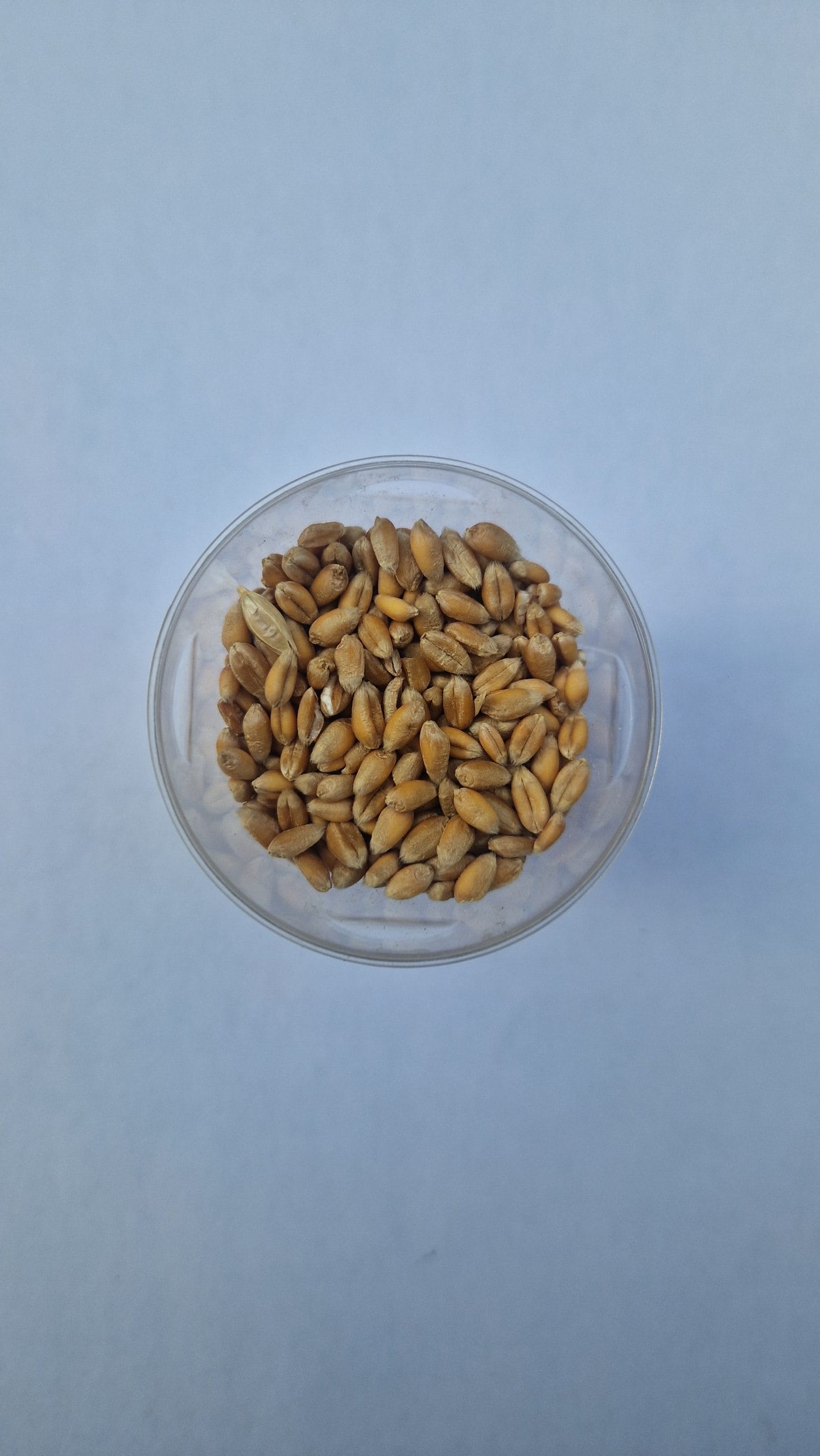
Wheatgrass has a bigger medicinal reputation than its evidence supports. What the composition data show, what the "green blood" claim gets wrong, and why none of it is a treatment.
Wheatgrass is one of the most widely used microgreens, and its best-known claim is wrong: chlorophyll is not “green blood” — it is digested as food, and it is not converted into haemoglobin. What is documented is composition. The single narrative review this page rests on, Wheatgrass (Triticum aestivum): a miraculous microgreen: an overview in the Journal of Future Foods, lists vitamins A, C and E and the minerals iron, magnesium and calcium among its constituents. The pharmacological properties usually attributed to wheatgrass come overwhelmingly from cell cultures and animal models rather than from trials in people, so this page sets out what has been investigated and where the research is still early.
It’s worth noticing from the outset that despite the widespread use of wheatgrass, much information on its medicinal benefits is lacking, and therefore further scientific research is needed to investigate its pharmacological potential. This article is general information, not medical advice — wheatgrass is a food, not a treatment for any disease, and the studies mentioned here are early-stage.
Wheatgrass at a glance:
as well as antioxidants and several bioactive compounds.
The review we draw on here is titled “a miraculous microgreen”. That is the authors’ rhetorical framing, not a finding, and we are not going to repeat it as though it were one. What follows is what is actually known about the individual compounds — most of it measured in the laboratory rather than in people.
Chlorophyll is the compound wheatgrass is best known for, and the one most surrounded by myth. It is sometimes nicknamed “green blood” because its structure resembles haem, the oxygen-carrying part of haemoglobin, with magnesium at the centre where haem has iron. That resemblance is real; the conclusion usually drawn from it is not. Chlorophyll is digested as food, it is not converted into haemoglobin, and drinking it does not treat anaemia. We previously repeated a version of that suggestion on this page and have removed it.
Chlorophyllin, a semi-synthetic chlorophyll derivative, has been reported to protect mitochondria from oxidative damage in laboratory work. Apigenin, a flavonoid, shows antioxidant and anti-inflammatory activity, and rutin and quercetin — both present in wheatgrass — have been studied for antioxidant, anti-diabetic and anti-inflammatory effects. These are compound-level findings from cell and animal studies. A compound showing activity in a dish is a long way from a glass of wheatgrass juice having an effect in a person, and the laboratory dose is rarely one you could reach by eating.
Wheatgrass has been studied for possible anti-ulcer effects, though it is not an established treatment for any condition. It was demonstrated, in studies that were carried out on rats, that wheatgrass juice contains various water-soluble biomolecules, proteins, and bioactive compounds that have anti-ulcer potential. Additionally, in another clinical study, wheatgrass extract was investigated as a complementary approach in patients with ulcerative colitis. This page previously went on to describe chlorophyll preparations being used on infected wounds, skin lesions, sinuses, abscesses and rashes. We have removed that passage. Do not put wheatgrass, or anything made from it, on a wound. Wounds that are infected, deep, or not healing need medical attention, and the historical clinical work in that area used pharmaceutical chlorophyllin preparations under supervision — it is not a reason to apply a food crop to broken skin.
An earlier version of this page promised a second part covering probiotic, dermatological, anti-arthritic and “detoxifying” effects. That second part was never written, and on reflection we are not going to write it in those terms: those are the weakest claims in the literature, and “detoxifying” is a marketing word rather than a physiological one. If we publish more on wheatgrass it will be through the Science Library, one study at a time.
Mishra N, Tripathi R, Pandey D, Shah K, Chauhan NS. Wheatgrass (Triticum aestivum): a miraculous microgreen: an overview. Journal of Future Foods 2025;5(3):239–247. doi:10.1016/j.jfutfo.2024.07.003 — a narrative review. It is the single source behind this page, which is why the page is written in terms of what has been investigated rather than what has been shown.
Studies from our Science Library that concern wheatgrass microgreens, in plain language with links to the original research. This list updates automatically as new studies are added.
No plain-language write-up for this crop yet — the peer-reviewed studies are listed further down this page, or browse the full Science Library.
Recipes and kitchen ideas from our cookbook team that use wheatgrass microgreens.
No recipes for this crop yet — the cookbook has plenty to start with.
Growing a different crop next? Every variety has a guide like this one in the Varieties database.
Our research archive holds 6 peer-reviewed studies on wheatgrass microgreens. They are free to read and download, and each one credits its original authors.
This article is part of the free knowledge portal of EVEC Microgreens. Wherever you are on your microgreens journey, there is a path for you:
Co-funded by the European Union.
This portal presents the microgreens methodology; the organisation behind it is EVEC Athens — the European Voluntary and Educational Center (evec.org.gr). Views and opinions expressed are those of the author(s) only and do not necessarily reflect those of the European Union or the European Commission. Neither the European Union nor the granting authority can be held responsible for them.
Open licence. Except where stated otherwise, the educational materials on this portal are licensed under CC BY 4.0 — free to use, adapt and share, including commercially, with credit. See the licence terms.
Accessibility. We aim for WCAG 2.1 AA and publish what does and does not yet meet it — see the accessibility statement. If anything here blocks you, tell us and we will send the material in a format that works for you.