Get in touch
Questions about growing, workshops, the cooperative or partnerships? Send us a message and we will reply by email.
Prefer email? Write to erasmus@evec.org.gr

EVEC Microgreens

Every time you eat or snack, you change the environment in your mouth. Why how often you eat sugar matters, what saliva does, and why diet works alongside fluoride, oral hygiene and dental care.
Have you ever thought about what happens in your mouth after you eat?
Every time you eat or snack, you change the environment around your teeth, gums, saliva and oral bacteria. This article focuses on the connection between food and oral health through some simple questions for better understanding.

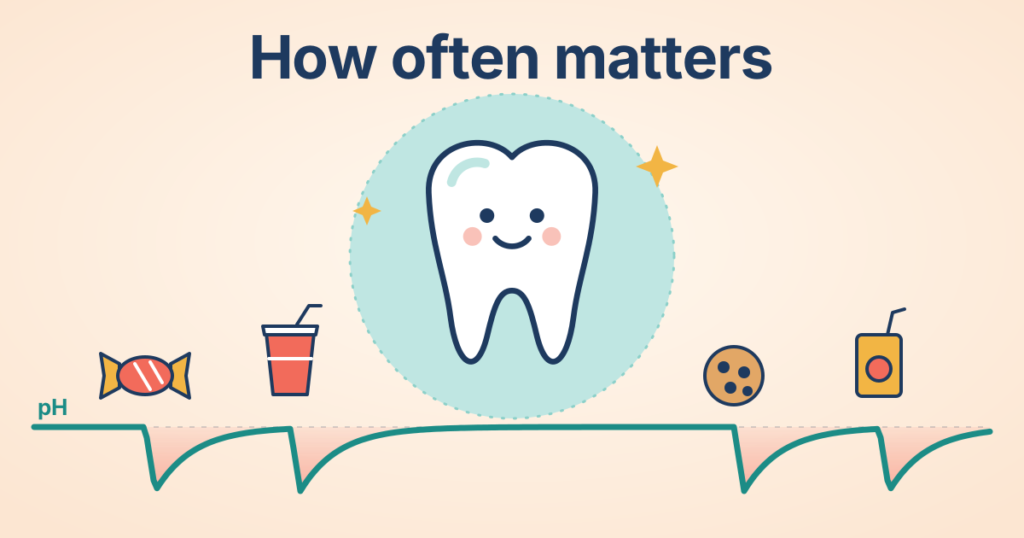
Saliva plays a vital role in neutralising acids and remineralising (Buzalaf et al., 2012). After eating, especially foods containing fermentable carbohydrates, oral bacteria can produce acids (Featherstone, 2008). Frequent sugar exposure, snacking and acidic foods and drinks challenge the oral environment and lower oral pH, which can promote demineralisation of the tooth enamel (Touger-Decker & van Loveren, 2003; Buzalaf et al., 2012).
This means that it is not only the amount of sugar we consume that matters, but also how frequently our teeth are exposed to it (World Health Organization, 2015; Touger-Decker & van Loveren, 2003). When sugary foods and drinks are consumed repeatedly throughout the day, the mouth experiences repeated periods of lower pH. Saliva helps the oral environment recover by neutralising acids and supporting the natural process of remineralisation.

Frequency is an important part of the picture. Constant snacking or sipping sugary or acidic drinks can repeatedly challenge the oral environment. In contrast, giving saliva enough time to perform its protective functions can help restore a more favourable environment around the teeth.
When it comes to food and oral health, a mouth-friendly diet is not a list of ‘good’ and ‘bad’ foods. A nutritious eating pattern that limits frequent sugar and acid exposure, combined with fluoride use, good oral hygiene and regular dental care, creates better conditions for maintaining healthy teeth and gums (Walsh et al., 2019; World Health Organization, 2025). Food should therefore be viewed as one part of oral health rather than as an isolated solution. Our everyday choices can influence the conditions inside our mouth, but diet works together with oral hygiene, fluoride exposure and professional dental care.

Part 1 of 4 in a series on food and oral health by the same EVEC Academy volunteer:
https://microgreens.org.gr/science-library/papers
On food and oral health: World Health Organization, Oral health fact sheet.
This article is part of the free knowledge portal of EVEC Microgreens. Wherever you are on your microgreens journey, there is a path for you:
Co-funded by the European Union.
This portal presents the microgreens methodology; the organisation behind it is EVEC Athens — the European Voluntary and Educational Center (evec.org.gr). Views and opinions expressed are those of the author(s) only and do not necessarily reflect those of the European Union or the European Commission. Neither the European Union nor the granting authority can be held responsible for them.
Open licence. Except where stated otherwise, the educational materials on this portal are licensed under CC BY 4.0 — free to use, adapt and share, including commercially, with credit. See the licence terms.
Accessibility. We aim for WCAG 2.1 AA and publish what does and does not yet meet it — see the accessibility statement. If anything here blocks you, tell us and we will send the material in a format that works for you.