Get in touch
Questions about growing, workshops, the cooperative or partnerships? Send us a message and we will reply by email.
Prefer email? Write to erasmus@evec.org.gr
EVEC Microgreens
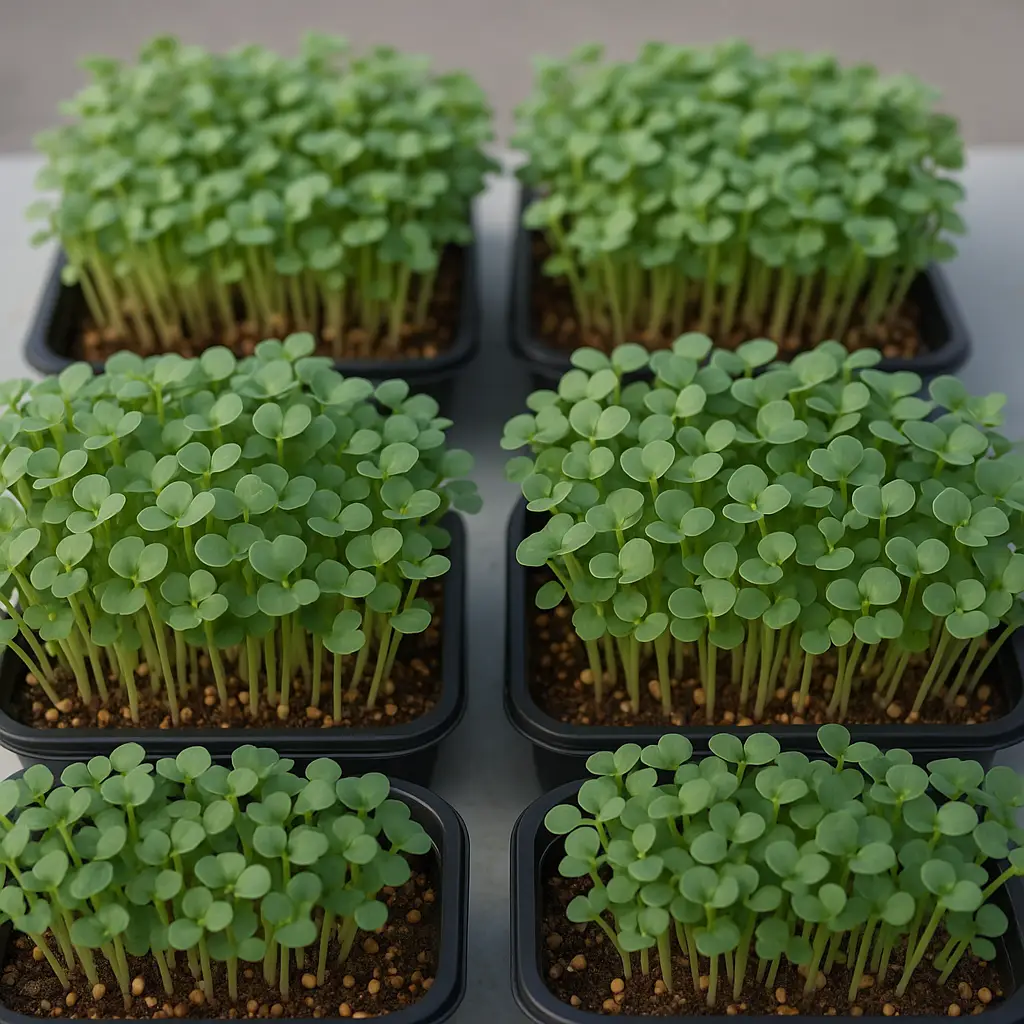
Broccoli microgreens carry a big reputation, mostly because of one compound: sulforaphane. Here is what human studies show, what they don't show yet, and how to eat your microgreens to get the most out of them.
Broccoli microgreens are tiny, but they carry a big reputation, mostly because of one compound: sulforaphane. So what do broccoli microgreens and sulforaphane actually do for people? Here is what human studies show, what they don’t show yet, and how to eat your microgreens to get the most out of them.
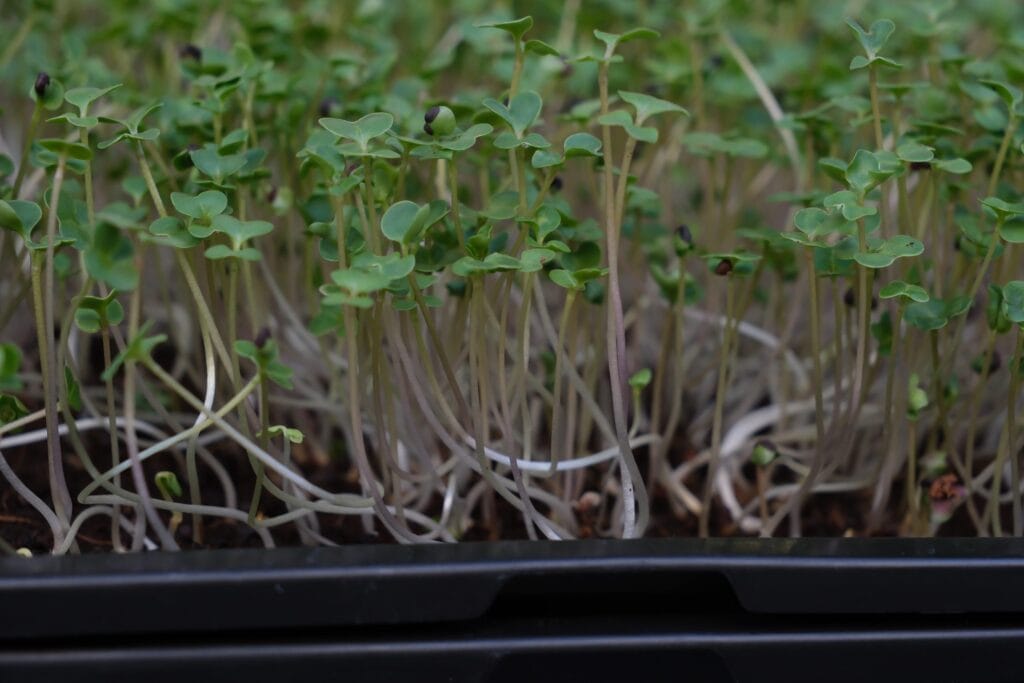
Broccoli plants store a harmless substance called glucoraphanin. They also store an enzyme, myrosinase, in a separate place inside their cells. When you cut or chew the plant, the two meet and glucoraphanin becomes sulforaphane (Saito et al., 2025).
Think of it as a two-part glue that only works when the tubes are mixed. For the young plant, it works as a defence. For us, it is interesting for a different reason.
In the body, sulforaphane switches on a “control switch” called Nrf2. Nrf2 turns on genes for the body’s own detox and antioxidant enzymes. That is why scientists link sulforaphane with detox, inflammation and cell protection (Saito et al., 2025).
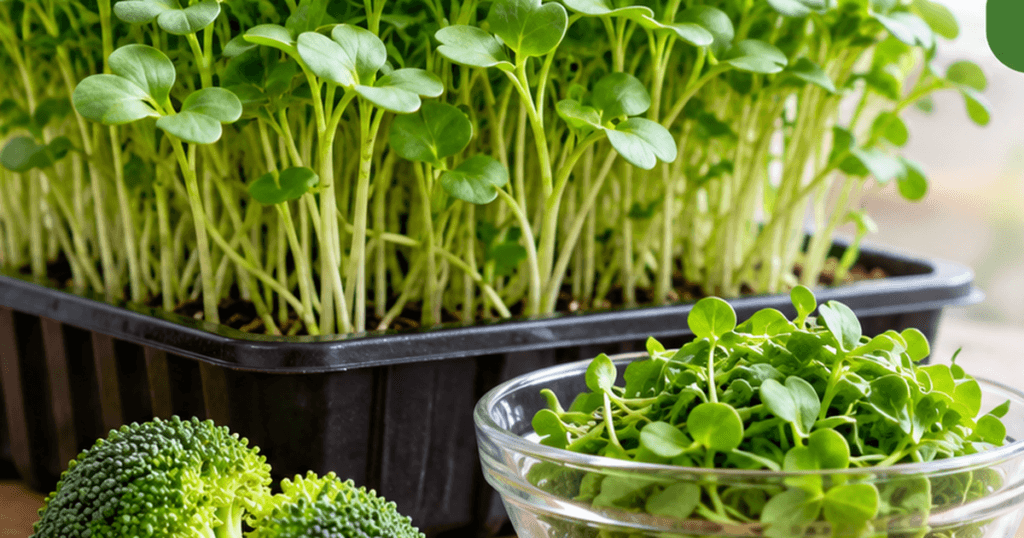
Most sulforaphane research uses broccoli sprouts, which are only a few days old, or drinks and extracts made from them. Microgreens are older, usually 7–14 days, with green leaves.
To link broccoli microgreens and sulforaphane properly, a team at Oregon State University first asked whether microgreens are just as rich. They measured 10-day-old broccoli microgreens and found about 13 µmol of glucoraphanin per gram. That is in the same range as the 16.6 µmol per gram reported for broccoli sprouts. The amount also stayed stable for six days in the fridge (Bouranis et al., 2023).
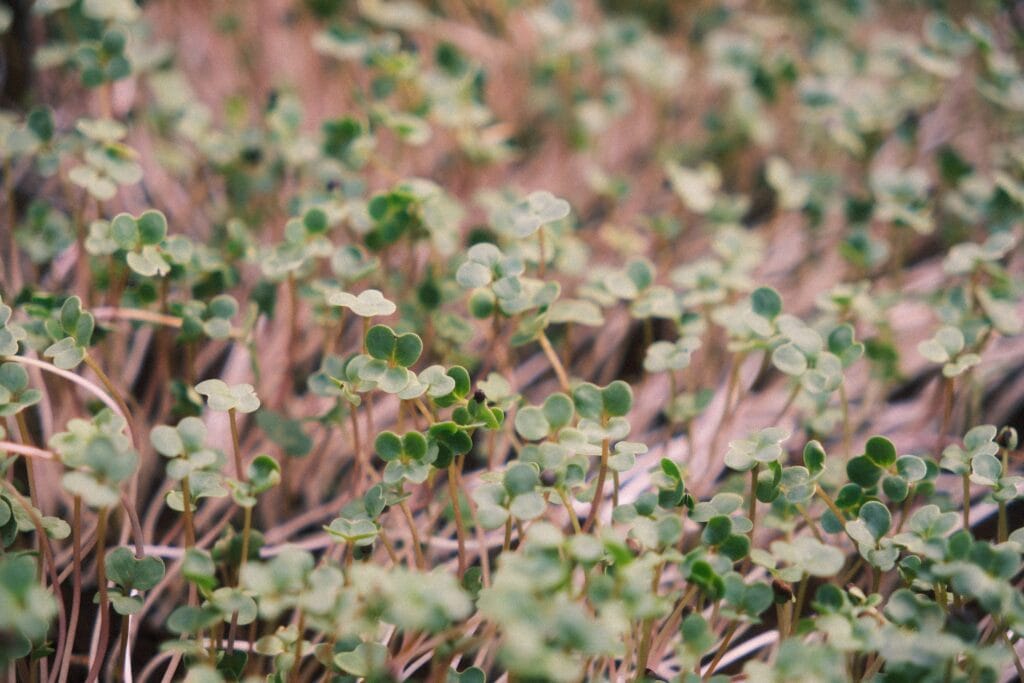
The same team then fed 11 healthy adults one serving of fresh broccoli microgreens with breakfast. The serving was just 16 g, about a small handful.
The results:
The authors conclude that fresh broccoli microgreens “can be a significant source” of sulforaphane. Note two limits: only 11 people took part, and the microgreens came from a company, 80 Acres Farms, whose staff are co-authors. This is common in food research, but it is worth knowing.
A 2025 review searched the US clinical trials registry. It found 84 trials of sulforaphane or broccoli extracts, of which 39 had published results (Saito et al., 2025). Most trials used 100–150 µmol of sulforaphane. Interestingly, the 16 g microgreen serving above contained about 100 µmol “on paper”, although the body does not absorb all of it.
Here is what the review found, area by area:
This is the strongest example. In Qidong, China, a region with heavy air pollution, 291 adults drank a broccoli sprout drink or a placebo every day for 12 weeks. Those on the broccoli drink excreted 61% more of the toxic pollutant benzene and 23% more acrolein, a lung irritant, in their urine (Egner et al., 2014). In other words, their bodies got rid of these pollutants faster. A later trial in the same area worked out the lowest dose that still works (Chen et al., 2019).
In healthy volunteers, sulforaphane boosted detox and reduced markers of inflammation. In people with type 2 diabetes, it improved blood sugar control. It showed no benefit for high blood pressure (Saito et al., 2025).
Results were “promising” in some early-stage prostate and breast cancer trials, but effects were limited in advanced cancer. Sulforaphane is not a cancer treatment. Anyone with cancer should follow their doctors’ advice.
A 2025 analysis combined six randomised trials of sulforaphane in people with autism. It found small to moderate improvements in overall symptoms, behaviour and social interaction, and side effects were similar to placebo (Wang et al., 2025). But not every trial agrees. A study in 40 children aged 3 to 7 (28 finished) found no significant difference from placebo (Magner et al., 2023). The authors say results “should be interpreted cautiously”.
The review warns that about half of the completed trials have never been published, many trials are small, and results are inconsistent (Saito et al., 2025). Also, almost all of them used sprouts, sprout drinks or supplements, not microgreens.
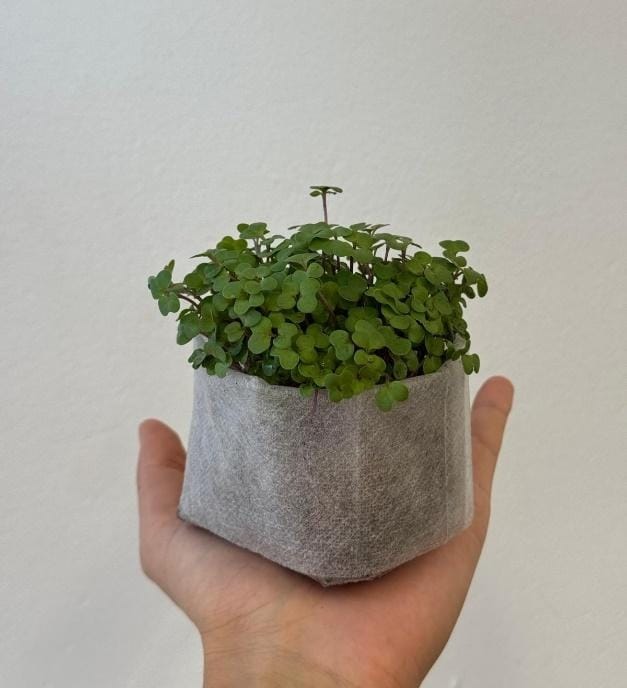
Many trials used concentrated supplements. When it comes to broccoli microgreens and sulforaphane, remember that a handful of microgreens is a normal food, and eating it is not the same as taking a medicine. If you have a health condition, take medication or are thinking about sulforaphane supplements, talk to a doctor first.
Broccoli microgreens and sulforaphane are a real science story, not just a trend. Microgreens hold about as much glucoraphanin as sprouts, and people absorb sulforaphane from them. Human trials with sprouts and extracts show promising effects, especially on clearing air pollutants.
What is still missing is a long trial showing that eating broccoli microgreens improves health. Until then, enjoy them as a fresh, tasty vegetable, raw and well chewed.
Why does this matter? Health claims spread fast online. Knowing what was really tested helps you choose food for good reasons, and spot hype when you see it.
Want to grow your own? Read our research-based guide to broccoli microgreens, or explore the library of 374 microgreens research papers.
Papers 1–5 are open-access papers in the EVEC science library.
This article is part of the free knowledge portal of EVEC Microgreens. Wherever you are on your microgreens journey, there is a path for you:
Co-funded by the European Union.
This portal presents the microgreens methodology; the organisation behind it is EVEC Athens — the European Voluntary and Educational Center (evec.org.gr). Views and opinions expressed are those of the author(s) only and do not necessarily reflect those of the European Union or the European Commission. Neither the European Union nor the granting authority can be held responsible for them.
Open licence. Except where stated otherwise, the educational materials on this portal are licensed under CC BY 4.0 — free to use, adapt and share, including commercially, with credit. See the licence terms.
Accessibility. We aim for WCAG 2.1 AA and publish what does and does not yet meet it — see the accessibility statement. If anything here blocks you, tell us and we will send the material in a format that works for you.