Get in touch
Questions about growing, workshops, the cooperative or partnerships? Send us a message and we will reply by email.
Prefer email? Write to erasmus@evec.org.gr
EVEC Microgreens
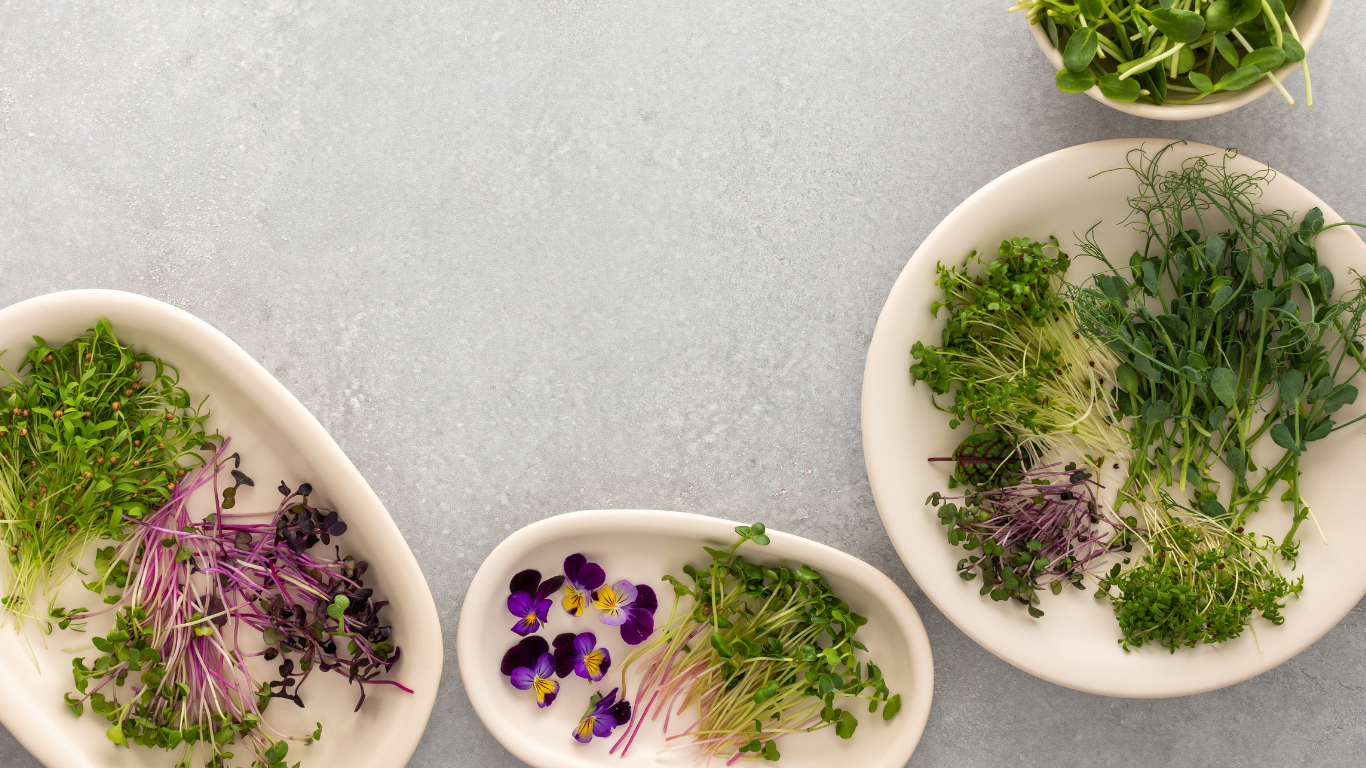
A Journal of Future Foods review, crop by crop: radish and cilantro for vitamin C, rapini highest in zinc, dandelion for selenium, carotenoids in wheat and jute.
Microgreens are easy to grow and maintain, but the more interesting property is nutritional: how much vitamin, mineral and antioxidant content they carry for their size.
According to a study published in the Journal of Future Foods by Yanqi Zhang, Zhenlei Xiao, Emily Ager, Lingyan Kong, and Libo Tan, microgreens carry useful concentrations of vitamins, minerals and antioxidant compounds for their weight. That review is a survey of composition data; it is not a trial of health outcomes in people.
What follows sets out what nutrients they contain, how those nutrients benefit the body, and which varieties are richest in each.
First things first: what exactly are vitamins? Vitamins are substances the body needs in small amounts and, with a few exceptions, cannot make for itself, so they have to come from food. They are usually sorted by what they dissolve in: the water-soluble ones (the B group and vitamin C) and the fat-soluble ones (A, D, E and K). With that definition in mind, let’s see which vitamins are present in microgreens.
The study shows that certain microgreens contain high levels of vitamin C, also known as ascorbic acid. This vitamin is well known for its powerful antioxidant effects and its essential role in collagen production. Now you understand why so many anti aging creams are loaded with vitamin C! Vitamin C also has an established role in normal immune function — which is a statement about the vitamin, not a promise that eating microgreens will stop you getting ill. Several microgreens are rich sources of it.
A standout example is radish microgreens (Raphanus sativus). Other vitamin C-rich microgreens include cilantro (Coriandrum sativum), cucumber (Cucumis sativus), jute (Corchorus olitorius), fenugreek (Trigonella foenum-graecum), spinach (Spinacia oleracea), roselle (Hibiscus sabdariffa), Sicilian broccoli, and red beet (Beta vulgaris). And here’s the fun part: most of these contain more vitamin C than their fully grown counterparts.
These micronutrients are essential for the human body to function properly. They’re involved in building bones and teeth, producing hormones, and supporting your nervous and muscular systems. According to the study, rapini microgreens (a member of the Brassicaceae family) had the highest levels of zinc (Zn), a crucial mineral for immune function, growth, and wound healing.
Copper (Cu) was found in greater concentrations in microgreens like bottle gourd and water spinach than in their adult forms. Copper plays a key role in red blood cell formation and the maintenance of blood vessels, nerves, and bones.
The study also identified selenium (Se), an antioxidant that regulates thyroid function, found notably in small burnet and dandelion microgreens.
Finally, let’s talk about antioxidant phytochemicals: carotenoids, polyphenols, and anthocyanins. Yes, we know, they sound a bit like alien words. But let’s simplify it. These compounds are studied for their activity against oxidative damage in the body. Diets high in fruit and vegetables are associated with lower rates of heart disease and some cancers, but that association belongs to whole dietary patterns studied over years — it is not evidence that any single compound, or any single food such as microgreens, reduces disease risk on its own.
Carotenoids are reported in microgreens such as wheat, barley, red sorrel, cilantro, red cabbage and jute. They are widely studied in connection with eye health, but that research concerns long-term dietary intake and supplements in people; the review cited here is a survey of what is in the plant and does not show that eating microgreens protects eyesight.
Polyphenols and anthocyanins, on the other hand, are powerful antioxidants found in microgreens like broccoli and mustard.
So… why should you include microgreens in your diet?
As you can see, microgreens are absolutely packed with vitamins, minerals, and antioxidant phytochemicals.
So yes, these little green guys are easy to grow and nutrient-dense for their size. We have removed a line claiming that a daily portion “can transform your health” — no study supports that, and microgreens are a vegetable, not a treatment.
“Superfood” is a marketing word rather than a nutritional category, and we have not used it as evidence for anything on this page. What the evidence supports is narrower and still worth knowing: for a number of vitamins and minerals, microgreens deliver more per gram than the mature plant, which makes them a genuinely useful thing to add to a plate.
Carlota
Correction note: we removed claims that microgreens “significantly boost your well being”, “strengthen your immune system”, are “linked to reducing the risk of heart disease and cancer”, and that a daily amount “can transform your health”. The review cited here (Zhang et al., 2021) is a survey of nutrient composition and does not test health outcomes in people. We have also removed a definition of “vitamin” that appeared here inside quotation marks and was attributed to the Oxford English Dictionary: that wording is not OED text, so both the quotation and the attribution are gone and the definition is now stated in our own words. The reference to oed.com has been dropped with it. See our editorial standards.
Zhang, Y., Xiao, Z., Ager, E., Kong, L., & Tan, L. (2021). Nutritional quality and health benefits of microgreens, a crop of modern agriculture. Journal of Future Foods, 1(1), 58–66. https://doi.org/10.1016/j.jfutfo.2021.07.001
This article is part of the free knowledge portal of EVEC Microgreens. Wherever you are on your microgreens journey, there is a path for you:
Co-funded by the European Union.
This portal presents the microgreens methodology; the organisation behind it is EVEC Athens — the European Voluntary and Educational Center (evec.org.gr). Views and opinions expressed are those of the author(s) only and do not necessarily reflect those of the European Union or the European Commission. Neither the European Union nor the granting authority can be held responsible for them.
Open licence. Except where stated otherwise, the educational materials on this portal are licensed under CC BY 4.0 — free to use, adapt and share, including commercially, with credit. See the licence terms.
Accessibility. We aim for WCAG 2.1 AA and publish what does and does not yet meet it — see the accessibility statement. If anything here blocks you, tell us and we will send the material in a format that works for you.