Get in touch
Questions about growing, workshops, the cooperative or partnerships? Send us a message and we will reply by email.
Prefer email? Write to erasmus@evec.org.gr

EVEC Microgreens
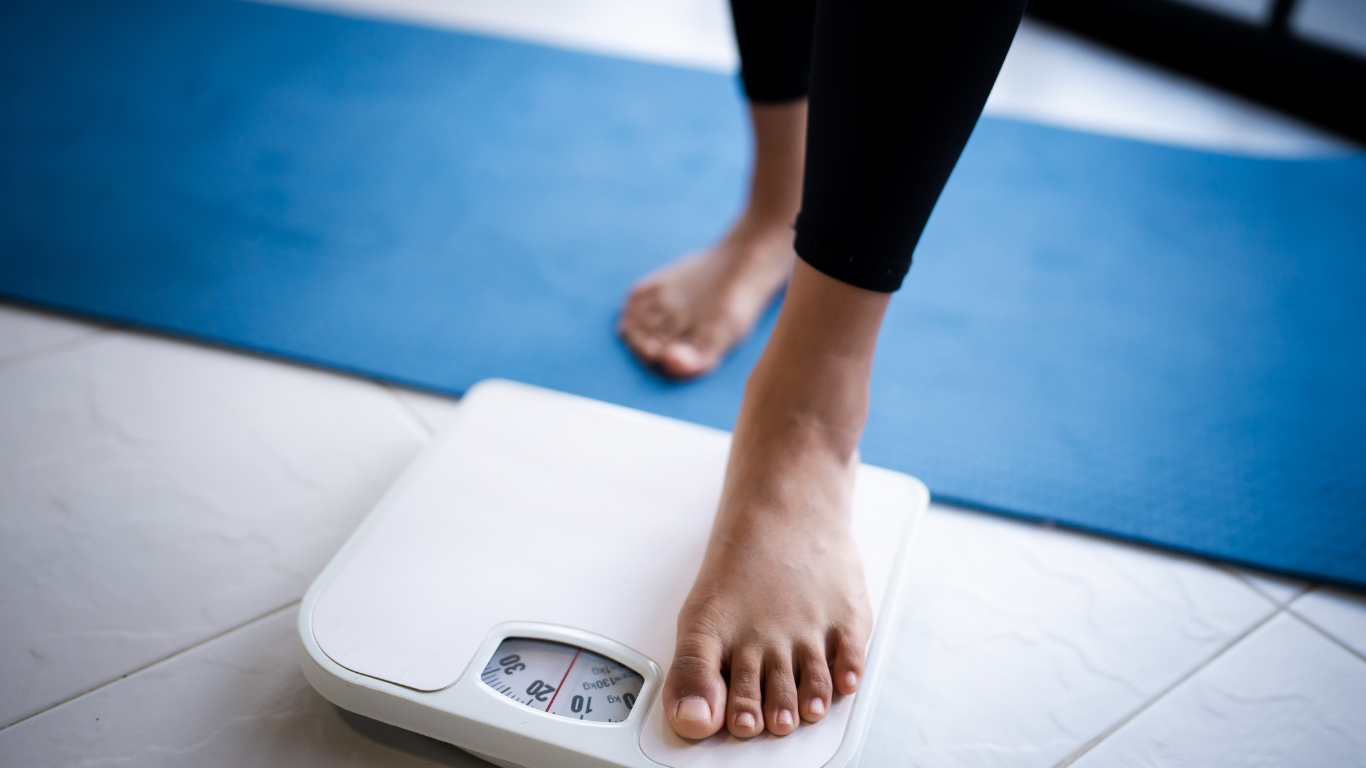
What microgreens can and cannot contribute against obesity — with the European and US figures properly sourced, and one unverifiable statistic removed rather than replaced.
This article returns to the research on the nutritional value and health benefits of microgreens, and to one question in particular: what they can contribute against the growing global problem of obesity. In the previous article, we discussed the study by Sibel Balik and colleagues titled Nutritional quality profiles of six microgreens, which analyzed the nutritional profiles of various microgreens.
One of the most striking claims from the study is that “one in every four individuals in the world suffers from a deficiency in essential micronutrients.” That is the study’s own opening line, and it is the reason a crop that concentrates micronutrients is worth taking seriously at all.
A figure we removed. An earlier version of this article attributed to a 2019 FAO report the claim that “41.9% of the global population struggles to maintain a healthy diet”. We could not verify that figure, and 41.9% is in fact the United States adult obesity rate quoted further down this same page — the number appears to have been copied across. Rather than substitute another statistic we have not checked, we have removed it. FAO does report that billions of people cannot afford a healthy diet; we would rather link you to the current edition of The State of Food Security and Nutrition in the World than quote a percentage second-hand.
The scale of the problem it points to is not in doubt, even if that one figure was.
This data links directly to the issue of obesity. According to the Spanish news agency EFE (2025), in its report “The enormous prevalence of obesity in the U.S. has fueled the rise of ‘miracle drugs,’” between 2017 and 2020, 41.9% of Americans were classified as obese, having a body mass index over 30 (J.L. Cereijido, EFE). Of those individuals, 58% suffered from hypertension and 23% from diabetes.
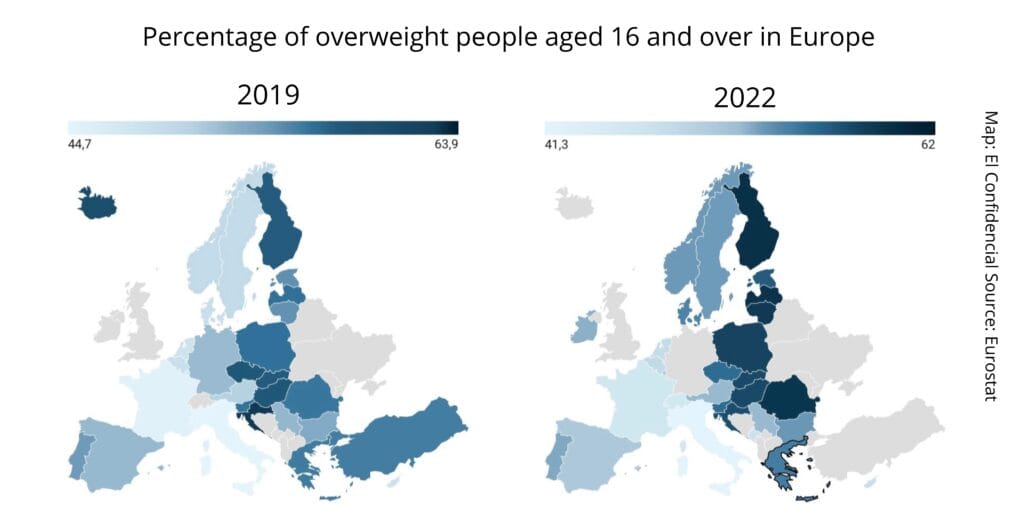
In Europe, the situation is not much better. The newspaper El Confidencial published an article titled “The Europe that’s getting fat: 60% of the population is obese. Are we on the way to becoming the next U.S.?” (Fran Sánchez Becerril), accompanied by a map showing the increase in overweight populations across European countries between 2019 and 2022. Note that the headline says obese while the figures underneath it — and the WHO report they draw on — describe people who are overweight or living with obesity, which is a considerably broader category. We have quoted the headline as published, but the distinction matters and the rest of this article uses the broader wording. Finland, Latvia, and Romania top the obesity rankings, while France and Italy report the lowest figures. However, the data for Greece (where we currently live) remains concerning: 54.4% of people over the age of 16 are overweight. Although this shows a slight improvement from the 56.2% reported in 2019, Greece still ranks among the EU countries with the highest overweight rates.
Dr. Kremlin Wickramasinghe, WHO advisor for Europe on nutrition and obesity, warned in the same article that “although the United States still has a higher overall prevalence, Europe is not far behind,” and added that “in several EU countries, especially in the south and east, the trends are mirroring those of the U.S., which is deeply concerning.” He also pointed out that one in four primary school children in Europe is already overweight or obese.
The WHO European Regional Obesity Report 2022 states that overweight and obesity now affect almost 60% of adults in the WHO European Region, and identifies obesity as the fourth most common risk factor for non-communicable diseases there. The longer-run growth figures quoted in the press — a 138% rise in obesity between 1975 and 2016, and upwards of 1.2 million deaths a year — are reported in the El Confidencial article cited below; we have not traced them to a specific WHO table, so we attribute them to that piece rather than presenting them as figures we have checked.
In light of this situation, one of the most urgent solutions is a transformation in dietary habits. This involves making nutrition education accessible to all, and ensuring that healthy food is affordable. Within that framework, microgreens are one small and practical option: a way to grow fresh vegetables cheaply, in very little space.
As we’ve explored in previous articles, they are rich in nutrients, concentrated in vitamins, antioxidants, minerals, and low in calories. That supports a modest, specific statement: microgreens are a nutrient-dense, low-calorie vegetable, and vegetables of that kind belong in the eating patterns recommended for weight management. It does not support the stronger claim this page used to make. An earlier version called microgreens “an ideal functional food to include in diets aimed at preventing or tackling overweight and obesity”. Obesity is a diagnosed medical condition; no trial has tested microgreens as a treatment or a preventive for it, so we have removed that sentence. See our editorial standards.
Moreover, they are easy to take care and fast to grow, even in small spaces. They can be cultivated in urban or home settings, making access to fresh, high quality nutritional food more feasible.
Microgreens are not a cure for anything, and nothing on this page should be read as a treatment for obesity. What they are is a small, cheap, practical step toward eating more vegetables — which is a worthwhile thing on its own terms.
Carlota
Zhang, Y., Xiao, Z., Ager, E., Kong, L., & Tan, L. (2021). Nutritional quality and health benefits of microgreens, a crop of modern agriculture. Journal of Future Foods, 1(1), 58–66. https://doi.org/10.1016/j.jfutfo.2021.07.001
Balik, S., Elgudayem, F., Dasgan, H.Y., Kafkas, N.E., & Gruda, N.S. (2025). “Nutritional quality profiles of six microgreens”. Scientific Reports, 15(1), 6213. Open the study ↗
World Health Organization Regional Office for Europe (2022). WHO European Regional Obesity Report 2022. WHO. Open the report ↗
EFE. (2025, March 4). La enorme prevalencia de la obesidad en EE.UU. ha disparado los “medicamentos milagro”. EFE. https://efe.com/mundo/2025-03-04/obesidad-eeuu-ozempic/
El Confidencial. (2025, June 8). La Europa que engorda: el 60 % de la población es obesa. ¿Vamos camino de convertirnos en EE.UU.? Fran Sánchez Becerril. https://www.elconfidencial.com/bienestar/2025-06-08/una-europa-cada-vez-mas-gorda_4140311/
This article is part of the free knowledge portal of EVEC Microgreens. Wherever you are on your microgreens journey, there is a path for you:
Co-funded by the European Union.
This portal presents the microgreens methodology; the organisation behind it is EVEC Athens — the European Voluntary and Educational Center (evec.org.gr). Views and opinions expressed are those of the author(s) only and do not necessarily reflect those of the European Union or the European Commission. Neither the European Union nor the granting authority can be held responsible for them.
Open licence. Except where stated otherwise, the educational materials on this portal are licensed under CC BY 4.0 — free to use, adapt and share, including commercially, with credit. See the licence terms.
Accessibility. We aim for WCAG 2.1 AA and publish what does and does not yet meet it — see the accessibility statement. If anything here blocks you, tell us and we will send the material in a format that works for you.