Get in touch
Questions about growing, workshops, the cooperative or partnerships? Send us a message and we will reply by email.
Prefer email? Write to erasmus@evec.org.gr

EVEC Microgreens
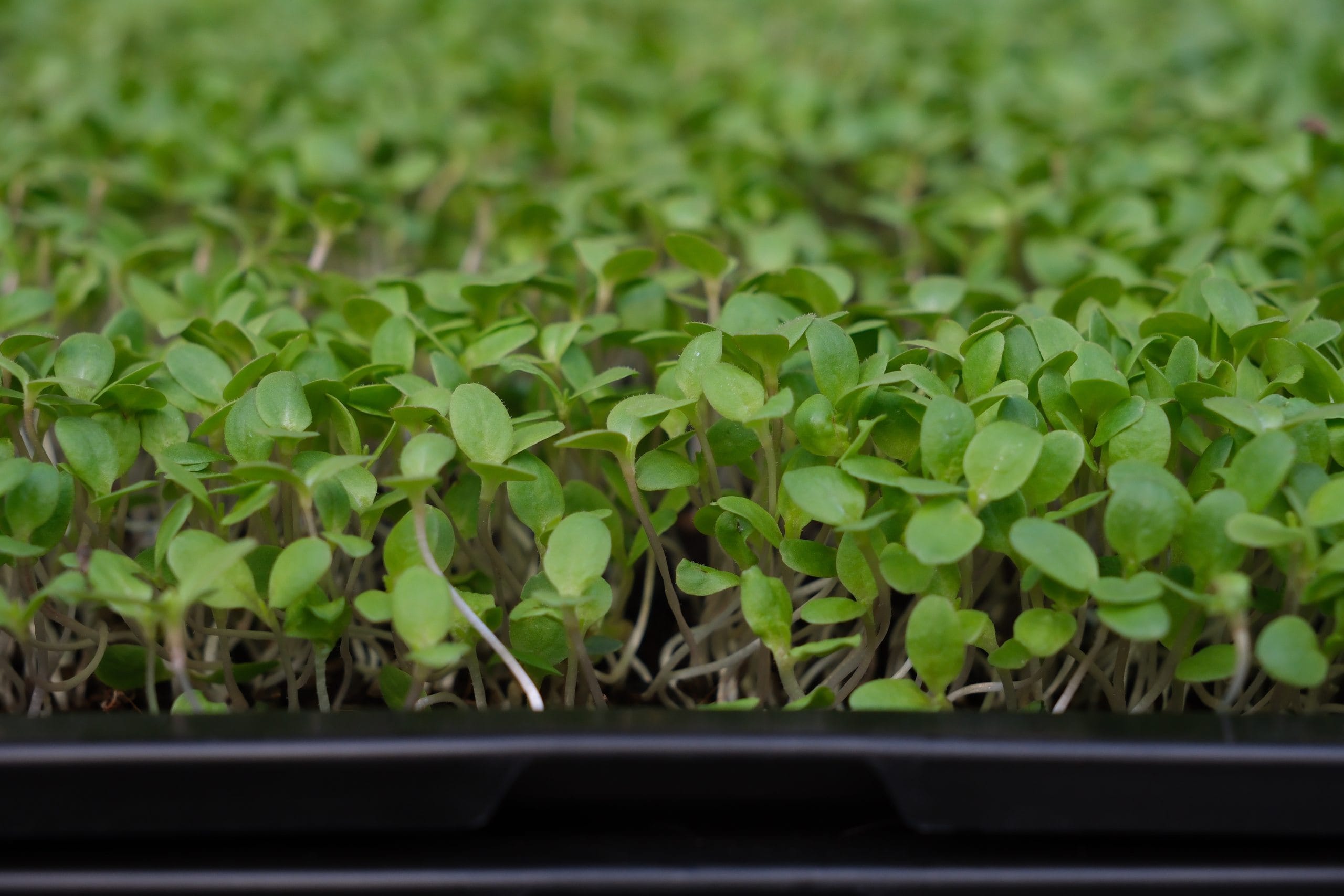
Buckwheat microgreens grow fast from soaked seed, taste bright and lemony, and are easy for beginners — here is how to sow, grow and eat them safely at home.
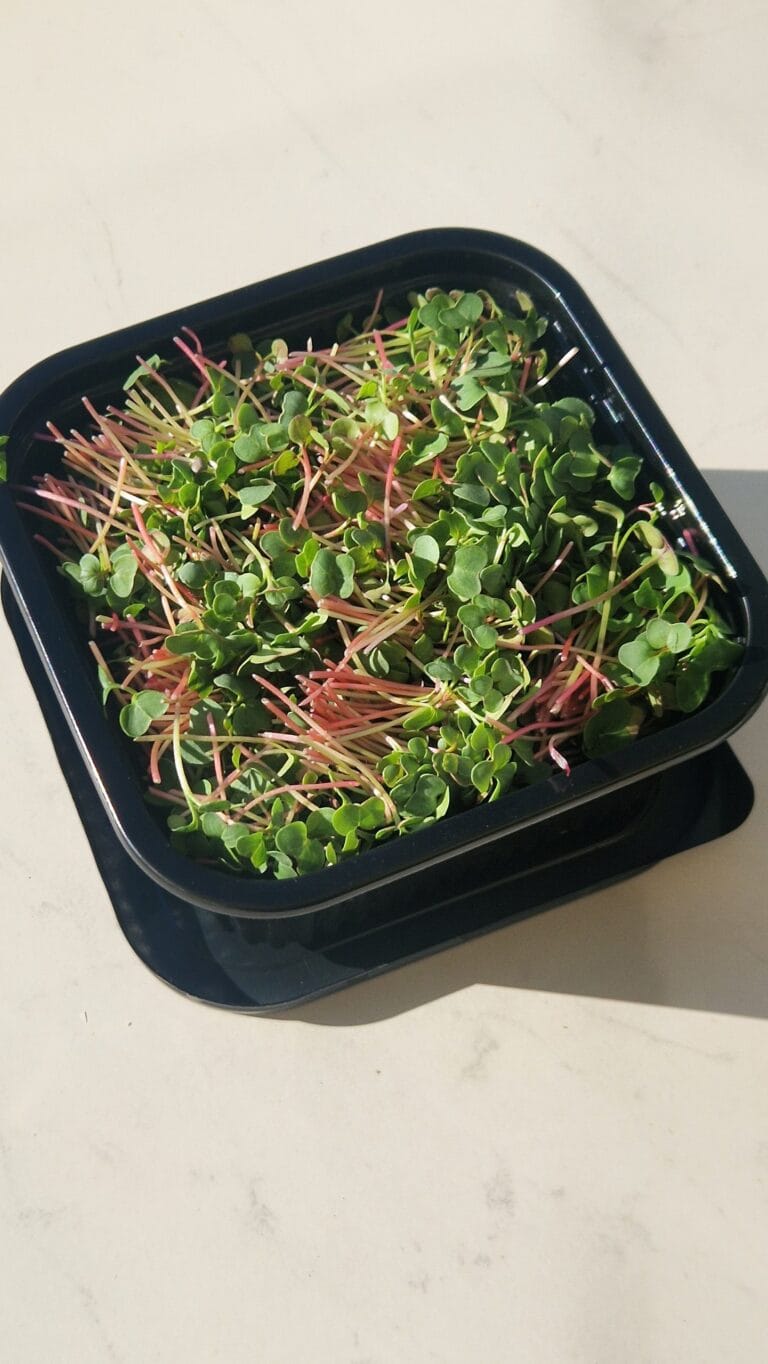
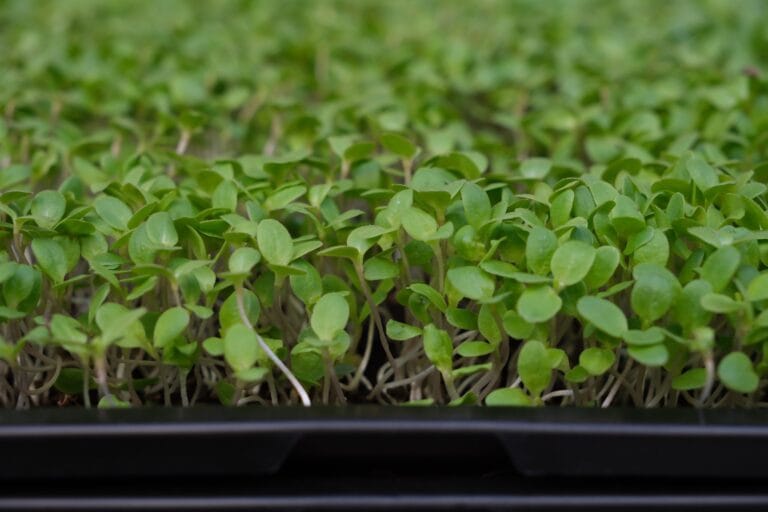
Buckwheat microgreens are one of the prettiest and most forgiving crops a beginner can start with. Grown from the same plant that gives us buckwheat flour and soba noodles (Fagopyrum esculentum), they push up broad, heart-shaped lime-green leaves on pink-tinged stems and carry a bright, lemony bite you will not find in many other trays. They germinate quickly once soaked, need no special kit, and are ready within a couple of weeks — a natural addition to your grow-at-home rotation. There is one honest caveat about how much to eat, which we come to below, but as a crop to grow they are genuinely easy.
They earn their place in a home tray for three reasons. First, they are fast and reliable: once the seed has had a good soak it germinates readily and rarely sulks. Second, they are beautiful — the pink stems and generous green cotyledons make them a favourite for garnishing plates, and they hold up well as a cut green. Third, that tart, citrus-like flavour is genuinely different from the peppery brassicas or the nutty larger seeds, so they add real contrast to a salad or bowl.
They are also cheap to grow from a big bag of seed and, like sunflower, belong to the family of larger, soaked seeds that give a satisfying, substantial harvest. We will be honest about the trade-offs too: the seeds can go mouldy if you overwater, the papery hulls like to cling to the leaves, and there is a real, if modest, safety note about quantity. None of these are dealbreakers once you know about them.
| Seed soaking | 12–24 hours (overnight) |
| Germination | 2–4 days |
| Blackout (dark) period | 3–4 days, lightly weighted |
| Ready to harvest | 8–12 days from sowing |
| Difficulty | Easy |
| Flavour | Tangy, citrusy and lemon-like |
Enjoy buckwheat microgreens as a garnish or salad green in normal culinary amounts. They naturally contain fagopyrin, a compound that — only in very large, regular quantities — can make skin more sensitive to sunlight (a reaction called fagopyrism). This is not a concern for ordinary eating, but it is a good reason not to treat them as a daily bulk green. Rinse the cut shoots to wash off any clinging black seed hulls, and use only untreated, food-grade seed.
Cut the stems just above the soil line with clean scissors when the seed leaves have fully opened — that is when the flavour and colour are at their best. Many stems will still be wearing their papery hull; brush your palm gently across the tops before cutting, or pick the worst off afterwards, as they are unpleasant to chew.
Buckwheat is more delicate than a sturdy brassica, so handle it lightly. Let the cut greens dry off any surface moisture, then store them in a lidded container lined with kitchen paper in the fridge. They are at their best eaten fresh; expect roughly five to seven days of good condition.
The flavour is bright, tart and distinctly lemony — closer to sorrel than to the peppery microgreens — so treat them as you would a fresh herb or a sharp salad leaf. They lift oily fish, cut through avocado or goat’s cheese, and scatter well over grain and noodle bowls (a nice nod to the soba noodles their grown-up seed becomes). Add them raw at the end rather than cooking them, which collapses both the colour and the tang.
Yes, in normal culinary amounts — but this is the one crop where honesty about quantity matters. Buckwheat greens contain fagopyrin, a natural light-sensitive compound. In large amounts it can cause fagopyrism, a reaction in which the skin becomes over-sensitive to sunlight. The compound is far more concentrated in the mature plant’s flowers and leaves than in a young tray of microgreens, and reported cases in people are rare and linked to eating a great deal over time, but the sensible approach is moderation: enjoy buckwheat microgreens as a garnish or a handful in a salad rather than juicing large quantities into a daily smoothie. Some growers cite a cautious ceiling of around 40 g of greens a day. For the wider picture on which microgreens carry a caveat, our guide to microgreens that are not always safe to eat is worth a read.
Buckwheat is one of the most rewarding trays for a beginner: quick, striking and full of character, as long as you use unhulled seed, keep the watering gentle and eat them in sensible amounts. Once you have a tray or two under your belt, they slot neatly into a rotation of larger soaked-seed crops.
Related: Sunflower microgreens, chickpea microgreens and the full library of crop guides.
Studies from our Science Library that concern buckwheat microgreens, in plain language with links to the original research. This list updates automatically as new studies are added.
No plain-language write-up for this crop yet — the peer-reviewed studies are listed further down this page, or browse the full Science Library.
Recipes and kitchen ideas from our cookbook team that use buckwheat microgreens.
No recipes for this crop yet — the cookbook has plenty to start with.
Growing a different crop next? Every variety has a guide like this one in the Varieties database.
Our research archive holds 3 peer-reviewed studies on buckwheat microgreens. They are free to read and download, and each one credits its original authors.
This article is part of the free knowledge portal of EVEC Microgreens. Wherever you are on your microgreens journey, there is a path for you:
Co-funded by the European Union.
This portal presents the microgreens methodology; the organisation behind it is EVEC Athens — the European Voluntary and Educational Center (evec.org.gr). Views and opinions expressed are those of the author(s) only and do not necessarily reflect those of the European Union or the European Commission. Neither the European Union nor the granting authority can be held responsible for them.
Open licence. Except where stated otherwise, the educational materials on this portal are licensed under CC BY 4.0 — free to use, adapt and share, including commercially, with credit. See the licence terms.
Accessibility. We aim for WCAG 2.1 AA and publish what does and does not yet meet it — see the accessibility statement. If anything here blocks you, tell us and we will send the material in a format that works for you.