Get in touch
Questions about growing, workshops, the cooperative or partnerships? Send us a message and we will reply by email.
Prefer email? Write to erasmus@evec.org.gr
EVEC Microgreens
Some plants are dangerous at the microgreen stage even when the mature plant is food. Solanaceae, rhubarb, raw legumes and ornamentals — what the toxicology actually establishes, and what it doesn't.
Most articles about microgreens are about how much is in them. This one is about the opposite problem: the species where the concentration of compounds at the seedling stage is a reason not to eat them.
Multiple studies have confirmed that in some species the nutritional content per gram can exceed that of the mature plant. But the same logic runs in both directions. A young plant concentrates the compounds it uses to defend itself against fungi, bacteria, herbivores and solar radiation, and some of those compounds are harmful to people. Edibility of the mature plant is not a guarantee.
Unlike sprouts, which are eaten within a few days of germination, microgreens are harvested slightly later, once the cotyledons have opened and sometimes the first true leaves have appeared. That stage matters, because it is when defensive chemistry is well established.
The Solanaceae family — tomato, potato, aubergine, pepper, tobacco and their relatives — is the most problematic group in microgreen cultivation. The ripe fruits of several of them are ordinary food; the leaves and young shoots are not. They contain steroidal glycoalkaloids: α-solanine and α-chaconine in potato, α-tomatine in tomato, and α-solasonine and α-solamargine in aubergine (EFSA, 2020).
One clarification worth making, because it is often got wrong: pepper does not produce steroidal glycoalkaloids — Capsicum makes capsaicinoids instead. It stays on the do-not-grow list on horticultural-extension advice, but not for this chemistry. Precision here is not pedantry; a grower who thinks “nightshade” is a single chemical category will make the wrong call on the next species they meet.
In the mature plant these compounds fall away in the edible parts, but in early growth they stay concentrated. EFSA’s assessment of glycoalkaloids describes gastrointestinal effects — vomiting, diarrhoea, abdominal pain — at the lower end, and neurological effects at higher exposures. For this reason food-safety guidance is that Solanaceae should be excluded from microgreen production entirely, even when the seed comes from an edible variety.
A second risk comes from simple unfamiliarity with ornamental and garden plants. Among the most dangerous:
• Castor bean (Ricinus communis): contains ricin, one of the most potent plant toxins known.
• Euphorbia: produces an irritating latex.
• Lantana (Lantana camara): causes serious lantadene liver toxicity in grazing livestock. In humans, ingestion generally produces only mild gastrointestinal upset — a review of 641 paediatric ingestions found no significant toxicity and no deaths. It stays off the list because it is an ornamental, not a food crop.
• Foxglove (Digitalis): contains cardiac glycosides that act on the heart. This one is not hypothetical — a published case series describes accidental digitoxin poisoning after Digitalis purpurea leaves were mistaken for borage.
These plants are rarely thought of as food, which is exactly the danger: the mistake is usually misidentification rather than deliberate use.
Rhubarb is a useful case because the popular explanation for it is not quite right. Its stalks are eaten; its leaves are not, and they have caused poisonings. The usual explanation is oxalic acid — but the oxalate concentration measured in rhubarb leaves is not high enough on its own to account for the severity of the reported cases, and toxicologists have long suspected a second, still-unidentified compound. The honest position is that the mechanism is not fully settled.
We have found no published measurement of oxalate in rhubarb at the microgreen stage, so we will not claim it is higher or lower than in mature leaves. The advice does not depend on that number: rhubarb is not grown as a microgreen, the leaf is the toxic part, and there is no reason to be the person who finds out what the second compound does.
Oxalate itself is not exotic — spinach, beetroot leaves and several other everyday foods contain it, and for most people that is not a problem. At high intakes, or for people prone to kidney stones, it is associated with:
• kidney stone formation
• gastrointestinal irritation
• reduced absorption of calcium and other minerals
• kidney damage at extreme doses
Raw kidney beans are genuinely dangerous. The lectin responsible is phytohaemagglutinin, concentrated in Phaseolus vulgaris — which covers red and white kidney beans and black beans — and an analysis of 50 suspected UK incidents between 1976 and 1989 documents what undercooked beans do to people. Cooking destroys it; a warm soak does not, and can make matters worse.
The microgreen picture is less clear-cut than “raw means dangerous”, and it is worth stating accurately. Germination itself degrades lectins substantially — a study following white kidney beans through germination measured exactly that decline. So the honest formulation is not that sprouting is useless, but that the extent of the decrease depends on the species and on how far germination has gone, and there is no threshold you can verify in a kitchen. Since these are eaten raw and no one is measuring residual phytohaemagglutinin at home, Phaseolus beans stay off the microgreen list. Note also that this is a genus-level judgement, not a “all beans are risky” one — species in other genera behave differently and need checking individually.
There is no universal rule. Whether a species is safe at the microgreen stage depends on:
• what the compound is for — defence chemistry is concentrated where the plant is most vulnerable
• where in the plant it sits — leaves and shoots often differ sharply from fruit
• the species’ own evolutionary history, which is why close relatives can differ
• how the chemistry changes as the plant matures
What is clear is that the edibility of a fruit or a mature plant does not guarantee a safe microgreen.
Home growing has led a lot of people to experiment with whatever seed is to hand. Combined with the absence of microgreen-specific regulation in most countries, that is where the real risk sits — not in the commercial supply chain. What recent studies measured in borage, sorghum and buckwheat is covered separately.
So, for anyone growing at home:
In short: plants that concentrate natural toxins in their leaves or shoots — Solanaceae, rhubarb, Phaseolus beans and ornamental species — should not be eaten as microgreens. The rest of the microgreen world is large, well documented and safe; the point of knowing where the edges are is so you can use the middle with confidence.
We hope this article has been very helpful and that you take great care when growing microgreens.
See you next time!
Carlota
This article is part of the free knowledge portal of EVEC Microgreens. Wherever you are on your microgreens journey, there is a path for you:
Co-funded by the European Union.
This portal presents the microgreens methodology; the organisation behind it is EVEC Athens — the European Voluntary and Educational Center (evec.org.gr). Views and opinions expressed are those of the author(s) only and do not necessarily reflect those of the European Union or the European Commission. Neither the European Union nor the granting authority can be held responsible for them.
Open licence. Except where stated otherwise, the educational materials on this portal are licensed under CC BY 4.0 — free to use, adapt and share, including commercially, with credit. See the licence terms.
Accessibility. We aim for WCAG 2.1 AA and publish what does and does not yet meet it — see the accessibility statement. If anything here blocks you, tell us and we will send the material in a format that works for you.

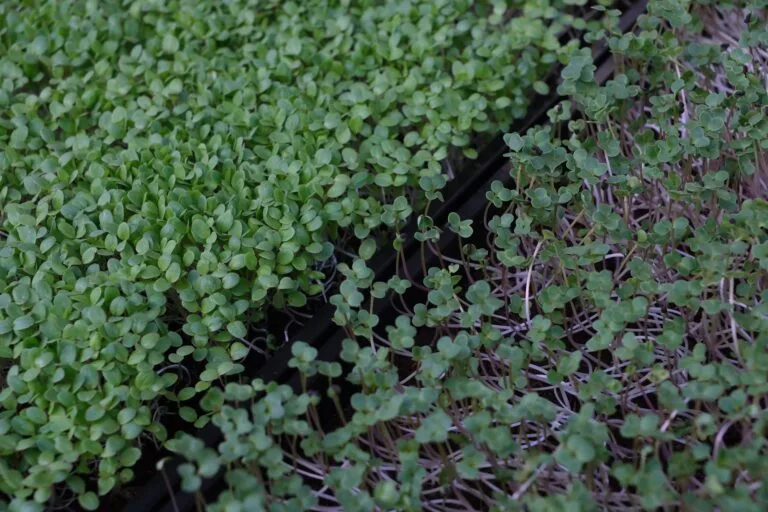

[…] we dive into a topic of great importance: microgreens that can be toxic. As we mentioned in the previous article, it is a serious mistake to assume that every edible plant can be consumed as a microgreen. Nothing […]
[…] Welcome to the third part of this article series in which we talk about microgreens that can be toxic to our […]
[…] be dressed with fungicide, which you do not want on something you eat raw — see our note on seed safety before you […]