Get in touch
Questions about growing, workshops, the cooperative or partnerships? Send us a message and we will reply by email.
Prefer email? Write to erasmus@evec.org.gr
EVEC Microgreens
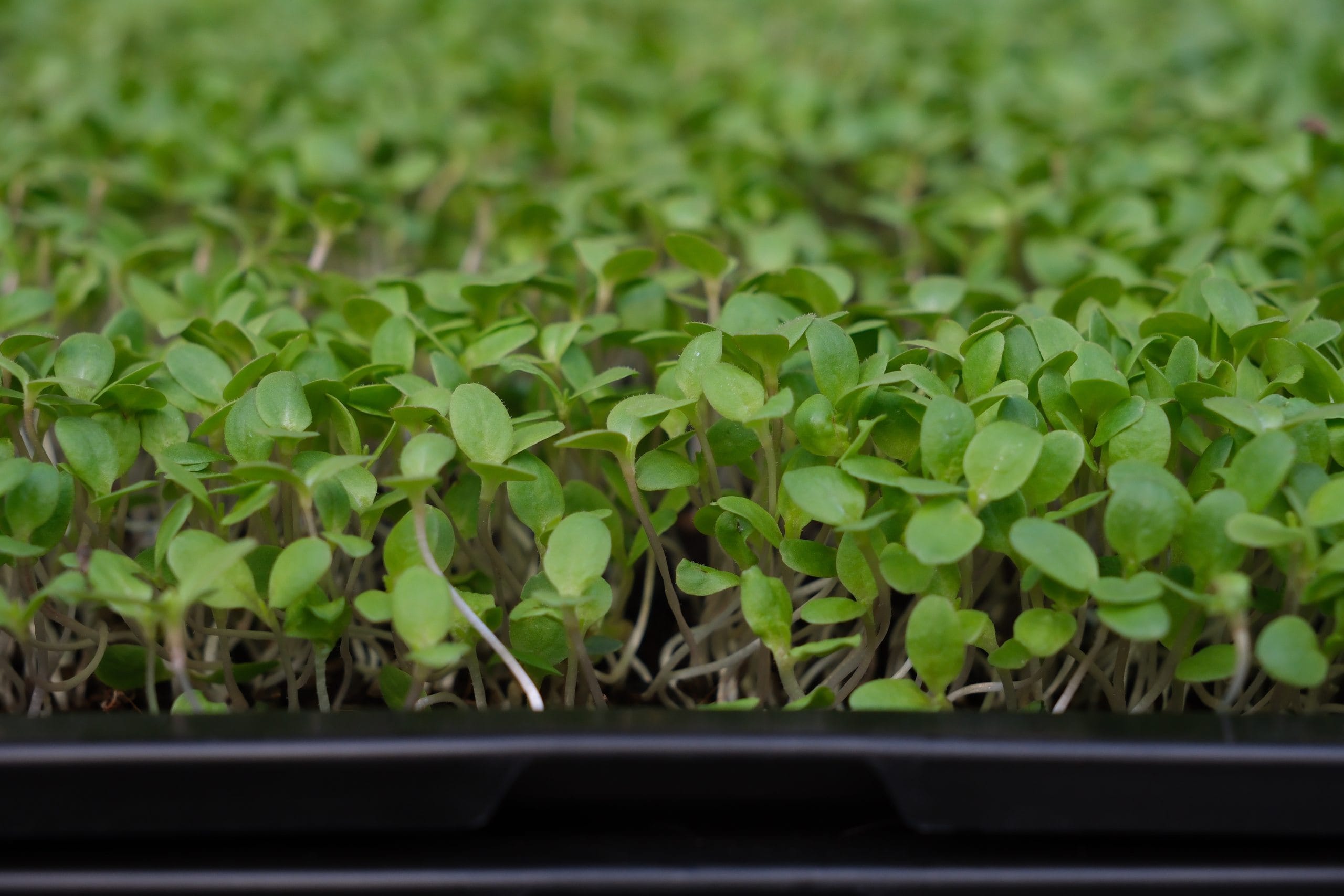
A free, self-paced beginner course in six short modules: set up your first tray, follow the 10-day cycle, pick your crop, fix problems, harvest and cook. No experience needed.
Type: Self-paced online course · Level: Complete beginner · Time: about 2 hours of reading across 10–14 days of growing · Cost: Free · Status: Pilot version, feedback welcome
This course takes you from a packet of seeds to a harvest you eat, using a windowsill, a tray and ten days or so of light daily care. It is a guided path through the open materials on this portal: each module tells you what to read, what to do, and how you know you are done. Work through the modules in order — the growing happens in real time alongside your reading.
Microgreens are young vegetable seedlings harvested just after their first leaves open — not sprouts, and not baby greens. Knowing the difference tells you why they are so fast, so nutritious and so safe to grow indoors.
Materials: Sprouts, microgreens or young edible plants — the differences
You are done when you can say what separates a microgreen from a sprout, and why microgreens are grown in light.
Your first crop decides how easy your first harvest is. Radish is the fastest and most forgiving; garden cress and kale are close behind. Open the guide for the crop you choose — it will be your companion for the whole cycle.
Materials: The Varieties database — recommended first crops: radish, garden cress or kale
You are done when you have chosen one crop, read its guide, and have seeds, a shallow tray and a growing medium ready.
This is the heart of the course. Our 10-Day Growing Guide walks you through every day from sowing to harvest: the blackout days, first light, watering from below, and what healthy growth looks like. Follow it day by day with your own tray.
Materials: Microgreens Growing Guide – 10 Days: Seed to Harvest (open draft — your feedback improves it)
You are done when your tray is sown, covered for blackout, and you know what you will do each day for the next ten.
Most first-tray problems are one of three things: too much water, too little light, or poor airflow. While your tray grows, browse the home-growing library so you recognise the warning signs early — fuzzy white roots are usually harmless root hairs, but true mould has a smell and a look you will learn to spot.
Materials: the Grow at Home library — pick the articles that match what you see in your tray
You are done when your seedlings are green, upright and past the halfway mark, and you have solved (or ruled out) at least one problem yourself.
Harvest with clean scissors just above the medium, ideally the morning you plan to eat them. Then close the loop: a harvest you cook is the moment this stops being an experiment and becomes food.
Materials: your crop’s guide (harvest section) and the Microgreens Cookbook
You are done when you have eaten something you grew.
One tray is a start; a rhythm is a habit. Try a second crop from the Varieties database, sow a new tray the day you harvest the old one, and tell us how the course worked for you — your feedback directly shapes the next version. If you are in Athens, come to a workshop; if you are aged 18–30, you can even join us longer-term through the European Solidarity Corps.
Materials: Varieties database · Send us your feedback · Volunteering & internships
You are done when your second tray is sown — because then you are no longer a beginner.
This course is an open educational resource of the microgreens methodology. The organisation behind the methodology is EVEC Athens (evec.org.gr). Teachers, youth workers and adult educators are welcome to use and adapt it — see all courses or partner with us to build one together.
This article is part of the free knowledge portal of EVEC Microgreens. Wherever you are on your microgreens journey, there is a path for you:
Co-funded by the European Union.
This portal presents the microgreens methodology; the organisation behind it is EVEC Athens — the European Voluntary and Educational Center (evec.org.gr). Views and opinions expressed are those of the author(s) only and do not necessarily reflect those of the European Union or the European Commission. Neither the European Union nor the granting authority can be held responsible for them.