Get in touch
Questions about growing, workshops, the cooperative or partnerships? Send us a message and we will reply by email.
Prefer email? Write to erasmus@evec.org.gr
EVEC Microgreens
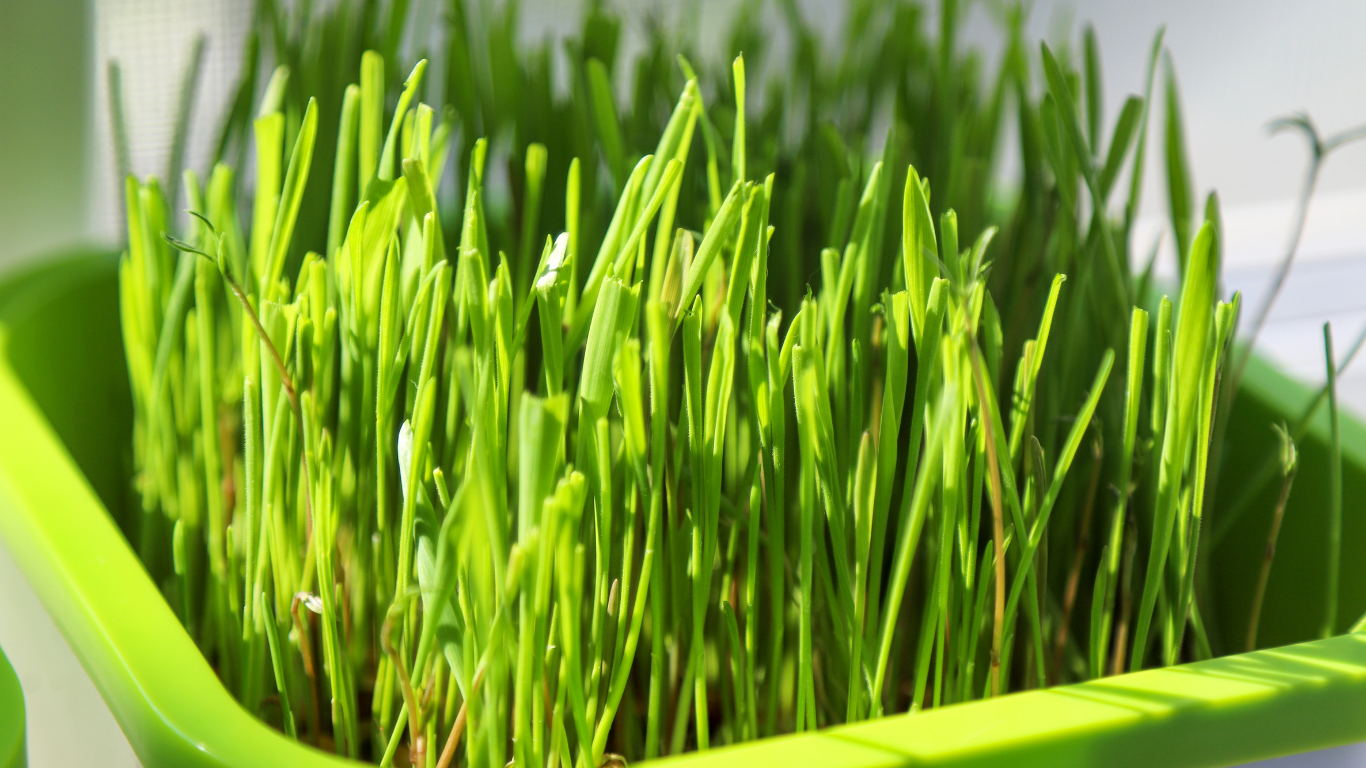
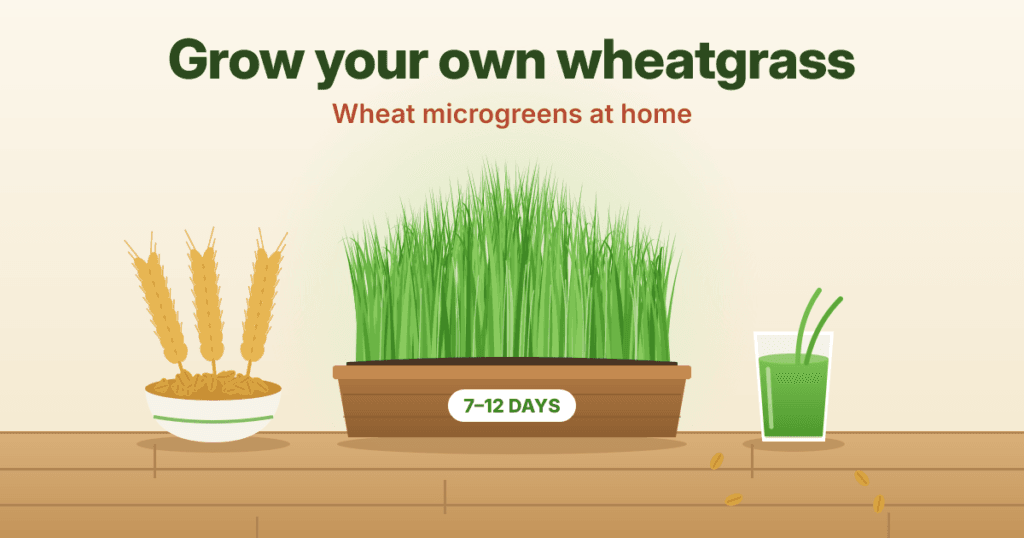
Wheat microgreens, better known as wheatgrass, grow from cheap kitchen grains in 7–12 days. This guide checks every step, from seed rate and soaking to harvest and storage, against the studies in the EVEC science library.
Wheat microgreens are better known as wheatgrass: the bright green blades that juice bars turn into small, very green shots. Young wheat plants harvested before about 15 days old are what people call wheatgrass (Mishra et al., 2025).
Wheat is one of the cheapest and easiest seeds to grow, and the grains are already in many kitchens. This guide checks every step against the studies in the EVEC science library. As always, ✅ means a study measured it and ⚠️ means it is an estimate.
| Step | Value | Evidence |
|---|---|---|
| Seeding density | About 700 g of seed per m². Around 90 g for a 25 × 50 cm tray | ✅ / ⚠️ tray conversion |
| Soaking time | 12–24 hours | ✅ |
| Blackout period | Until the seeds sprout, usually 2–5 days | ✅ / ⚠️ |
| Growing under light | 5–8 days | ✅ |
| Best light | White light 12–16 h a day; grows even under weak light | ✅ |
| Ideal temperature | 18–25 °C | ✅ |
| Ideal humidity | About 50–65% | ✅ |
| Total days to harvest | 7–12 days (10–15 days if you want it for juice) | ✅ |
| Shelf life | Up to 9 days at 4 °C in a sealed bag | ✅ |
| Best way to eat | Juiced or blended; raw blades are tough | ✅ / ⚠️ |
An Indian study sowed wheat at 705 g of seed per m² and harvested 630 g of fresh microgreens per m². That means wheat gives back a little less weight than you sow, unlike leafy microgreens such as mustard (Arya et al., 2023) ✅. A Spanish study sowed wheat much more densely: 20 g of seed on a 7.5 × 11.5 cm sheet (Viltres-Portales et al., 2024) ✅.
What this means for you: aim for about 700 g per m², a thick single layer where the grains touch but do not pile up. On a 25 × 50 cm tray, that is about 90 g of dry seed ⚠️ (our conversion).
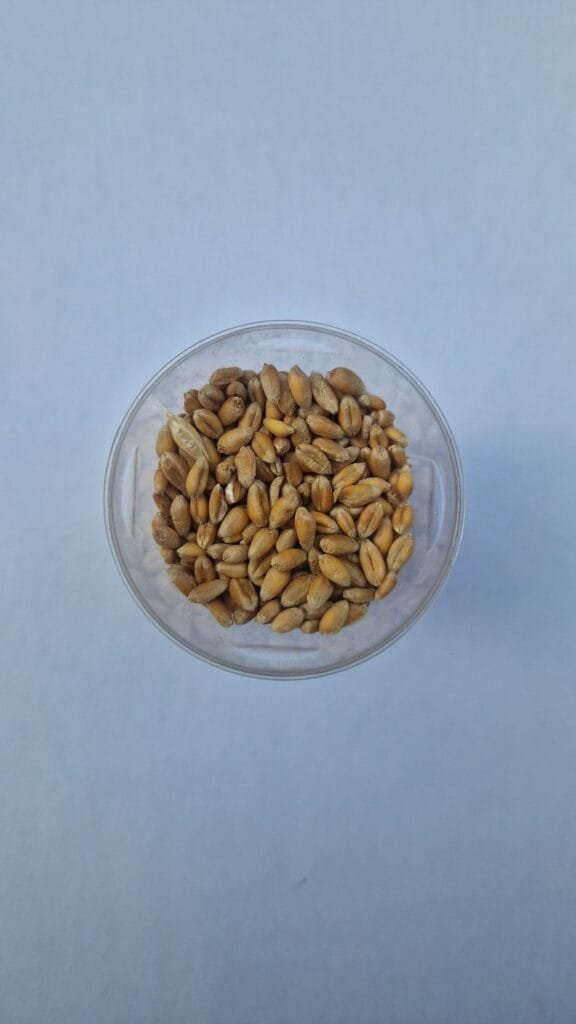
Wheat studies soaked the grains for 12 hours (Arya et al., 2023) or 24 hours (Islam et al., 2023; Uma et al., 2023) ✅.
Soaking clearly helped in one Korean study. Wheat soaked for 24 hours and grown in soil had the best germination (97%), the tallest plants and the highest yield. These plants also had more carotenoids, flavonoids, phenolics and vitamin C than unsoaked ones (Islam et al., 2023) ✅.
Recommendation: soak 12–24 hours in cool water, then drain and rinse ✅.
Studies kept wheat in the dark until the seeds sprouted (Arya et al., 2023) or for 5 days (Viltres-Portales et al., 2024) ✅.
Recommendation: keep the tray covered until the roots have gripped and the shoots are about 2–3 cm tall, usually 2–5 days ✅ / ⚠️. Mist the seeds once or twice a day so they do not dry out ⚠️.
The Spanish study gave wheat 8 days of light after 5 dark days (Viltres-Portales et al., 2024). A Turkish study cut its wheat on day 7 after sowing, and a Korean study grew it for 12 days in total (Altuner, 2024; Islam et al., 2023) ✅.
Recommendation: 5–8 days under light ✅.
Wheat is not fussy about light. Studies used 150 µmol/m²/s for 12 hours a day (Islam et al., 2023), a household spiral bulb for 16 hours (Altuner, 2024) and even a weak 35 µmol/m²/s for 16 hours (Viltres-Portales et al., 2024) ✅.
More light did make a difference in one study of six microgreens, including wheat. Trays grown outdoors under a rain shelter, with more sunlight, gave higher yields and more nutrients, while trays grown indoors had longer seedlings (Arya et al., 2023) ✅.
Recommendation: a bright window or a white LED for 12–16 hours a day ✅. If the blades are pale and floppy, give them more light ⚠️.
Wheat studies used 20 °C by day and 15 °C at night (Islam et al., 2023), 21/17 °C (Altuner, 2024) and about 26 °C (Viltres-Portales et al., 2024) ✅. An Indian study grew it in a room at about 29 °C (Arya et al., 2023) ✅.
Recommendation: 18–25 °C ✅. Wheat is a cool-season crop, so a cool room is fine ⚠️.
Studies grew wheat at about 50–60% (Altuner, 2024), 59% (Viltres-Portales et al., 2024), 60% (Islam et al., 2023) and 65–73% relative humidity (Arya et al., 2023) ✅.
Recommendation: about 50–65% ✅. Wheat seeds stay wet for a long time after soaking, so give the tray airflow once it is uncovered ⚠️. Read our guide on how to prevent mould when growing microgreens.
Studies harvested wheat microgreens on day 7 (Altuner, 2024), day 8 to 12 depending on the growing material (Uma et al., 2023), day 12 (Islam et al., 2023) and day 13 (Viltres-Portales et al., 2024) ✅. In one study, wheat on coco peat was ready on day 8, in soil on day 10 and in water on day 12 (Uma et al., 2023) ✅.
For juice: a review reports that 15-day wheatgrass juice had more chlorophyll, carotenoids and polyphenols than 10-day juice. It concludes that wheatgrass has its highest nutrient content at about 12–15 days (Mishra et al., 2025) ✅.
Recommendation: 7–12 days for eating, 10–15 days for juicing ✅. Cut the blades about 1 cm above the soil ⚠️.
Wheat keeps well. In a study of six microgreens, wheat (together with horse gram) kept the longest: up to 9 days at 4 °C in a sealed zip-lock bag. At room temperature (28 °C), the six species lasted only about 4.5 days in bags, and 1 day in open foil containers (Arya et al., 2023) ✅.
How to extend it:
More tips: extending the shelf life of microgreens.
What is in them? In a Turkish study of seven cereal microgreen varieties (barley, wheat and oat), the wheat varieties had the highest antioxidant activity, phenolics, flavonoids and chlorophyll of the group (Altuner, 2024) ✅. Wheatgrass contains vitamins A, C and E, B vitamins, and minerals such as iron, calcium and magnesium (Mishra et al., 2025) ✅. Wheat can also take up selenium when it is added to the water, but less than kale and kohlrabi did (Viltres-Portales et al., 2024) ✅.
An honest note on taste: in an Indian taste test of six microgreens, wheat scored among the lowest for overall liking (Arya et al., 2023) ✅. That is why most people drink it or blend it with fruit.
⚠️ Estimate: the blades are fibrous and hard to chew. Chop them very finely and sprinkle a little over salads, or chew a few blades and spit out the fibre.
✅ Wheatgrass is usually eaten as a juice or powder (Mishra et al., 2025). A slow juicer or a blender plus a sieve both work ⚠️. Start with a small shot and mix it with apple or orange juice ⚠️.
⚠️ Estimate: freeze fresh wheatgrass juice in an ice-cube tray and drop a cube into smoothies. We found no study on freezing wheat microgreens.
⚠️ Estimate: we found no cooking study for wheat microgreens. Add the juice or finely chopped blades to dishes after cooking, not before.
A note on health claims: wheatgrass is often sold as a “miracle” food. The review in the EVEC library lists many possible benefits, but it also says there is a lack of scientific evidence for them and that clinical studies are needed (Mishra et al., 2025) ✅.
Gluten: wheat grains contain gluten. We found no study in the library that measured gluten in wheat microgreens. If you have coeliac disease or a wheat allergy, ask your doctor before eating wheatgrass, and never eat the seeds or roots ⚠️.
These recipes are suggestions and have not been tested in a study ⚠️. Under 15? Ask an adult to help with the blender and knife.
Blend a small handful of wheatgrass with 1 apple, half a lemon (peeled) and 100 ml of water. Strain through a sieve and drink straight away.
Blend 1 banana, a few strawberries, 200 ml of milk or yogurt and a small handful of chopped wheatgrass until smooth.
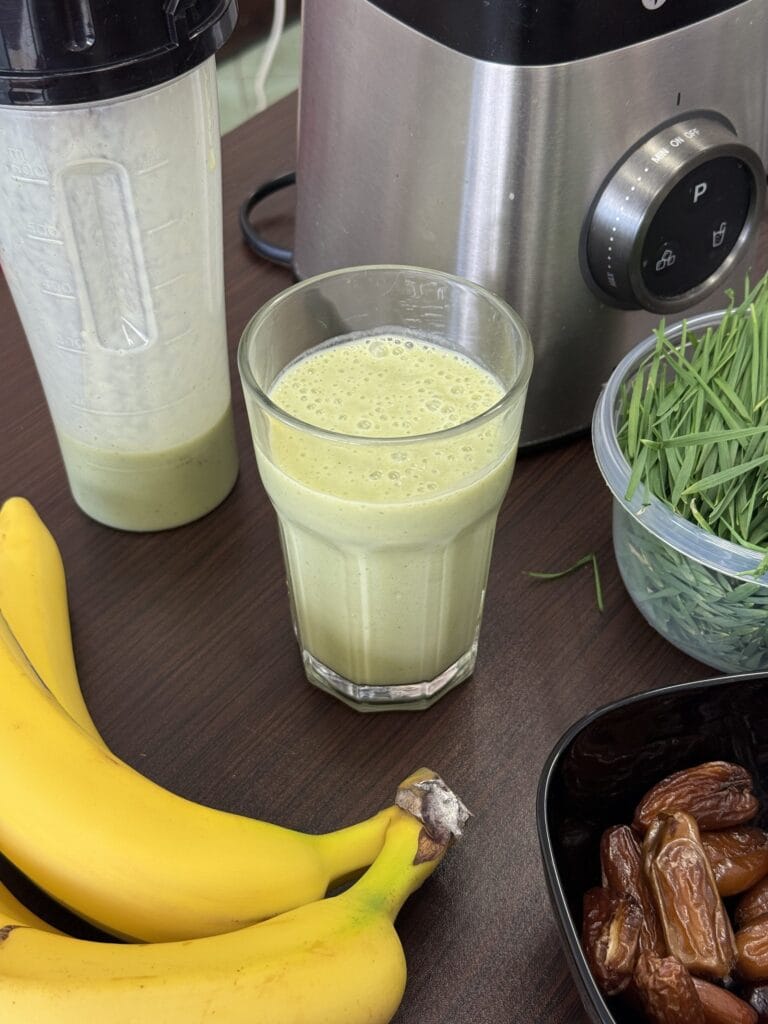
Mix wheatgrass juice with lemon juice and a little honey, freeze in an ice-cube tray, and add the cubes to a glass of water or lemonade.
More ideas: EVEC microgreens cookbook.
Wheat microgreens grow from cheap kitchen grains, cope with weak light and keep longer in the fridge than most microgreens. They are also the “cat grass” many cats love to nibble. That makes wheatgrass one of the easiest crops for a first try at home or in a classroom.
Compare it with our other guides: radish, broccoli, pea and sunflower, or read the studies in the library of 374 microgreens research papers.
All are open-access papers in the EVEC science library.
This article is part of the free knowledge portal of EVEC Microgreens. Wherever you are on your microgreens journey, there is a path for you:
Co-funded by the European Union.
This portal presents the microgreens methodology; the organisation behind it is EVEC Athens — the European Voluntary and Educational Center (evec.org.gr). Views and opinions expressed are those of the author(s) only and do not necessarily reflect those of the European Union or the European Commission. Neither the European Union nor the granting authority can be held responsible for them.
Open licence. Except where stated otherwise, the educational materials on this portal are licensed under CC BY 4.0 — free to use, adapt and share, including commercially, with credit. See the licence terms.
Accessibility. We aim for WCAG 2.1 AA and publish what does and does not yet meet it — see the accessibility statement. If anything here blocks you, tell us and we will send the material in a format that works for you.