Get in touch
Questions about growing, workshops, the cooperative or partnerships? Send us a message and we will reply by email.
Prefer email? Write to erasmus@evec.org.gr
EVEC Microgreens
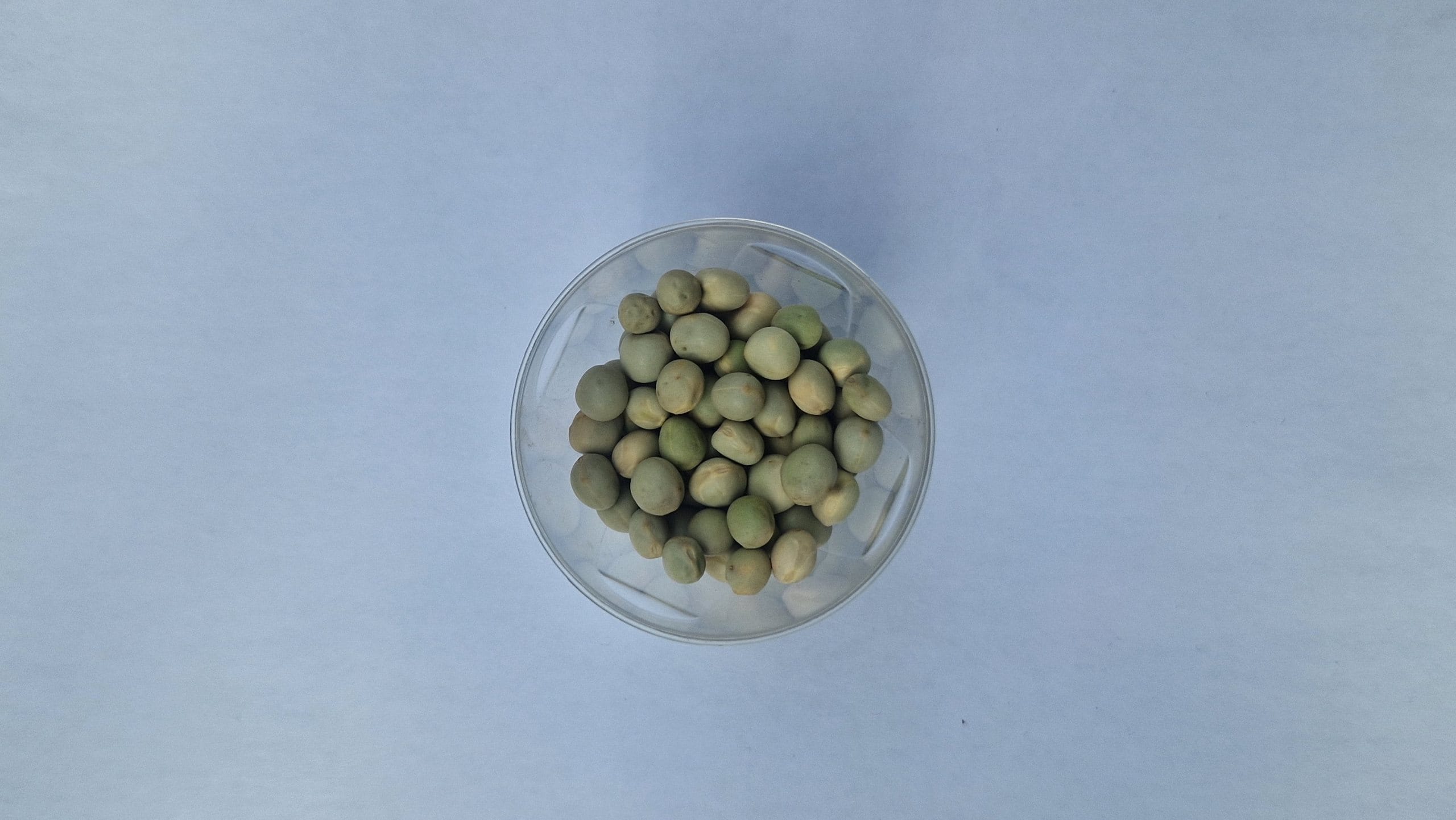
Pea microgreens growing conditions, checked step by step against 17 open-access studies: seed rate, soaking, blackout, light, temperature, humidity and harvest day. Every value is marked as measured by a study or estimated.
Pea microgreens, often sold as pea shoots, are the gentle giant of the microgreen world. The seeds are big, the shoots are crunchy and sweet, and the tray looks like a tiny forest within a week.
Peas also break some of the rules you may know from radish and broccoli. They need far more seed, and they actually like a soak. This guide checks every step against the studies in the EVEC science library.
As always, every value carries a label. ✅ means a study measured it. ⚠️ means it is an estimate.
| Step | Value | Evidence |
|---|---|---|
| Seeding density | 1–2 seeds per cm² (about 1.4–3.1 kg of seed per m²). Around 170–380 g for a 25 × 50 cm tray | ✅ / ⚠️ tray conversion |
| Soaking time | 6–24 hours (most studies soaked) | ✅ |
| Blackout period | 2–3 days | ✅ |
| Growing under light | 6–9 days | ✅ |
| Best light | White LED, about 100–230 µmol/m²/s, 16 h a day | ✅ |
| Ideal temperature | 20–25 °C | ✅ |
| Ideal humidity | Covered while germinating; 50–75% under light | ✅ |
| Total days to harvest | 8–12 days | ✅ |
| Shelf life | No pea-specific study found; about a week in the fridge | ⚠️ |
| Best way to eat | Raw, stir-fried at the end, or even baked | ✅ / ⚠️ |
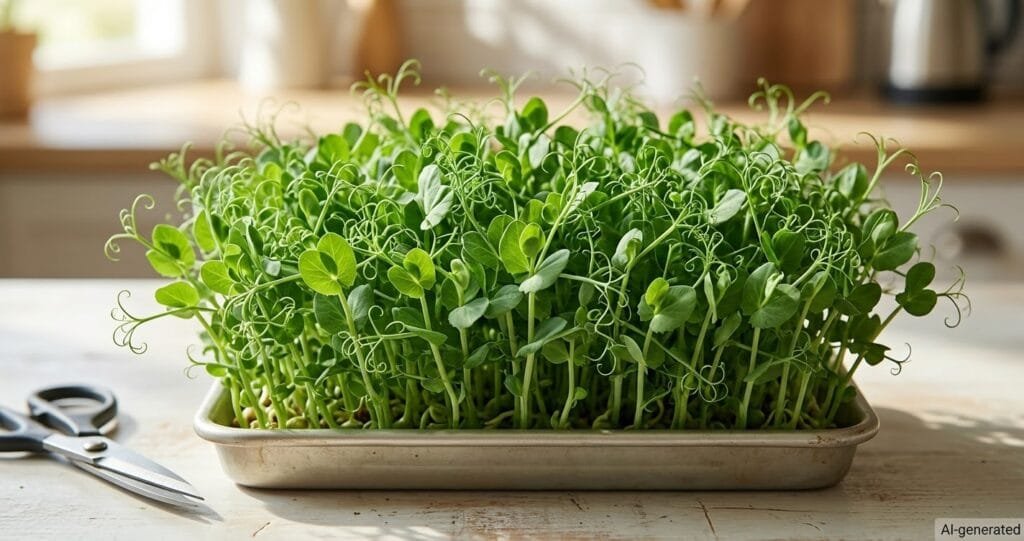
Pea seeds are heavy, about 137–153 mg each, so you need a lot more seed by weight than for small seeds (Poudel et al., 2023; Li et al., 2021) ✅.
Most pea studies sowed 1 seed per cm² (Poudel et al., 2023 and 2025; Pérez-Leal et al., 2025) ✅. A US seed supplier’s rate used in one study was 1,285 g per m² (Li et al., 2021) ✅. An Irish study tested several densities and found the highest pea yield at 2 seeds per cm². The same study warned that denser sowing also raised the number of bacteria and fungi on microgreens (Dubey et al., 2026) ✅.
What this means for you: sow 1–2 seeds per cm² ✅. On a 25 × 50 cm tray, that is roughly 170–380 g of dry seed ⚠️ (our conversion). Start at about 1.5 seeds per cm², and do not go denser than 2.
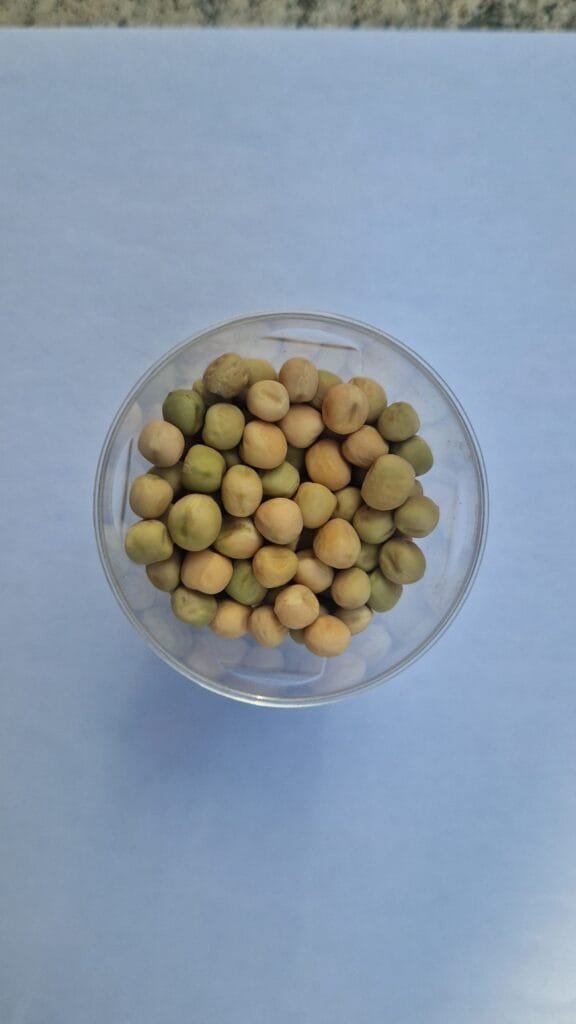
Unlike broccoli, peas are usually soaked. In the library, pea studies soaked the seeds for:
One caution: a ten-species study, which included pea, found that a 6-hour soak lowered average fresh yield across all species, from 1,001 to 875 g per m² (Li et al., 2021) ✅. That result was an average, though. The same paper notes that earlier work recommended cold-water soaking for large seeds such as pea.
Recommendation: soak pea seeds 6–12 hours in cool water, then drain well ✅. Rinse them once or twice if you soak longer ⚠️.
Pea studies kept the trays covered for 2–3 days:
Recommendation: 2–3 days ✅. Uncover the tray when the shoots are pushing up against the lid. Some growers put a light weight on the lid to help the roots grip ⚠️.
After blackout, studies gave pea shoots about 7–8 days of light before harvesting on day 10 (Bantis, 2021; Deng et al., 2021) ✅. A Hungarian study cut its peas 12 days after the lights came on (Balázs et al., 2023) ✅.
Recommendation: 6–9 days under light ✅.
Brightness. The two pea studies point in slightly different directions. A US study found the highest pea yield, 3.24 kg per m², at 100 µmol/m²/s. Yield dropped at 200 and 300 (Poudel et al., 2025) ✅. A Polish study compared 115 and 230 µmol/m²/s of white LED light and found heavier, taller plants at 230 (Frąszczak et al., 2024) ✅.
Colour. In a Greek plant-factory study, pea shoots had the lowest phenolic content under the light with the most blue (Bantis, 2021) ✅. A Japanese study regrew cut pea seedlings in three places. The ones regrown indoors under daylight had the highest antioxidant activity (Tsuruoka & Hosoya, 2024) ✅.
Recommendation: a white (full-spectrum) LED at about 100–230 µmol/m²/s, 16 hours a day, or a bright window ✅. Pea shoots are forgiving, so you do not need a powerful lamp.
Pea studies grew their microgreens between 20 and 25 °C. Examples: 20 °C (Balázs et al., 2023), 21 °C by day and 17 °C by night (Frąszczak et al., 2024), 22 °C (Bantis, 2021), 23 °C (Balık et al., 2025) and about 25 °C (Poudel et al., 2023) ✅.
Recommendation: 20–25 °C ✅. Peas are a cool-season crop, so avoid very hot rooms ⚠️.
Tip: peas have big, wet seeds that can go mouldy if the air is still. Give the tray airflow once it is uncovered ⚠️. Read our guide on how to prevent mould when growing microgreens.
Studies harvested pea microgreens between day 6 and day 12 after sowing. One study harvested on days 6–8 (Li et al., 2021), while others cut on day 10 (Bantis, 2021; Deng et al., 2021) or day 12 (Dubey et al., 2026) ✅.
Recommendation: 8–12 days, when the shoots are about 8–12 cm tall and the first leaves have opened ✅ / ⚠️. Cut about 1 cm above the seed.
Bonus: a second harvest. The Japanese study above regrew pea seedlings from the seeds and roots left after cutting. The authors note that when these are kept in water, new shoots appear within a few days (Tsuruoka & Hosoya, 2024) ✅. The second crop is usually smaller ⚠️.
We found no shelf-life study on pea microgreens in the EVEC library. Studies on other microgreens found 8–10 days at 4–5 °C, so about a week in the fridge is a sensible guide for peas ⚠️ (estimate).
How to extend it (⚠️ general practice, not pea-specific studies):
Safety facts we did find: pea seeds bought online carried fewer bacteria than borage, carrot or onion seeds (Ocho Bernal et al., 2023) ✅. When germs were added to growing mats on purpose, pea shoots picked up far fewer than sunflower shoots (Deng et al., 2021) ✅. Still, buy seeds sold for sprouting or microgreens, and keep your trays clean ⚠️. More: extending the shelf life of microgreens.
What is in them? A 2025 study of six microgreens found 70.76 mg of vitamin C per 100 g in pea, the second highest of the six (Balık et al., 2025) ✅. A Polish study found that microgreens, including green pea, were rich in carotenoids and chlorophylls (Wojdyło et al., 2020) ✅.
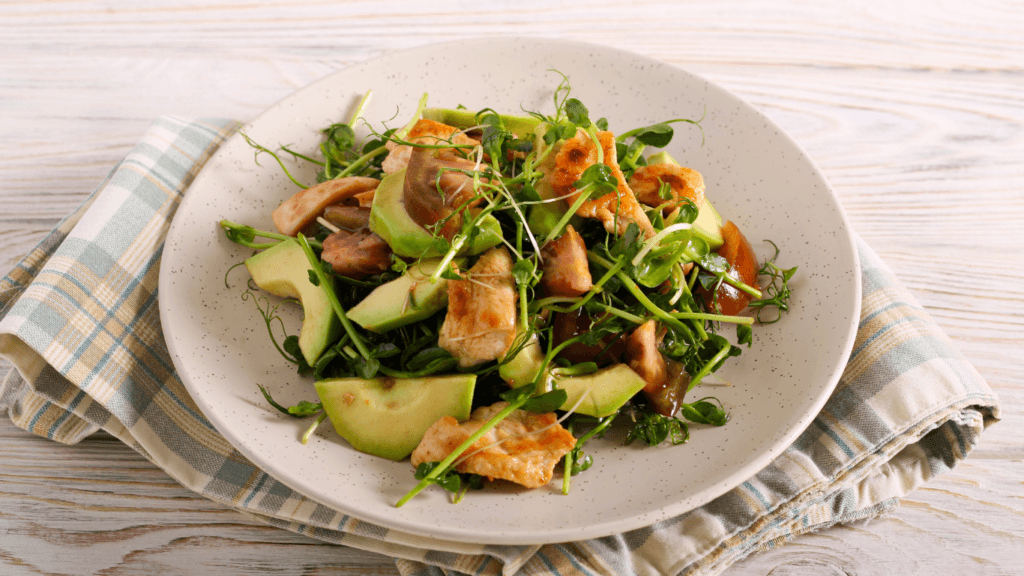
Raw keeps the most vitamin C. In radish microgreens, hot-air drying cut vitamin C by up to 63% (Jauregui et al., 2025) ✅. Peas were not tested, but vitamin C behaves the same way ⚠️. Pea shoots are sweet and crunchy, so they work well on their own in salads ⚠️.
⚠️ Estimate: their mild taste blends easily with fruit. We found no smoothie study for pea microgreens.
⚠️ Estimate: freezing makes them limp. Use frozen pea shoots in soups or smoothies only.
✅ Peas are one of the few microgreens tested in cooking. In a German study, pea microgreens were baked into wheat bread. Their quercetin, a plant compound, did not decrease with baking, and kaempferol fell only slightly. The green pigments and carotenoids, however, were lost (Klopsch et al., 2018). So a quick stir-fry or adding them at the end of cooking keeps a lot of their value ⚠️.
A note on health claims: in a lab study, extracts of LED-grown pea microgreens slowed the growth of cancer cells in a dish (Truzzi et al., 2021) ✅. That was a test on cells, not people, so it does not show that eating pea shoots prevents cancer.
These recipes are suggestions and have not been tested in a study ⚠️. Under 15? Ask an adult to help with the stove and knife.
Heat a little olive oil in a pan. Add 1 sliced garlic clove for 30 seconds, then 2 big handfuls of pea shoots. Stir for about one minute, until just wilted. Finish with lemon juice and a pinch of salt.
Make a classic horiatiki with tomato, cucumber, onion, olives and feta. Top it with a handful of raw pea shoots and dress with olive oil and oregano.
Whisk 2 eggs with crumbled feta and cook them in a pan. Just before folding, add a handful of pea shoots so they warm through but stay crunchy.
More ideas: EVEC microgreens cookbook.
Pea microgreens give one of the biggest harvests of any microgreen. In a ten-species study, pea produced the highest fresh yield, 2,484 g per m² (Li et al., 2021) ✅. They are cheap, forgiving and can even regrow once.
That makes them a perfect first crop for a classroom or a kitchen window. Compare them with our other guides: radish, broccoli and the beginner pea page, or read the studies in the library of 374 microgreens research papers.
All are open-access papers in the EVEC science library.
This article is part of the free knowledge portal of EVEC Microgreens. Wherever you are on your microgreens journey, there is a path for you:
Co-funded by the European Union.
This portal presents the microgreens methodology; the organisation behind it is EVEC Athens — the European Voluntary and Educational Center (evec.org.gr). Views and opinions expressed are those of the author(s) only and do not necessarily reflect those of the European Union or the European Commission. Neither the European Union nor the granting authority can be held responsible for them.
Open licence. Except where stated otherwise, the educational materials on this portal are licensed under CC BY 4.0 — free to use, adapt and share, including commercially, with credit. See the licence terms.
Accessibility. We aim for WCAG 2.1 AA and publish what does and does not yet meet it — see the accessibility statement. If anything here blocks you, tell us and we will send the material in a format that works for you.