Get in touch
Questions about growing, workshops, the cooperative or partnerships? Send us a message and we will reply by email.
Prefer email? Write to erasmus@evec.org.gr
EVEC Microgreens
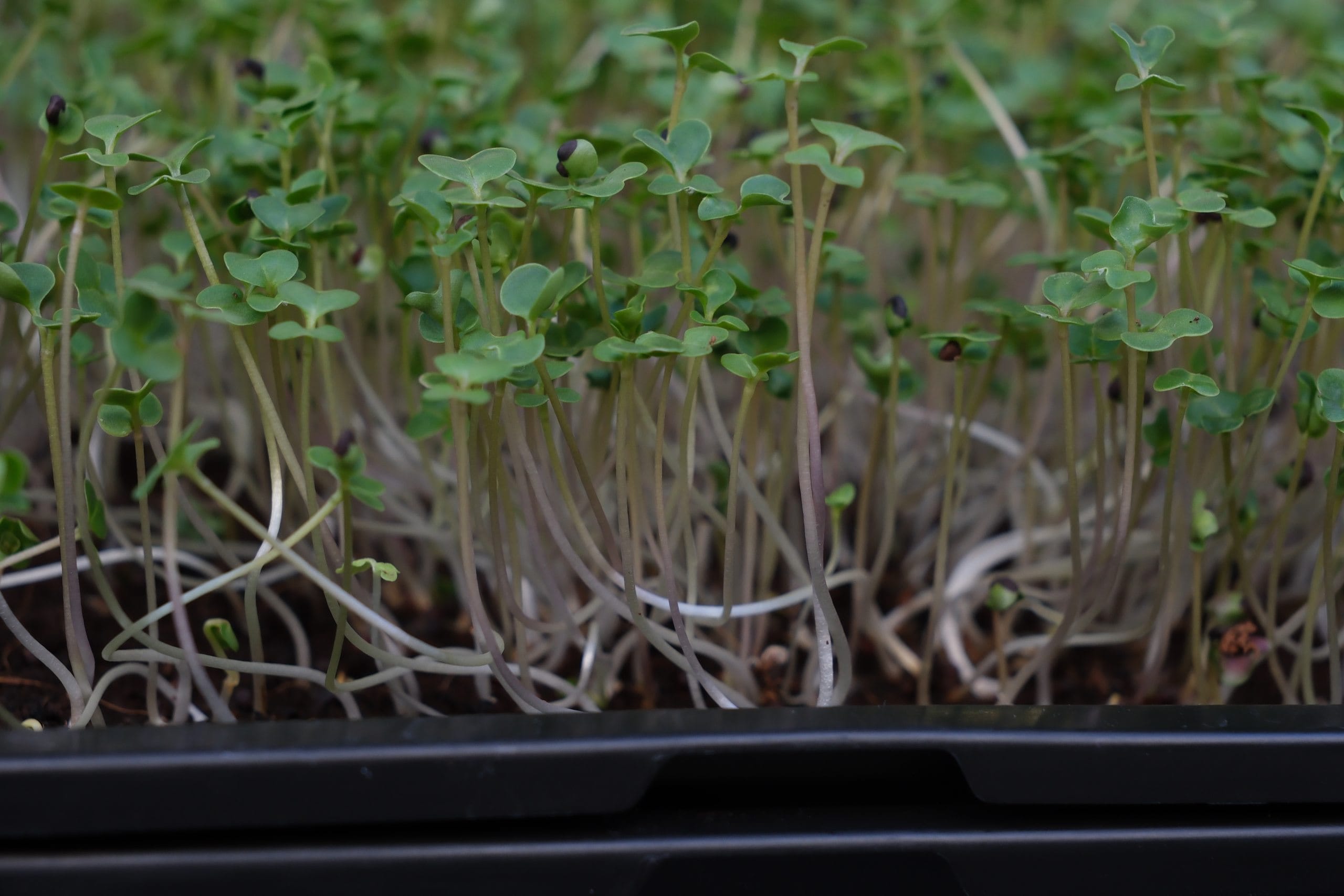
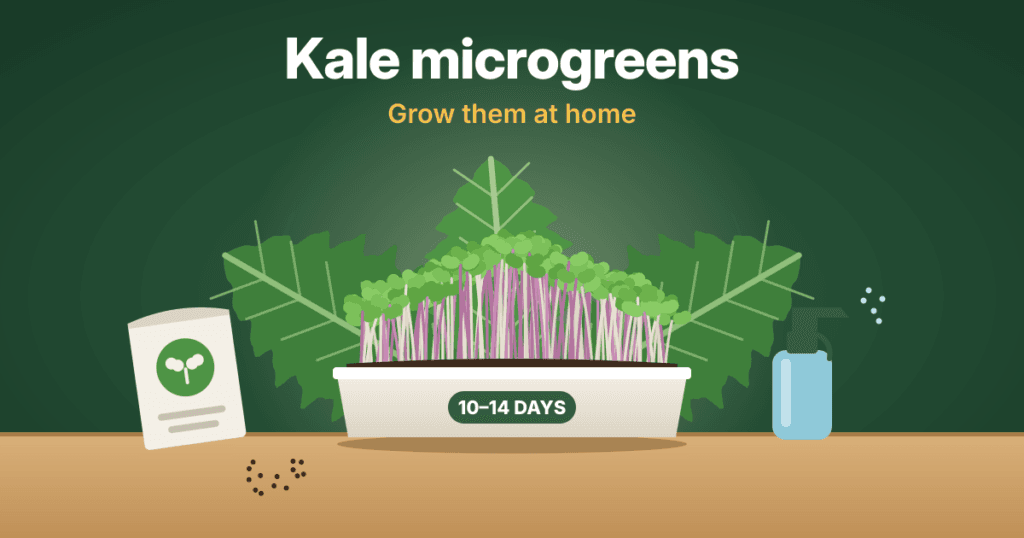
Grow kale microgreens step by step: seed rate, soaking, blackout, light, temperature, humidity, harvest, storage and recipes, checked against 19 studies. Every value is marked as measured by a study (✅) or estimated (⚠️).
Kale microgreens are the tiny seedlings of kale, the leafy cousin of broccoli and cabbage. Grown for 10–14 days, they are soft and mild, nothing like the tough leaves many people avoid. In an online survey in Italy and Spain, about half of the people asked said they never eat kale at all (Cano-Lamadrid et al., 2023) ✅. Kale microgreens may be the easiest way to change that.
This guide checks every step against 19 studies, most of them from the EVEC science library. As always, ✅ means a study measured it and ⚠️ means it is an estimate.
Which kale? Studies used green curly kale, Tuscan “black” kale (‘Nero di Toscana’), red kale (‘Scarlet’) and ‘Red Russian’ kale. Most kale belongs to the same species as broccoli and cabbage, but ‘Red Russian’ is a close cousin, Brassica napus (Di Gioia et al., 2023; Hooks et al., 2022) ✅. All of them grow the same way as microgreens ⚠️.
| Step | Value | Evidence |
|---|---|---|
| Seeding density | 3–4 seeds per cm² (about 100–150 g of seed per m²). Around 15 g for a 25 × 50 cm tray | ✅ / ⚠️ tray conversion |
| Soaking time | Not needed: sow dry seed on a wet growing material | ✅ / ⚠️ |
| Blackout period | 2–3 days, until the seeds sprout (longer in a cool room) | ✅ |
| Growing under light | About 8–11 days | ✅ / ⚠️ our range |
| Best light | White LED for 16 hours a day; brighter light gives more antioxidants | ✅ |
| Ideal temperature | About 20–22 °C by day, a few degrees cooler at night; 20–25 °C for sprouting | ✅ / ⚠️ our range |
| Ideal humidity | Covered while sprouting; about 50–70% under light | ✅ |
| Total days to harvest | 10–14 days (up to 19 in a cold room) | ✅ |
| Shelf life | Up to about a week at 4 °C in a closed box; eat within a few days for the most antioxidants | ✅ |
| Best way to eat | Raw, in salads, sandwiches and smoothies; mild taste | ✅ / ⚠️ |
An Italian study sowed kale at 3, 4 and 5 seeds per cm². Going from 3 to 5 seeds gave 26% more harvest, but the crop grew 41% less evenly. The authors suggest 4 seeds per cm² as a good balance between looks and yield (Signore et al., 2024) ✅.
Other studies used similar rates: 3.0 seeds per cm² (Di Gioia et al., 2023), 3.8 seeds per cm² (de la Fuente et al., 2019) and 125 g of seed per m² (Hooks et al., 2022) ✅. One gram of kale seed holds about 240–330 seeds (Di Bella et al., 2020; Signore et al., 2024; Tavan et al., 2024) ✅.
What this means for you: for kale microgreens, aim for 3–4 seeds per cm², about 100–150 g per m². On a 25 × 50 cm tray, that is roughly 12–19 g, so about 15 g of seed ⚠️ (our conversion). Spread the seeds evenly in a single layer ⚠️.
Most kale studies sowed the seeds straight onto the growing material, then sprayed them with water or covered them (Frąszczak et al., 2023; Signore et al., 2024; Tavan et al., 2024) ✅. One Korean lab study soaked kale seeds for 24 hours first (Lee et al., 2023) ✅.
Recommendation: no soaking needed ✅ / ⚠️. Small dry seeds are also easier to spread evenly than wet ones ⚠️.
Studies kept kale covered and dark until the seeds sprouted:
Recommendation: 2–3 days ✅. In a cool room it can take a day or two longer (see section 6) ✅. Mist the surface if it starts to dry ⚠️. Not every seed sprouts on the same day, so wait until most of them are up ⚠️.
After blackout, the studies gave kale between about 8 and 14 days of light:
Recommendation: about 8–11 days under light ✅ / ⚠️ (our middle range). Give it a few more days if you want bigger plants with the first true leaf ⚠️.
Kale needs real light. A Danish–Latvian study grew 14 microgreens under a bright LED (209.5 µmol/m²/s) and a dim one (45 µmol/m²/s). Kale gave 2.42 kg per m² under the bright light but only 1.09 kg per m² under the dim one, 122% more with the brighter lamp (Mir et al., 2024) ✅. Sunflower, by contrast, did well under both.
Brighter light, more antioxidants. Green kale grown under 210 µmol/m²/s had about 28% more phenolic compounds than kale grown under 120 or 160 µmol/m²/s (Flores et al., 2024) ✅.
Colour matters too.
What about a windowsill? A US study grew kale and broccoli microgreens either on a windowsill or in a growth chamber with 12 hours of light a day, and harvested them on day 10. All were rich in polyphenols and glucosinolates. The windowsill microgreens had more of some flavonol compounds, which add colour and a bitter taste, and the chamber ones had more of two glucosinolates (Liu et al., 2022) ✅.
Recommendation: a white LED for 16 hours a day ✅. Most studies used 90–250 µmol/m²/s for 16–18 hours ✅. A bright, sunny window also works, but kale grows less in dim light ✅ / ⚠️.
Most kale studies used 21 °C by day and 17 °C at night (Frąszczak et al., 2023; Podsędek et al., 2024; Gudžinskaitė et al., 2024; Vaštakaitė-Kairienė et al., 2023) ✅. Others used 20 °C (Signore et al., 2024), about 22–23 °C (Hooks et al., 2022; Tavan et al., 2024) or 25 °C (Lee et al., 2023) ✅.
Cold slows everything down. An Italian study tested Tuscan kale seeds at different temperatures. On average they sprouted in about 2 days at 20–25 °C, 2.5 days at 15 °C and 4 days at 10 °C, and not at all at 5 °C. In an unheated greenhouse in Sicily in winter (about 15 °C on average), the kale microgreens were ready only after 19 days (Di Bella et al., 2020) ✅.
Recommendation: about 20–22 °C by day and a few degrees cooler at night ✅ / ⚠️ (our range). Keep the tray at 20–25 °C while the seeds sprout ✅.
Recommendation: keep kale microgreens at about 50–70% humidity under light ✅. Water from below and keep air moving once the cover is off ⚠️. Read our guide on how to prevent mould when growing microgreens.
Studies harvested kale microgreens between day 10 and day 17 after sowing:
In a Spanish greenhouse in late summer, kale was ready on day 7; in a cold Sicilian greenhouse in winter, it took 19 days (de la Fuente et al., 2019; Di Bella et al., 2020) ✅.
How much will you get? ‘Red Russian’ kale gave 1,444 g of fresh microgreens per m² on day 11 (Di Gioia et al., 2023) ✅. On a 25 × 50 cm tray, that is about 180 g ⚠️ (our conversion). In the Italian sowing study, kale gave a bigger harvest than rapini and cress (Signore et al., 2024) ✅.
Recommendation: harvest at 10–14 days ✅, when the two seed leaves are fully open and the first true leaf is just appearing ✅ (Hooks et al., 2022). Cut about 1 cm above the soil with clean scissors ⚠️.
A Greek study. Researchers in Athens packed kale microgreens in small sealed tubs covered with a plastic film that lets some air through. After a week at 4 °C and 90% humidity, the microgreens had lost only about 1.5–2.5% of their weight (Katsenios et al., 2021) ✅.
But antioxidants fade. In a Lithuanian study, the phenolic antioxidants in kale stored in the dark at 4 °C fell during 1–5 days of storage, with most of the drop in the first 3 days (Vaštakaitė-Kairienė et al., 2023) ✅. Another study found that kale stored at 4 °C under a dim white LED kept more phenolics after 5 days than kale stored in the dark (Gudžinskaitė et al., 2024) ✅. That is useful for shop display fridges, not yet for home fridges ⚠️.
How to extend it:
More tips: extending the shelf life of microgreens.
Food safety. Seeds can carry germs. In a US study of microgreen seeds bought online, 3 of 11 kale seed samples had detectable coliform bacteria and 4 had detectable moulds and yeasts. No Salmonella or Listeria was found in the kale seeds (Ocho Bernal et al., 2023) ✅. The fridge slows germs down but does not remove them: in a 2026 study on sunflower and radish microgreens, germs that survived a UV-C light treatment grew back partly during 14 days at 4 °C (Işık et al., 2026) ✅.
So: buy seeds sold for sprouting or microgreens, use clean trays and fresh growing material, and rinse before eating ⚠️.
What is in them?
How do they taste? In a consumer taste test, some tasters found kale sprouts too bitter, while kale microgreens were, if anything, too mild: not spicy, bitter or flavourful enough for some tasters (Cano-Lamadrid et al., 2023) ✅. Good news if you don’t like strong greens.
⚠️ Our pick. Their mild taste (✅ Cano-Lamadrid et al., 2023) works in salads, sandwiches, wraps and on top of soups and eggs ⚠️.
⚠️ Estimate: they blend well with orange, banana or apple. We found no smoothie study for kale microgreens.
⚠️ Estimate: freezing makes them limp, so use frozen kale microgreens only in smoothies or soups. We found no freezing study.
⚠️ Estimate: we found no cooking study for kale microgreens. Add them at the end, off the heat. Carotenoids dissolve in fat, so a little olive oil on your salad is a sensible habit ⚠️ (general nutrition knowledge, not tested on kale microgreens).
A note on health claims: you may read that kale microgreens fight inflammation or cancer. Those results come from lab tests (for example Vučetić et al., 2025), not from people. No study has yet shown that eating kale microgreens improves people’s health ⚠️.
These recipes are suggestions and have not been tested in a study ⚠️. Under 15? Ask an adult to help with the stove, blender and knife.
Chop tomato, cucumber and red onion, add olives and a slice of feta, then drizzle with olive oil and sprinkle with oregano. Top with a big handful of kale microgreens just before serving.
Cook a thin omelette with 2 eggs. Take the pan off the heat, add grated cheese and a handful of kale microgreens, and roll it up in a warm tortilla or pita.
Blend 1 peeled orange, 1 banana, 150 g of yogurt and a small handful of kale microgreens until smooth. Drink it straight away.
More ideas: EVEC microgreens cookbook.
Kale microgreens grow in under two weeks from cheap seed, taste mild, and are rich in vitamin C, carotenoids and polyphenols. They need more light than sunflower, so a small LED lamp makes a big difference. That makes them a good second crop once you have tried an easy one.
Start with our beginner page on kale microgreens, compare kale with our other guides on radish, broccoli, pea, sunflower and wheat, or read the studies in the library of 374 microgreens research papers.
Papers 1–17 and 19 are open-access papers in the EVEC science library. Paper 18 is a study outside the library.
This article is part of the free knowledge portal of EVEC Microgreens. Wherever you are on your microgreens journey, there is a path for you:
Co-funded by the European Union.
This portal presents the microgreens methodology; the organisation behind it is EVEC Athens — the European Voluntary and Educational Center (evec.org.gr). Views and opinions expressed are those of the author(s) only and do not necessarily reflect those of the European Union or the European Commission. Neither the European Union nor the granting authority can be held responsible for them.
Open licence. Except where stated otherwise, the educational materials on this portal are licensed under CC BY 4.0 — free to use, adapt and share, including commercially, with credit. See the licence terms.
Accessibility. We aim for WCAG 2.1 AA and publish what does and does not yet meet it — see the accessibility statement. If anything here blocks you, tell us and we will send the material in a format that works for you.