Get in touch
Questions about growing, workshops, the cooperative or partnerships? Send us a message and we will reply by email.
Prefer email? Write to erasmus@evec.org.gr
EVEC Microgreens
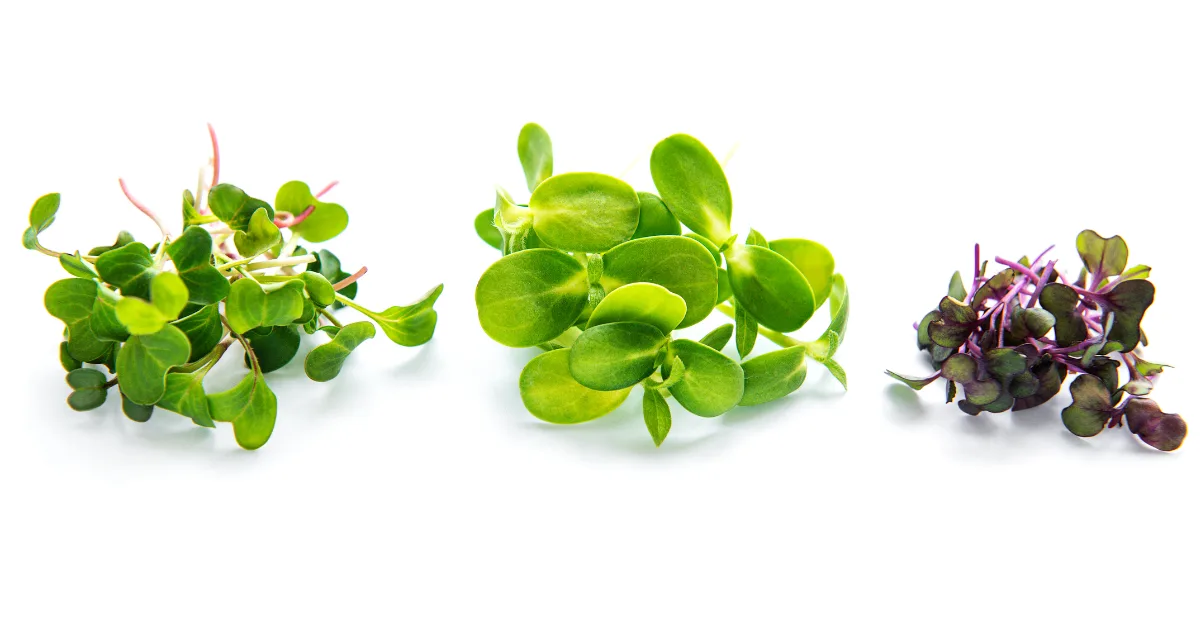
Sunflower microgreens, step by step, checked against 12 studies: seed rate, soaking, blackout, light, temperature, humidity, harvest day, storage and food safety. Every value is marked as measured by a study or as an estimate.
Sunflower microgreens are the crunchy, nutty shoots you often see on top of salads and wraps. They are one of the most popular microgreens to grow. In a survey of 176 US microgreen growers, sunflower (28%), radish (29%) and peas (27%) were the most popular crops (Misra & Gibson, 2021).
They are also big plants for a tiny crop, so they need their own rules. This guide checks every step against the studies in the EVEC science library and one new 2026 storage study.
As always, every value carries a label. ✅ means a study measured it. ⚠️ means it is an estimate.
| Step | Value | Evidence |
|---|---|---|
| Seeding density | About 1 seed per cm² (roughly 500–600 g of seed per m²). Around 60–75 g for a 25 × 50 cm tray | ✅ / ⚠️ tray conversion |
| Soaking time | 6–12 hours | ✅ |
| Blackout period | 2–3 days | ✅ |
| Growing under light | 5–8 days | ✅ |
| Best light | White LED or fluorescent, 12–16 h a day; grows well even in fairly low light | ✅ |
| Ideal temperature | 22–25 °C | ✅ |
| Ideal humidity | Covered while germinating; about 40–65% under light | ✅ |
| Total days to harvest | 8–10 days | ✅ |
| Shelf life | Keep at 4 °C; about a week | ✅ cold helps / ⚠️ “a week” |
| Best way to eat | Raw, in wraps and salads, or dried into powder for baking | ✅ / ⚠️ |
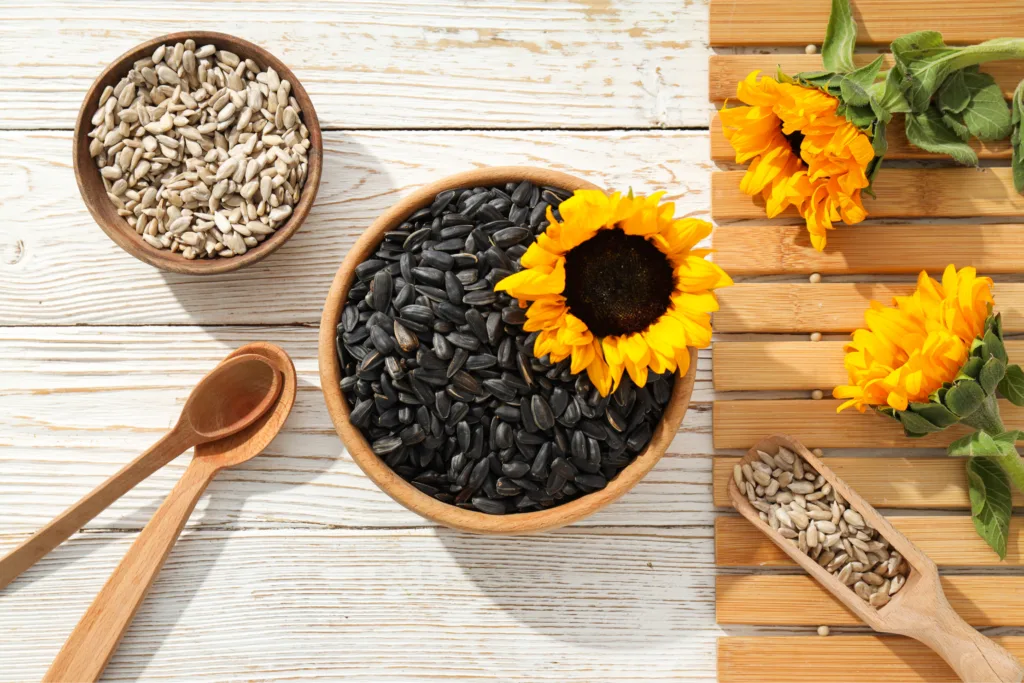
Sunflower seeds are large. ‘Black oil’ sunflower seed, the type used in most studies, weighed 58.3 g per 1,000 seeds, and studies sowed it at 1 seed per cm² (Di Gioia et al., 2023; Poudel et al., 2023) ✅. A Thai study sowed 500 g of seed per m² (Thepsilvisut et al., 2023) ✅. One Danish–Latvian study used a much denser 1,875 g per m² (Mir et al., 2024) ✅.
What this means for you: aim for about 1 seed per cm², which is roughly 500–600 g per m². On a 25 × 50 cm tray, that is about 60–75 g of dry seed ⚠️ (our conversion). Spread the seeds in a single layer so they do not sit on top of each other ⚠️.
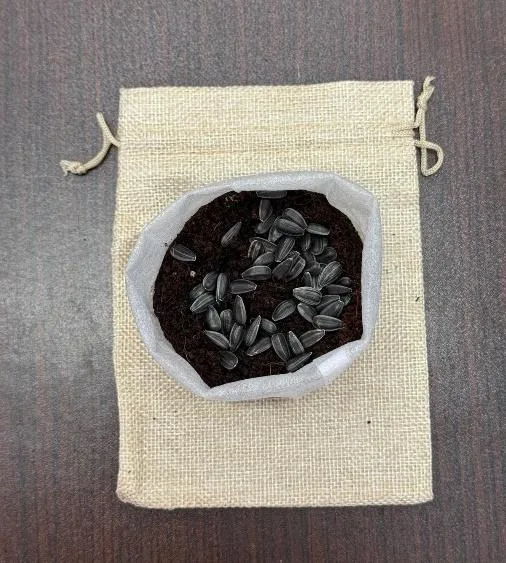
Sunflower seeds are almost always soaked. In the studies, the soaking times were:
Recommendation: soak 6–12 hours in cool water, then drain well ✅. If you soak longer, rinse the seeds once ⚠️.
Studies kept the trays dark for 2–3 days:
Recommendation: 2–3 days ✅. Many growers put a light weight on the lid so the roots grip and the seed shells loosen ⚠️.
After blackout, the studies gave sunflower shoots between about 5 and 8 days of light:
Recommendation: 5–8 days under light ✅.
Sunflower copes with low light. A Danish–Latvian study grew 14 microgreens under a bright LED (209.5 µmol/m²/s) and a dim one (45 µmol/m²/s). Sunflower gave the most fresh biomass under both: 7.22 kg per m² under the bright light and 5.99 kg per m² under the dim one. It also turned light into biomass more efficiently than any other species (Mir et al., 2024) ✅.
Other set-ups that worked: fluorescent daylight tubes for 16 hours a day (Deng et al., 2021; Thepsilvisut et al., 2023), white light for 12 hours (Işık et al., 2026) and 350 µmol/m²/s for 16 hours (Balık et al., 2025) ✅. In a UK vertical-farm study, sunflower grew more where the light had more red compared with far-red (Claydon et al., 2025) ✅.
Recommendation: a white (full-spectrum) LED or fluorescent light for 12–16 hours a day, or a bright window ✅. You do not need a powerful lamp ⚠️.
Studies grew sunflower microgreens between 23 and 25 °C: 23 °C (Balık et al., 2025), about 25 °C (Thepsilvisut et al., 2023; Gupta et al., 2024; Poudel et al., 2023) ✅. A Thai greenhouse study grew them at 30 °C (Boonrat et al., 2025) ✅.
Recommendation: 22–25 °C ✅. Warmer rooms work but make the tray dry out faster ⚠️.
Tip: sunflower seeds are big and wet after soaking, so mould is a risk in still air. Give the tray airflow once it is uncovered ⚠️. Read our guide on how to prevent mould when growing microgreens.
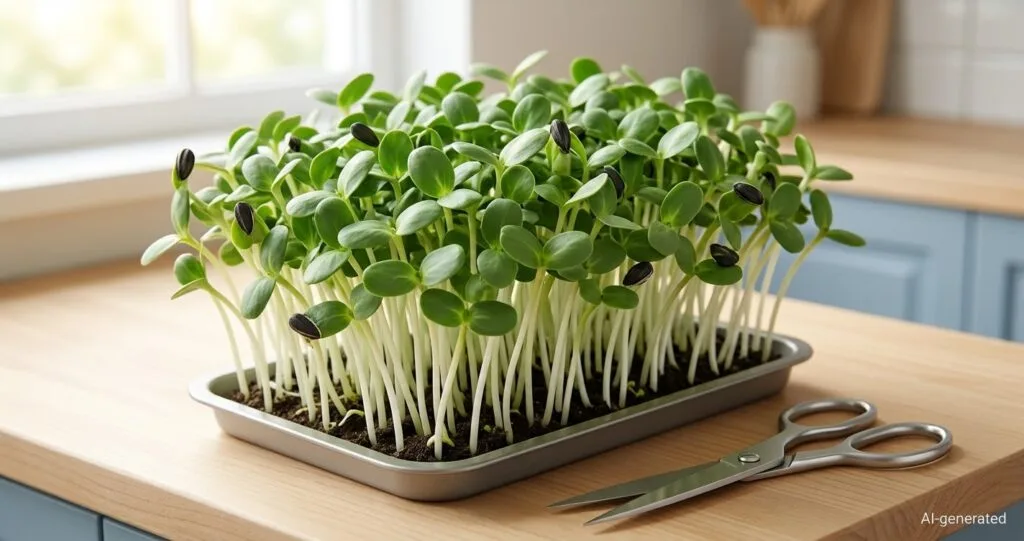
Studies harvested sunflower microgreens between day 7 and day 10 after sowing: day 7 (Gupta et al., 2024), day 9 (Poudel et al., 2023), day 9 ± 1 (Işık et al., 2026) and day 10 (Di Gioia et al., 2023; Deng et al., 2021; Thepsilvisut et al., 2023) ✅.
One Thai study measured the shoots on days 5, 6 and 7. Flavonoids in the leaves were highest on day 5 and then fell, while in the stems they rose (Boonrat et al., 2025) ✅. So a slightly earlier harvest is not a loss.
Recommendation: 8–10 days, when the two seed leaves are open and before the first true leaves grow big ✅ / ⚠️. Many growers find the shoots turn more bitter once true leaves appear ⚠️. Cut about 1 cm above the soil, and pick off any seed shells still stuck to the leaves ⚠️.
Cold matters most. A 2026 study stored sunflower microgreens at 4 °C and 12 °C for 15 days. Samples kept at 4 °C in sealed polypropylene packs kept more moisture, chlorophyll, vitamin C and antioxidants and had fewer microbes (Azarpazhooh et al., 2026) ✅.
Home fridges and packs are not the same as a lab, so about a week in the fridge is a sensible guide ⚠️ (estimate).
How to extend it:
Food safety: why it matters more for sunflower. When germs were added to growing mats on purpose, sunflower shoots picked up far more of them than pea shoots did. Growing on peat led to less transfer than growing on fibre mats (Deng et al., 2021) ✅. In a Thai study, Bacillus cereus bacteria on sunflower shoots stayed within the limit only when they were grown in peat moss or coconut coir, and the authors advise cleaning before eating (Thepsilvisut et al., 2023) ✅. A UV-C light treatment after harvest cut germs a lot, but they grew back partly in the fridge (Işık et al., 2026) ✅.
So: buy seeds sold for sprouting or microgreens, use clean trays and fresh substrate, and rinse before eating ⚠️. More: extending the shelf life of microgreens.
What is in them?
The most common way ⚠️. They are crunchy and nutty, so they work on their own in salads, sandwiches and wraps ⚠️.
⚠️ Estimate: they blend well with banana or apple. We found no smoothie study for sunflower microgreens.
⚠️ Estimate: freezing makes them soft. Use frozen shoots only in smoothies or soups.
✅ Sunflower microgreens have been tested in baking. Dried and powdered, they replaced 4%, 8% or 12% of the flour in gluten-free cakes. The cakes gained protein, fibre, minerals and antioxidants. But the more powder, the darker the cake and the lower the overall liking score (Mansouri et al., 2024). For fresh shoots, a quick stir-fry or adding them at the end is a sensible choice ⚠️.
These recipes are suggestions and have not been tested in a study ⚠️. Under 15? Ask an adult to help with the stove and knife.
Fill a warm pita with grilled chicken or halloumi, tomato and tzatziki. Add a big handful of sunflower shoots for crunch.
Mix cooked lentils with chopped cucumber, red pepper, olive oil, lemon juice and oregano. Top with sunflower shoots just before serving.
Blend 1 cup of sunflower shoots, a handful of basil, 2 tablespoons of grated cheese, a few walnuts, olive oil and a squeeze of lemon. Stir it into warm pasta off the heat.
More ideas: EVEC microgreens cookbook.
Sunflower microgreens give a big harvest. In the 17-species study, they had the heaviest single shoot (390 mg) and one of the highest yields, 1,657 g per m² (Di Gioia et al., 2023) ✅. They grow well even under weak light and contain little nitrate.
That makes them a great crop for a school windowsill, as long as you keep things clean. Compare them with our other guides: radish, broccoli, pea and the beginner sunflower page, or read the studies in the library of 374 microgreens research papers.
Papers 1–11 are open-access papers in the EVEC science library. Paper 12 is an open-access 2026 study outside the library, and paper 13 is the farm survey quoted in the introduction.
This article is part of the free knowledge portal of EVEC Microgreens. Wherever you are on your microgreens journey, there is a path for you:
Co-funded by the European Union.
This portal presents the microgreens methodology; the organisation behind it is EVEC Athens — the European Voluntary and Educational Center (evec.org.gr). Views and opinions expressed are those of the author(s) only and do not necessarily reflect those of the European Union or the European Commission. Neither the European Union nor the granting authority can be held responsible for them.
Open licence. Except where stated otherwise, the educational materials on this portal are licensed under CC BY 4.0 — free to use, adapt and share, including commercially, with credit. See the licence terms.
Accessibility. We aim for WCAG 2.1 AA and publish what does and does not yet meet it — see the accessibility statement. If anything here blocks you, tell us and we will send the material in a format that works for you.