Get in touch
Questions about growing, workshops, the cooperative or partnerships? Send us a message and we will reply by email.
Prefer email? Write to erasmus@evec.org.gr
EVEC Microgreens
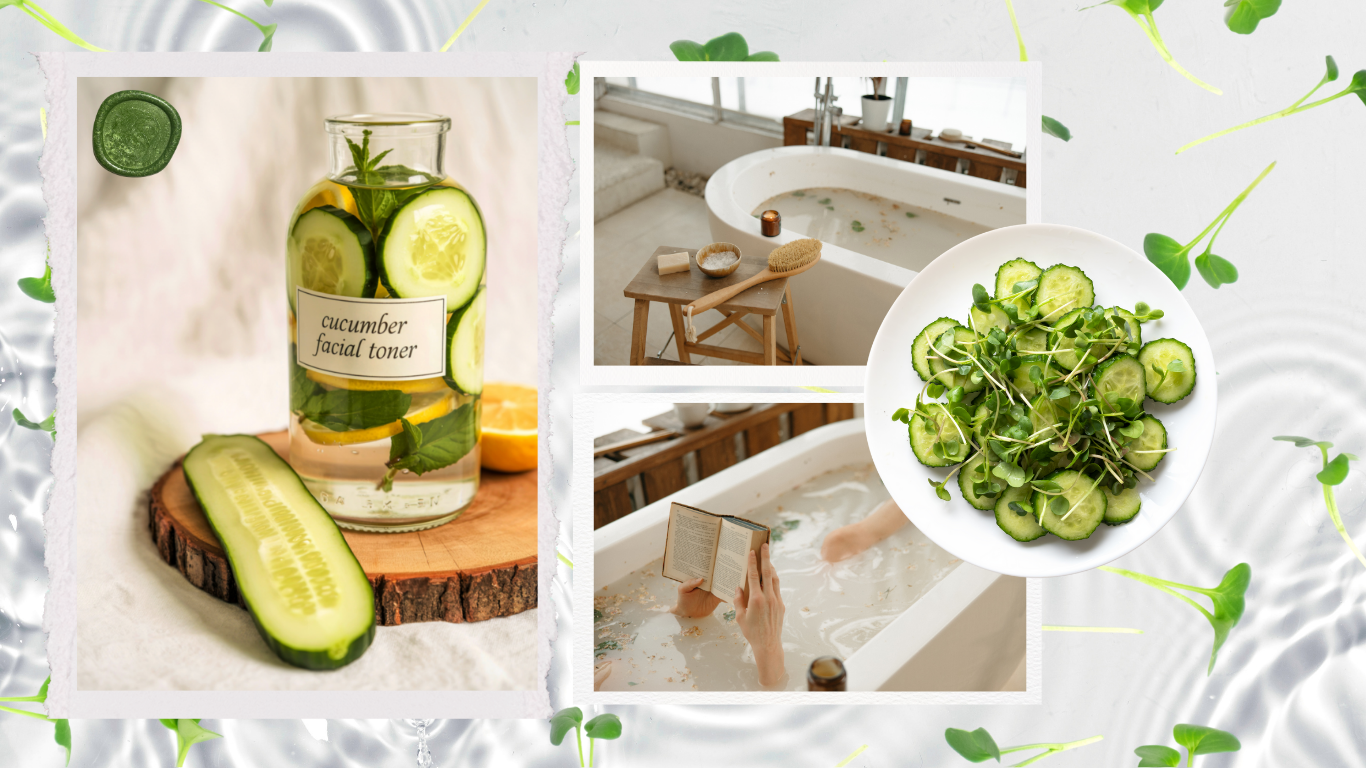
Part 2 of the beauty series: a cucumber microgreen toner and a spinach and green tea toner, plus basil and sunflower bath soaks with Epsom salts or oats.
From your salad to your bathroom shelf. Two more homemade cosmetics you can make from a tray of greens — and, as in Part 1, no promises about what they do to your face.
Part 1 covered masks and smoothies as simple ways to add microgreens to a beauty routine. This part adds two more treatments you can make at home: DIY toners and microgreen baths. Both are easy and cheap to make, and both are pleasant to use. That is the whole of the case for them.
What we corrected in this article. This page used to open by calling microgreens a “glow-up weapon” and these recipes “perfect for glowing, healthy skin”. It also said the toners deliver antioxidants, vitamins and minerals “directly absorbed into your skin”, and described a microgreen bath as a detox. Skin is a barrier, detoxification is the work of your liver and kidneys, and none of those claims had a source behind them. The recipes are unchanged. The same correction has been applied across all four parts of this series.
A toner is a light liquid you wipe or spritz on after cleansing. The industry credits them with balancing skin’s pH and tightening pores; we are not in a position to verify either, so read that as convention rather than as something this page asserts. We used to claim that making them with microgreens delivers antioxidants, vitamins and minerals “directly absorbed into your skin”. That is not how skin works — the outer layer is a barrier, and most nutrients in a blended plant do not cross it. Treat these as pleasant, inexpensive homemade cosmetics rather than as a delivery system for nutrition.
A cooling summer toner. Cucumber and aloe vera are mostly water, so this is a light, pleasant splash after cleansing — that is the whole of the claim.
You’ll need:
How to make:
You may use it during your morning and evening skincare routine after cleansing. Spritz directly onto skin or apply with a cotton pad.
A green tea and honey version of the toner above, made the same way. As Part 1 says, we are not going to tell you spinach suits mature or flaky skin better than any other kind.
You’ll need:
How to make:
Apply it daily with a cotton pad to refresh and hydrate.
If you are tired after a long week, want to pamper yourself a bit, and you got a bath at home, you may want to try a microgreen bath. A microgreen bath is a pleasant, relaxing thing to do. It is not a detox — that job belongs to your liver and kidneys — and warm water does not “open pores” in a way that lets plant nutrients into your body. Enjoy it for what it is.
A fragrant bath soak of basil, Epsom salts and lavender. The warm water and the twenty quiet minutes are the relaxing part.
You’ll need:
How to make:
An oat and coconut oil soak. The oats and the oil are the part you will feel; the greens are along for the ride.
You’ll need:
How to make:
That is four recipes across two parts: face masks and smoothies in Part 1, toners and baths here. All of them are cheap, all of them are made from something you can grow on a windowsill, and none of them is a treatment. The series continues with infused water and a DIY face cream in Part 3, and an exfoliant and a serum in Part 4.
How to Incorporate Microgreens into Your Beauty Routine – Part 1/4
“Eat your skincare: vitamin C, collagen and microgreens”
Green Elegance: DIY Spinach Recipes for Nourished Hair and Glowing Skin
This article is part of the free knowledge portal of EVEC Microgreens. Wherever you are on your microgreens journey, there is a path for you:
Co-funded by the European Union.
This portal presents the microgreens methodology; the organisation behind it is EVEC Athens — the European Voluntary and Educational Center (evec.org.gr). Views and opinions expressed are those of the author(s) only and do not necessarily reflect those of the European Union or the European Commission. Neither the European Union nor the granting authority can be held responsible for them.
Open licence. Except where stated otherwise, the educational materials on this portal are licensed under CC BY 4.0 — free to use, adapt and share, including commercially, with credit. See the licence terms.
Accessibility. We aim for WCAG 2.1 AA and publish what does and does not yet meet it — see the accessibility statement. If anything here blocks you, tell us and we will send the material in a format that works for you.


[…] How to Incorporate Microgreens into Your Beauty Routine: Microgreens Toner and Baths – Part 2/4 […]
[…] How to Incorporate Microgreens into Your Beauty Routine: Microgreens Toner and Baths – Part 2/4 […]