Get in touch
Questions about growing, workshops, the cooperative or partnerships? Send us a message and we will reply by email.
Prefer email? Write to erasmus@evec.org.gr

EVEC Microgreens
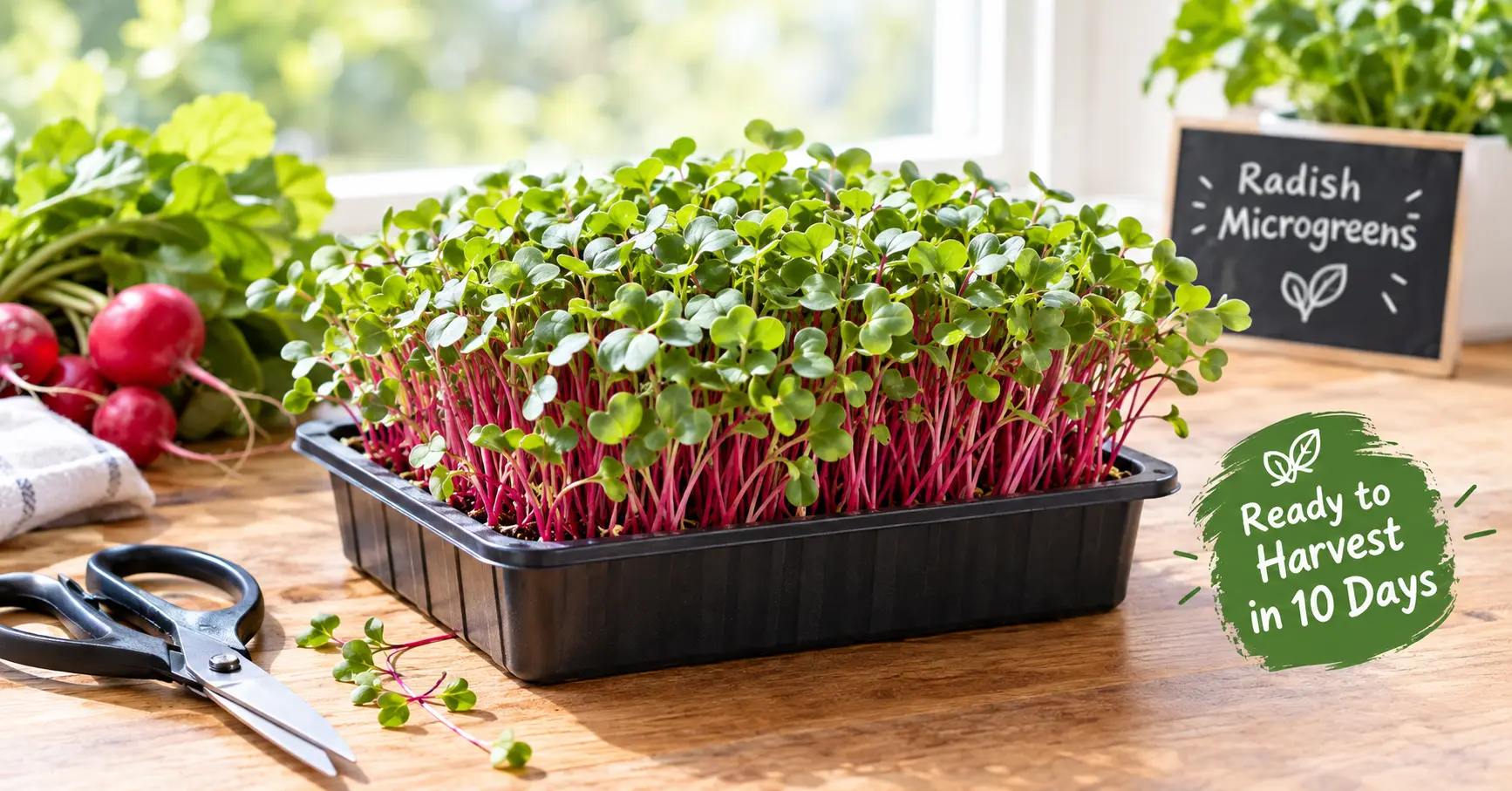
Radish microgreens growing conditions, checked one by one against open-access studies: seed density, soaking, blackout, light, temperature, humidity, harvest day and storage. Every value is marked as measured by a study or estimated.
Radish microgreens are the sprinter of the microgreen world. Sow them on Monday, and you can be eating them the following week.
They are also one of the most studied microgreens there is. Our science library holds more than 60 research papers that mention radish microgreens. So instead of guessing, this guide takes the radish microgreens growing conditions one step at a time and checks each one against what scientists actually measured.
Every value below carries a label. ✅ means a study measured it. ⚠️ means it is an estimate: common grower practice or our own reasoning. You will always know which is which.
| Step | Value | Evidence |
|---|---|---|
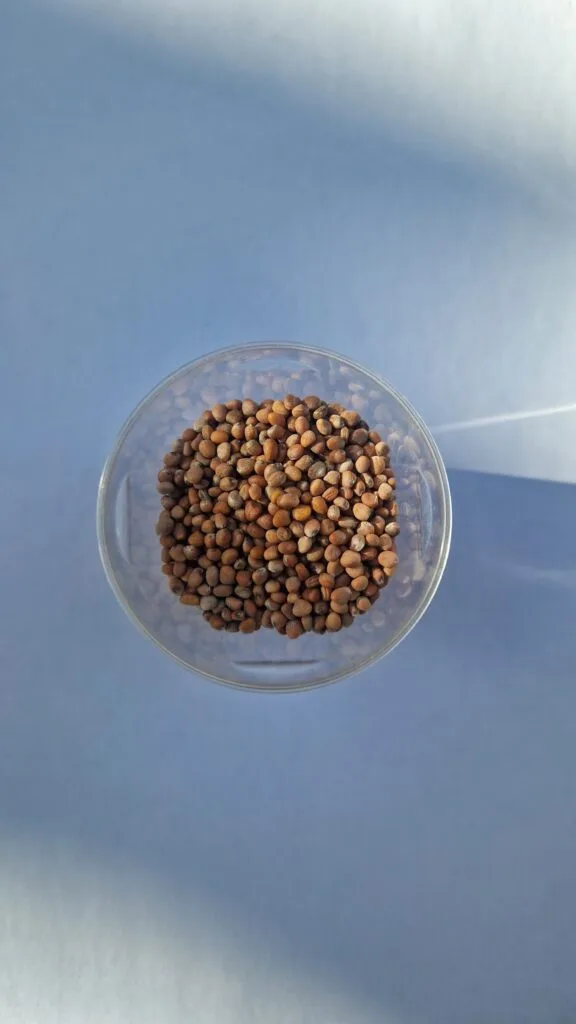
| Seeding density | About 170–220 g of seed per m² (about 2–2.6 seeds per cm²). Around 22–27 g for a standard 25 × 50 cm tray | ✅ |
| Soaking time | Optional. Studies used 24 h; 6–12 h is common home practice | ✅ / ⚠️ |
| Blackout period | 2–4 days (3 is most common) | ✅ |
| Growing under light | 5–7 days | ✅ |
| Best light | LED, blue + red (or white with red); about 100 µmol/m²/s for 16 h a day | ✅ |
| Ideal temperature | 20–25 °C for germination; 20–24 °C while growing | ✅ |
| Ideal humidity | 90–95% in blackout; 60–70% under light | ✅ |
| Total days to harvest | 7–10 days (day 10 gave the best yield in one study) | ✅ |
| Shelf life | About 8 days at 4–5 °C in a perforated container | ✅ |
| Best way to eat | Raw, or added at the very end of cooking | ⚠️ / ⚠️ |
This is where beginners usually go wrong. Too few seeds gives a thin, floppy tray. Too many gives a damp mat where mould loves to grow.
The good news: several studies landed on almost the same number. A US Department of Agriculture team sowed radish at about 26,000 seeds per m² (Ortiz et al., 2024). With their seeds weighing 8.13 g per 1,000, that works out to roughly 211 g per m².
A Croatian study used 2.5 g in a 13 × 10 cm container, which is about 190 g per m² (Mlinarić et al., 2023). A Korean team used 10 g on a 20 × 30 cm tray, about 167 g per m² (Tilahun et al., 2024). Two US studies sowed 2 seeds per cm² (Poudel et al., 2023; Jauregui et al., 2025).
What this means for you: aim for about 170–220 g of seed per m² ✅. For a standard 25 × 50 cm tray, that is roughly 22–27 g ⚠️ (our own conversion). Radish seeds vary in size, so weigh them if you can.
Does sowing thicker pay off? A Danish study found that a high seeding density produced 37% more harvest from the same space (Cowden et al., 2024) ✅. Just remember that a thicker tray needs more airflow.
Soaking wakes the seed up by letting it drink water before it touches the soil.
Most radish studies in our library soaked the seeds for 24 hours in tap or distilled water before sowing (Mlinarić et al., 2023; Tilahun et al., 2023; Dhaka et al., 2023; Garegnani et al., 2024) ✅.
But soaking is not essential. The USDA harvest study and a US drying study describe no soaking step, and both still grew healthy trays (Ortiz et al., 2024; Jauregui et al., 2025) ✅.
Our advice: soaking is optional for radish. If you do soak, 6–12 hours is a common home practice ⚠️ (estimate — no study compared soaking times for radish). Drain the seeds well before sowing so they do not sit in a puddle.
“Blackout” means covering the tray so no light gets in. In the dark, seedlings stretch upward looking for light, which gives longer, straighter stems.
Studies kept radish in the dark for between 2 and 4 days:
Recommendation: 2–4 days, with 3 days a safe middle ✅. Lift the cover once the seedlings are pushing up against it.
Once uncovered, the seedlings turn green and open their first leaves, called cotyledons.
If you subtract the blackout days from the harvest day, the radish studies gave their plants between 4 and 8 days of light. Most gave about 5–6 days (Bantis, 2021; Garegnani et al., 2024; Ortiz et al., 2024; Tilahun et al., 2024) ✅.
Recommendation: 5–7 days under light ✅.
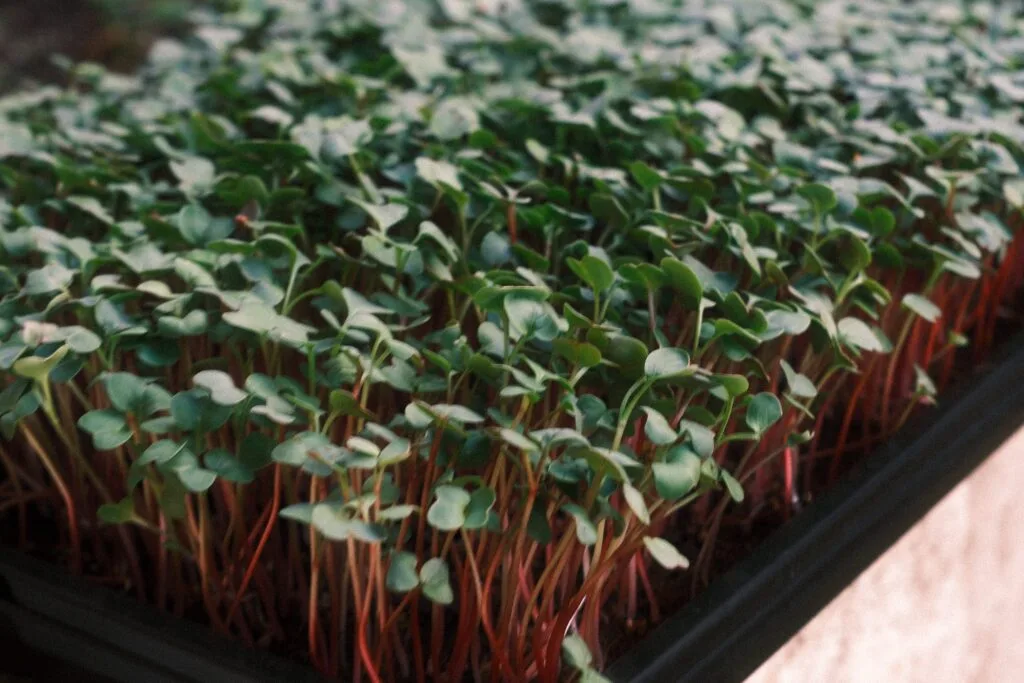
Light is the most researched part of growing radish microgreens, and the findings are useful.
Colour of light. Blue and red LEDs come up again and again. A Croatian study found that a blue + red mix boosted most healthy plant compounds compared with white light (Mlinarić et al., 2023) ✅. In Portugal, a red + blue combination raised the purple anthocyanin pigments in the ‘Red Rambo’ variety (Silva et al., 2025) ✅. An Italian space-farming study got the most growth with 40% blue, 20% green and 40% red (Garegnani et al., 2024) ✅.
Brightness. A Russian study compared three light levels. 100 µmol/m²/s gave the highest yield. Doubling the light to 200 made the plants shorter and raised electricity use per kilo by 157% (Vetchinnikov et al., 2021) ✅. A second study recommended 100 µmol/m²/s for 16 hours a day as the best balance of yield and cost (Filatov & Olonin, 2023) ✅.
Hours per day. Most studies used 16 hours on and 8 hours off. Leaving the lights on for 24 hours increased radish weight with no leaf damage (Shibaeva et al., 2022) ✅, but it also uses more electricity.
Recommendation: a full-spectrum or blue + red LED grow light, about 100 µmol/m²/s, 16 hours a day ✅. A sunny windowsill also works, though your stems may lean towards the glass ⚠️.
An Italian study tested radish seeds at eight temperatures from 5 to 35 °C. Germination was best at 20–25 °C (Toscano et al., 2025) ✅. An Indian study found red radish germinated best at 26 °C (Dhaka et al., 2023) ✅.
While growing, studies kept their radish between 20 and 25 °C (Tilahun et al., 2024; Bantis, 2021; Mlinarić et al., 2023; Ortiz et al., 2024) ✅.
Recommendation: 20–25 °C to germinate, then 20–24 °C to grow ✅. A normal room in spring or autumn is ideal.
Humidity is the amount of water vapour in the air. Seeds want it high at the start and lower later.
Tip: once the cover comes off, give the tray some moving air, such as a small fan or an open window ⚠️. That is your best defence against mould. Read our guide on how to prevent mould when growing microgreens.
Radish is ready when the cotyledons are fully open, usually just as the first “true” leaf appears.
The clearest answer comes from the USDA study. Their radish showed its first true leaf on day 7. Harvesting on day 10 gave the highest yield and chlorophyll, about 20% more than earlier harvests. Those day-10 microgreens also showed less decay in the fridge (Ortiz et al., 2024) ✅.
Other studies harvested on day 7 (Mlinarić et al., 2023), day 8 (Dhaka et al., 2023; Garegnani et al., 2024) or day 10 (Tilahun et al., 2024) ✅.
Recommendation: 7–10 days from sowing ✅. Cut with clean scissors just above the soil.
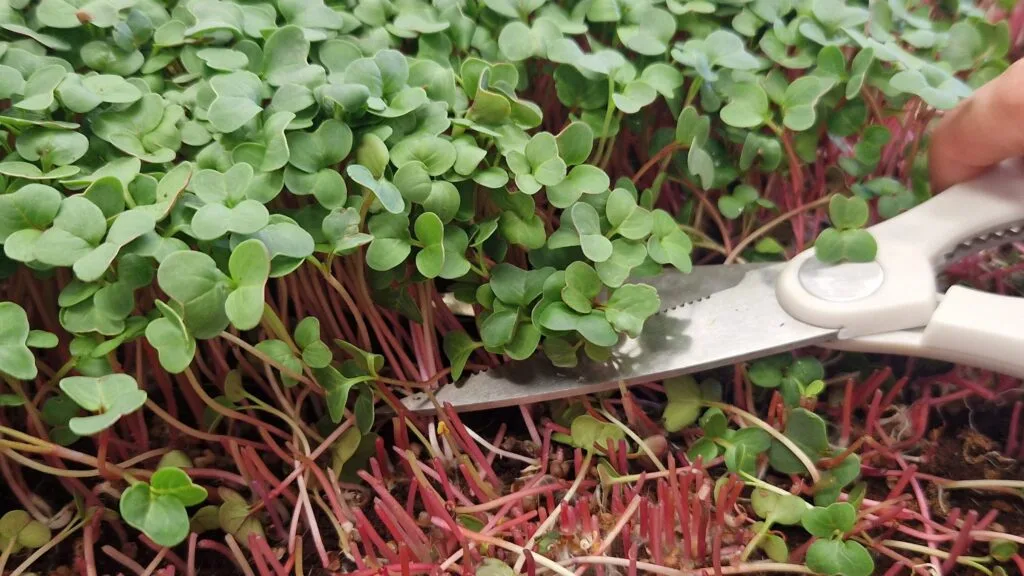
Freshly cut microgreens keep breathing, and that uses up their energy. Cold slows this down.
How long they last: an Indian study stored radish microgreens at 5 °C in perforated packaging. They stayed sellable for 8 days, whether in a rigid plastic clamshell or a plastic bag. The clamshell did better on weight loss and microbes (Ghoora & Srividya, 2020) ✅.
How to extend it:
A safety note: germs can pass to microgreens from dirty seeds, water or soil. A 2026 study found that UV-C light reduced these germs but could not remove them completely (Işık et al., 2026) ✅. Prevention matters most: buy seeds sold for sprouting or microgreens, wash your trays, and use clean water ⚠️. More tips: extending the shelf life of microgreens.
First, an honest warning: radish microgreens are spicy. The heat comes from sulphur-containing compounds, the same family behind mustard and wasabi (Cano-Lamadrid et al., 2023) ✅. In a Malaysian taste test, secondary school students gave red radish one of the lowest acceptability scores of five microgreens. It also stood out for its heat and astringency (Rozali & Rahim, 2024) ✅.
So the trick is to pair them with something mild, creamy or fresh.
Why bother? A Polish study found radish microgreens were a better source of soluble fibre, organic acids and minerals than the radish root (Kajszczak et al., 2025) ✅. The ‘Red Rambo’ variety provided 155–188 mg of polyphenols per 100 g (Silva et al., 2025) ✅.
The best option ⚠️. Heat damages vitamin C. When radish microgreens were dried with hot air, vitamin C fell by up to 63% (Jauregui et al., 2025). Raw keeps the most.
This works well with dairy ✅. An Indian team blended radish microgreen juice into lassi, a yogurt drink, and reached an acceptability score of 8.29 out of 9. At higher amounts, though, the pungency took over (Gunjal et al., 2025).
⚠️ Estimate: we found no study in our library on freezing radish microgreens at home. Freezing will make the leaves limp, so use frozen ones only in smoothies or hot dishes, not salads. Freeze them flat in a sealed bag and use them within a few weeks.
⚠️ Estimate: add them at the very end, on top of soup, eggs or pasta, rather than cooking them. This follows from the vitamin C losses with heat above.
✅ A 2025 study found hot-air drying is an effective way to preserve radish microgreens. Some vitamins dropped, but vitamins B1 and B9 stayed stable (Jauregui et al., 2025).
These are our own kitchen suggestions, not tested in a study ⚠️. Under 15? Ask an adult to help with the blender and knife.
Mix 200 g Greek yogurt, half a grated cucumber (squeezed dry), 1 small garlic clove, a splash of olive oil and a pinch of salt. Stir in a big handful of chopped radish microgreens. The yogurt softens the heat. Great with pita or grilled vegetables.
Inspired by the lassi study. Blend 150 g plain yogurt, 50 ml cold water, 1 teaspoon honey and 1 tablespoon of radish microgreens. Taste, then add a little more if you like the kick. Drink the same day.
Mash half an avocado onto toast with lemon juice and salt. Pile on radish microgreens just before eating. The creamy avocado balances the pepper.
Find more ideas in the EVEC microgreens cookbook.
Radish microgreens prove you do not need a garden, a big budget or a lot of time to grow real food. A tray, a window or a lamp, and ten days are enough.
Growing them the research-backed way also means less wasted seed, fewer mouldy trays and greens that last longer in the fridge. Ready to start? Follow our hands-on step-by-step radish microgreens guide or our free grow at home course, compare other crops in the varieties database, or read the original studies in our library of 374 microgreens research papers.
All are open-access papers in the EVEC science library.
This article is part of the free knowledge portal of EVEC Microgreens. Wherever you are on your microgreens journey, there is a path for you:
Co-funded by the European Union.
This portal presents the microgreens methodology; the organisation behind it is EVEC Athens — the European Voluntary and Educational Center (evec.org.gr). Views and opinions expressed are those of the author(s) only and do not necessarily reflect those of the European Union or the European Commission. Neither the European Union nor the granting authority can be held responsible for them.
Open licence. Except where stated otherwise, the educational materials on this portal are licensed under CC BY 4.0 — free to use, adapt and share, including commercially, with credit. See the licence terms.
Accessibility. We aim for WCAG 2.1 AA and publish what does and does not yet meet it — see the accessibility statement. If anything here blocks you, tell us and we will send the material in a format that works for you.