Get in touch
Questions about growing, workshops, the cooperative or partnerships? Send us a message and we will reply by email.
Prefer email? Write to erasmus@evec.org.gr
EVEC Microgreens
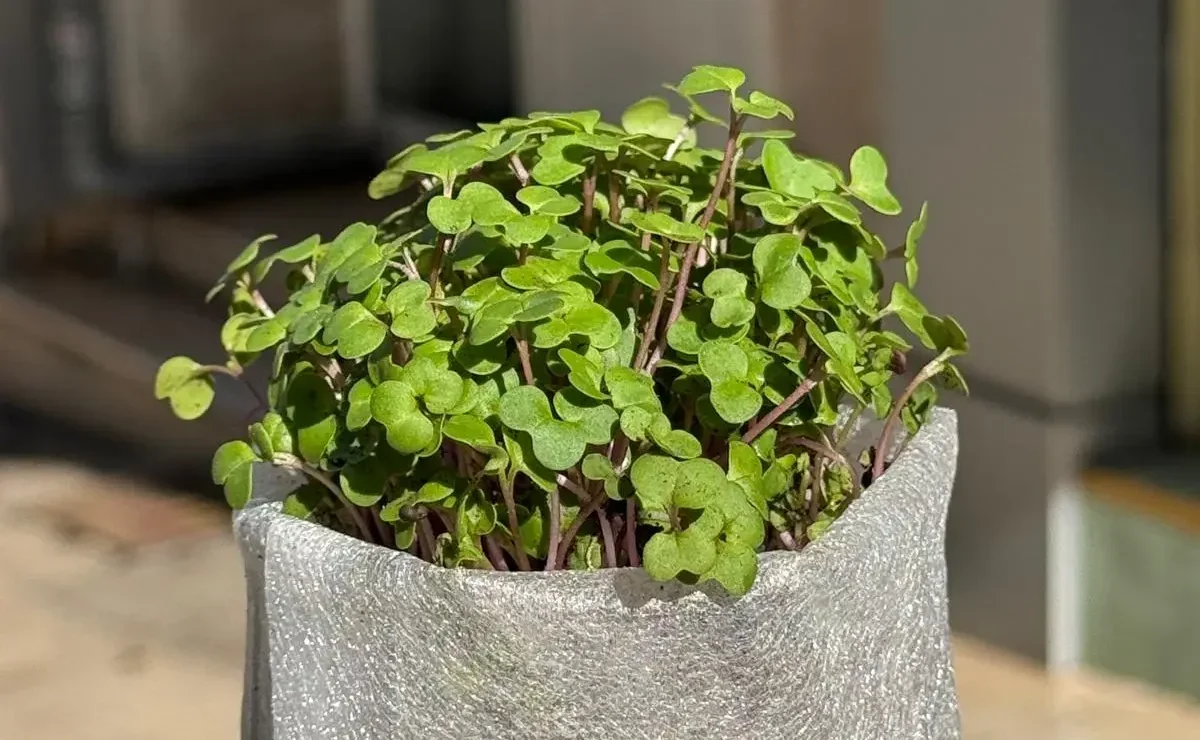
Broccoli microgreens growing conditions, checked one by one against 16 open-access studies: seed density, soaking, blackout, light, temperature, humidity, harvest day and storage. Every value is marked as measured by a study or estimated.
Broccoli microgreens are probably the most famous microgreen in the world, mostly because of one compound: sulforaphane. But how do you actually grow a good tray? This guide answers that question one step at a time, checking the broccoli microgreens growing conditions (seed, water, light, temperature, humidity and timing) against the research in the EVEC science library.
Every value carries a label. ✅ means a study measured it. ⚠️ means it is an estimate. That way you always know how sure we are.
| Step | Value | Evidence |
|---|---|---|
| Seeding density | About 100–210 g of seed per m² (3–6.6 seeds per cm²). Around 15–25 g for a 25 × 50 cm tray | ✅ / ⚠️ tray conversion |
| Soaking time | Not needed. One study found soaking lowered yield | ✅ |
| Blackout period | 2–4 days | ✅ |
| Growing under light | 4–9 days (most often 4–6) | ✅ |
| Best light | White or red + blue LED, about 50–100 µmol/m²/s, 16 h a day. Avoid blue only | ✅ |
| Ideal temperature | 20–25 °C | ✅ |
| Ideal humidity | 90–95% in blackout; 50–70% under light | ✅ |
| Total days to harvest | 8–13 days (day 13 gave the best yield in one study) | ✅ |
| Shelf life | About 8–10 days at 4–5 °C | ✅ |
| Best way to eat | Raw and well chewed, or added at the end of cooking | ⚠️ / ⚠️ |
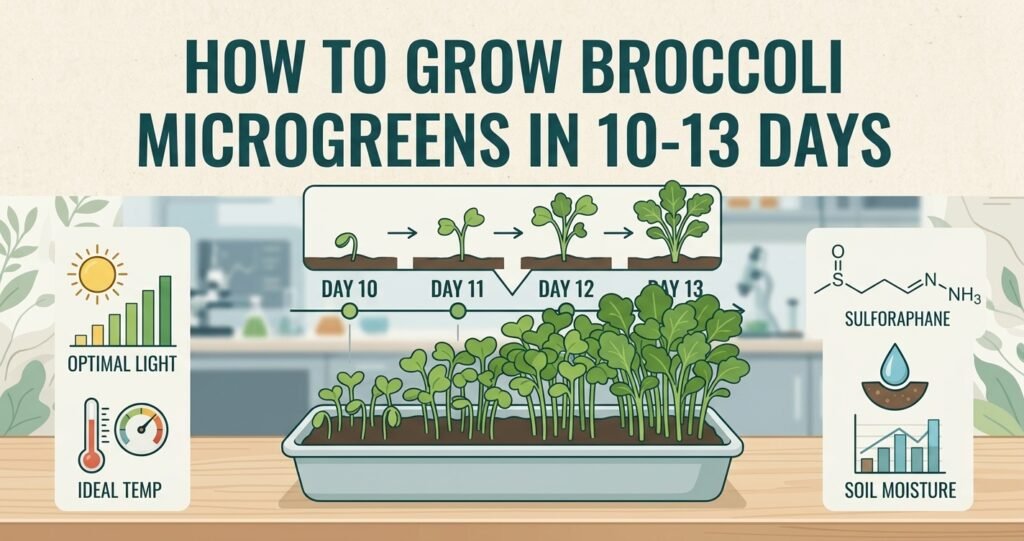
Broccoli seeds are small: about 3.15 g per 1,000 seeds in a US Department of Agriculture study (Ortiz et al., 2024). That team sowed about 66,000 seeds per m², which works out to roughly 208 g per m² ✅.
Other studies sowed less. Two Italian teams used 4 seeds per cm² (Paradiso et al., 2018; Palmitessa et al., 2022), and a Chinese team used 3 seeds per cm² (Gao et al., 2021a) ✅. By weight, a Croatian study used 10 g on a 0.085 m² tray, about 117 g per m² (Vrkić et al., 2024). A US study followed the seed supplier’s rate of 98.3 g per m² (Li T. et al., 2023) ✅.
What this means for you: aim for about 100–210 g per m² ✅. On a standard 25 × 50 cm tray, that is roughly 15–25 g of seed ⚠️ (our conversion). Start in the middle, at about 20 g. Seeds packed too densely stay wet, and mould likes that.
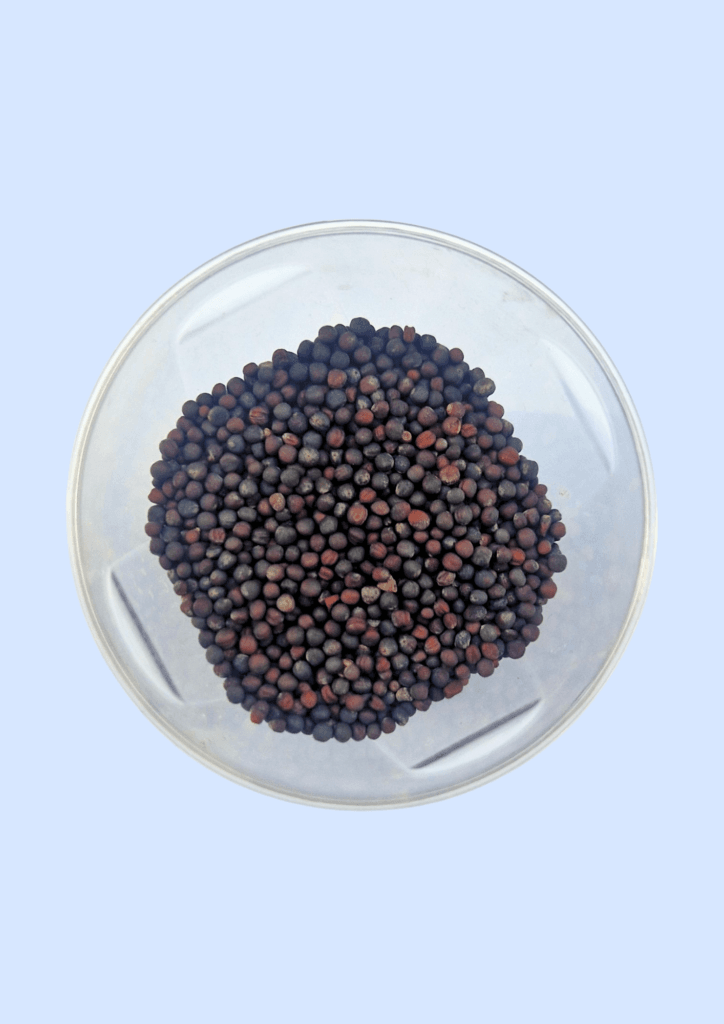
Many growers soak seeds out of habit. For broccoli, the research says you can skip it.
A US greenhouse study tested ten microgreen species, broccoli among them, with and without a 6-hour soak. When soaking made a difference, it lowered fresh or dry weight and mineral content. Averaged over the ten species in one round, soaked trays gave 875 g of fresh greens per m², against 1,001 g for unsoaked trays (Li et al., 2021) ✅. The authors advise weighing any faster germination against this loss.
Studies that did soak broccoli used only 3–6 hours (Tallei et al., 2024 and 2025; Gao et al., 2021a and 2021b) ✅. The Croatian and USDA studies sowed seeds without soaking (Vrkić et al., 2024; Ortiz et al., 2024) ✅.
Recommendation: sow broccoli seeds dry ✅. If you want to soak, keep it short (3–6 hours) and drain well.
“Blackout” means covering the tray so no light gets in. Seedlings stretch up in the dark, which gives you taller, straighter stems.
Recommendation: 2–4 days ✅. Uncover the tray when most seeds have sprouted and the seedlings start pushing up.
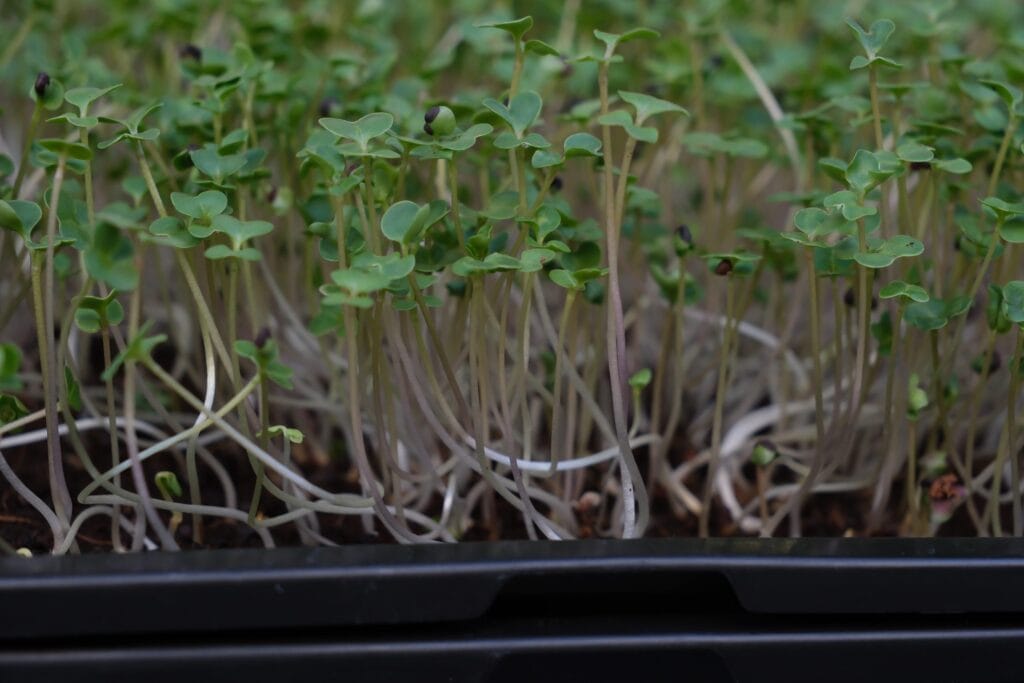
If you subtract the dark days from the harvest day, broccoli studies gave their plants 4 to 9 days of light, most often 4–6 days (Gao et al., 2021a and 2021b; Lu et al., 2021; Li Y. et al., 2023; Ortiz et al., 2024) ✅.
Recommendation: 5–7 days under light for a home tray ✅. Wait longer (see section 8) if you want the biggest harvest.
Brightness. Broccoli does not need very strong light. A Chinese study found the highest fresh weight at 50 µmol/m²/s, while 70 µmol/m²/s gave more vitamin C and glucosinolates (Gao et al., 2021a) ✅. A USDA study found the highest fresh weight at 50–100 µmol/m²/s. Lower light raised vitamin C and phenolics, while stronger light gave more chlorophyll and colour (Shahkoomahally et al., 2025) ✅.
Colour. Avoid blue-only light. In an Italian study, pure blue light lowered yield by 13.5% and polyphenols by 14.2% (Palmitessa et al., 2022) ✅. Adding a little far-red light under low light made plants taller and heavier, but lowered total phenolics (Shahkoomahally et al., 2025) ✅.
Hours per day. Most studies used 16 hours of light. Leaving lights on 24 hours raised broccoli weight with no leaf damage (Shibaeva et al., 2022) ✅, but it costs more electricity.
Recommendation: a white or red + blue LED grow light, about 50–100 µmol/m²/s, 16 hours a day ✅. A bright windowsill works too ⚠️. In the Italian study, broccoli in a greenhouse with more natural light yielded 18% more than in a growth chamber (Palmitessa et al., 2022).
Broccoli studies grew their microgreens between 20 and 25 °C. Examples: 20 °C (Paradiso et al., 2018), 21 °C by day and 17 °C by night (Samuolienė et al., 2019), 22 °C (Gao et al., 2021b) and 25 °C (Vrkić et al., 2024; Ortiz et al., 2024) ✅.
Recommendation: 20–25 °C ✅. A normal indoor room is ideal. Avoid hot windowsills in summer ⚠️.
Tip: once the cover is off, give the tray moving air ⚠️. Water from below rather than over the leaves ⚠️. Read more on how to prevent mould when growing microgreens.
Studies harvested broccoli between day 7 and day 13 after sowing ✅. The most useful answer comes from the USDA study. Its broccoli showed the first true leaf on day 10. Harvesting on day 13 gave the highest yield and chlorophyll, about 20% more than earlier cuts, and those microgreens decayed less in the fridge (Ortiz et al., 2024) ✅.
Recommendation: 8–10 days for tender greens, or 12–13 days for the biggest harvest ✅. Cut just above the soil with clean scissors.
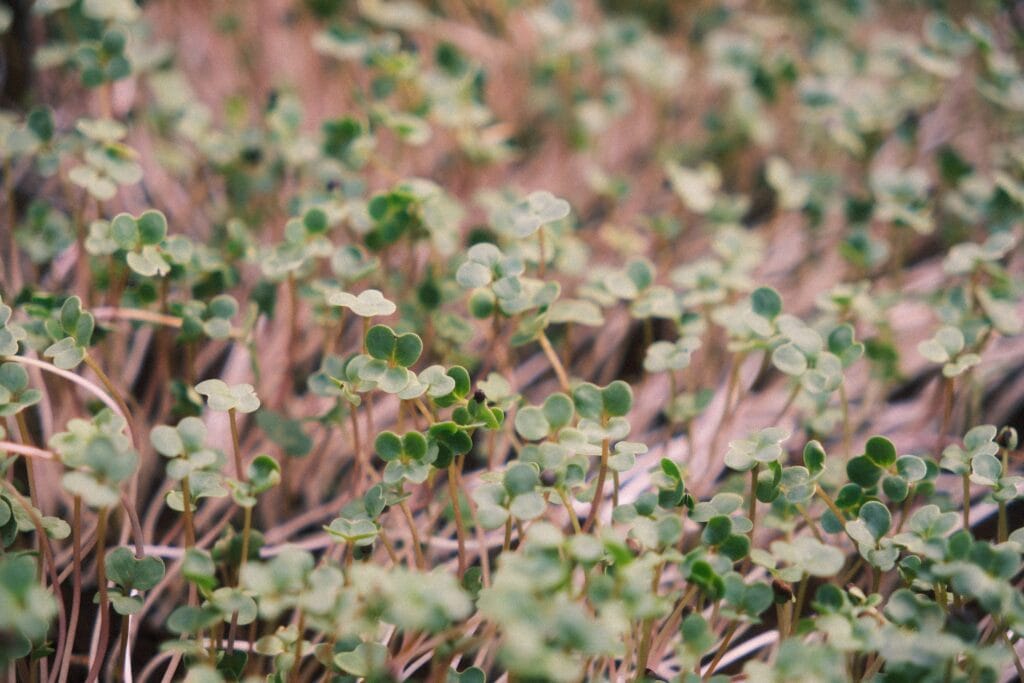
Broccoli microgreens are delicate. An Italian study of packaged microgreens found a shelf life of no more than ten days at 5 °C. Broccoli was the first to lose sensory quality, because it breathes faster and grew more mould (Paradiso et al., 2018) ✅.
How to extend it:
More tips: extending the shelf life of microgreens.
Why sulforaphane matters for how you eat them. Broccoli microgreens contain glucoraphanin. When the plant is chopped or chewed, an enzyme called myrosinase turns it into sulforaphane (Le et al., 2020) ✅. In a small US study, 11 healthy adults ate one serving of fresh broccoli microgreens. Sulforaphane products then showed up in their urine, at levels similar to those seen in broccoli sprout studies (Bouranis et al., 2023) ✅. The study measured how much sulforaphane people absorbed, not health effects.
The best option ⚠️. Raw and well chewed keeps the enzyme working.
✅ Blending crushes the cells. When broccoli microgreens were cold-pressed into juice, the glucosinolates had turned into isothiocyanates, the sulforaphane family (Belošević et al., 2024). The juice tasted bitter and “grassy”, though, so mix it with fruit or yogurt ⚠️.
⚠️ Estimate: we found no study in the library on freezing broccoli microgreens at home. Frozen leaves turn limp, so use them only in smoothies or hot dishes.
⚠️ Estimate: add them at the very end, on top of soup, eggs or pasta. Strong heat can switch off the myrosinase enzyme. We did not find a study in the library that compared raw and cooked broccoli microgreens, so this is reasoning, not a measured result.
✅ The results are mixed. One study found air-fryer-dried broccoli microgreens had the highest antioxidant activity in a lab test, and microwave-dried ones the lowest (Tallei et al., 2025). A second study by the same team found that fresh microgreens came out best overall (Tallei et al., 2024). Fresh is the safe choice.
Fresh matters. In a taste study with 150 people, broccoli microgreens from a local farm scored better than a supermarket sample, whether they were grown in soil or water (Chen et al., 2020) ✅.
These recipes are suggestions and have not been tested in a study ⚠️. Under 15? Ask an adult to help with the blender and the stove.
Blend 2 big handfuls of broccoli microgreens, 30 g walnuts or almonds, 30 g grated hard cheese, 1 small garlic clove, the juice of half a lemon and 4 tablespoons of olive oil. Stir it into pasta after you drain it, off the heat.
Spread hummus on a wrap, then add grated carrot, cucumber sticks and a thick layer of broccoli microgreens. Roll it up tightly. Good for a school lunchbox. Keep it cold.
Blend 1 banana, a handful of frozen berries, 150 g yogurt and a small handful of broccoli microgreens. The fruit hides the grassy taste.
More ideas: EVEC microgreens cookbook.
A tray of broccoli microgreens uses very few resources. One study estimated that broccoli microgreens need 158–236 times less water than a nutritionally equivalent amount of mature broccoli grown in California’s Central Valley, and 93–95% less time (Weber, 2017) ✅.
A tray, a lamp or a window, and under two weeks are enough. Ready to compare with other crops? See the radish guide, the beginner broccoli page, the varieties database, or read the studies themselves in the library of 374 microgreens research papers.
All are open-access papers in the EVEC science library.
This article is part of the free knowledge portal of EVEC Microgreens. Wherever you are on your microgreens journey, there is a path for you:
Co-funded by the European Union.
This portal presents the microgreens methodology; the organisation behind it is EVEC Athens — the European Voluntary and Educational Center (evec.org.gr). Views and opinions expressed are those of the author(s) only and do not necessarily reflect those of the European Union or the European Commission. Neither the European Union nor the granting authority can be held responsible for them.
Open licence. Except where stated otherwise, the educational materials on this portal are licensed under CC BY 4.0 — free to use, adapt and share, including commercially, with credit. See the licence terms.
Accessibility. We aim for WCAG 2.1 AA and publish what does and does not yet meet it — see the accessibility statement. If anything here blocks you, tell us and we will send the material in a format that works for you.