Get in touch
Questions about growing, workshops, the cooperative or partnerships? Send us a message and we will reply by email.
Prefer email? Write to erasmus@evec.org.gr

EVEC Microgreens

Researchers have cold-pressed broccoli, red beet and amaranth microgreens into juice. Here is what they measured, how it tasted, and what no study has tested yet.
You have probably seen microgreens sprinkled on top of a soup or a salad. A pinch here, a pinch there. But what if you could drink them instead?
That is exactly what food scientists have been testing. Microgreen juice is now a real research subject, and the results are more interesting — and more honest — than the usual “superfood” headlines suggest. Here are five things the studies actually found.
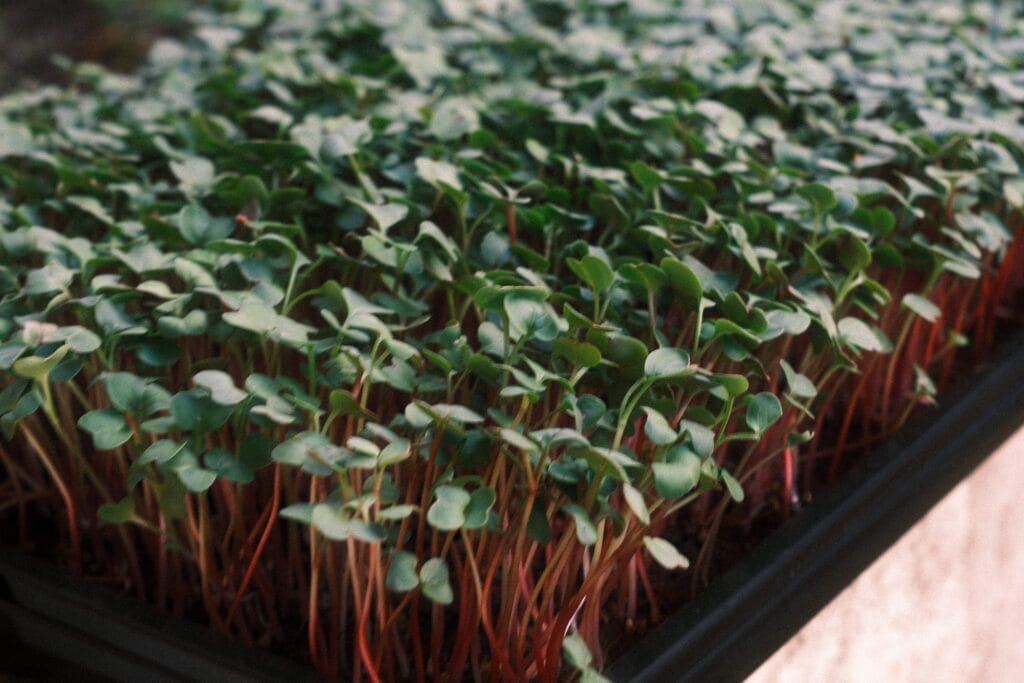
Microgreens are baby vegetable plants, harvested when they are only a few centimetres tall. Microgreen juice is simply what comes out when you press them.
Researchers usually use a cold press. That means squeezing the plants slowly, without heating them, so delicate compounds have a better chance of surviving.
In 2024, a team at the University of Belgrade pressed three kinds of microgreens — broccoli, red beet and amaranth — and studied what happened. Their paper in the journal Foods is the most detailed look at microgreen juice so far, and it gives us most of our answers.
Microgreens are tiny and delicate, so you might assume pressing them gives you a few sad drops.
Not so. The Belgrade team measured microgreen juice yields of 70.2% for broccoli, 62.0% for red beet and 53.4% for amaranth. In other words, pressing 100 grams of broccoli microgreens gave about 70 grams of juice. The researchers themselves described this as a very high yield for mechanical pressing.
The juice is also extremely light. It was more than 98% water, with a mild acidity (pH 5.96 to 6.52) and very little sugar — between 1.8 and 2.0 degrees Brix. That combination puts microgreen juice firmly in the low-calorie drink category.
So the practical answer is: yes, juicing microgreens works, and it is not wasteful.
Here is the part the marketing usually skips.
The researchers found that the microgreen juices still contained a high content of phenolic compounds — the plant chemicals linked to antioxidant activity — but significantly less than in the microgreens they started with.
Think of it like squeezing a sponge. A lot comes out. Not everything does. Some helpful compounds stay locked in the pulp and fibre you throw away.
This is a useful reality check. Drinking microgreen juice is not the same as eating the same weight of microgreens. If you want everything the plant has to offer, eating them whole is still the most complete option.
Broccoli microgreens are known for glucosinolates, the compounds behind broccoli’s reputation as a health food.
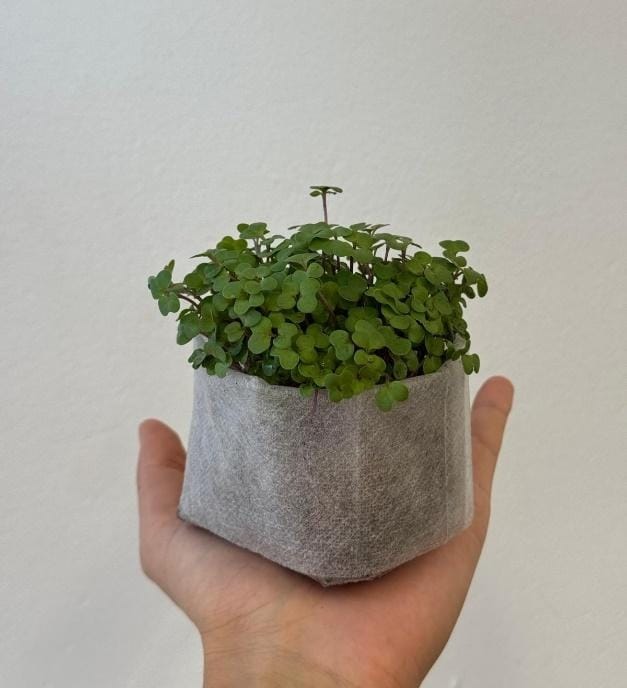
When the team analysed broccoli microgreen juice, the glucosinolates had vanished. But they had not simply been destroyed — they had been degraded into isothiocyanates, a related family of compounds.
This happens because crushing plant tissue releases an enzyme called myrosinase, which converts glucosinolates the moment the cells break open. The same thing happens in your mouth when you chew.
So the compounds transformed rather than disappeared. It is a good reminder that food chemistry is rarely a simple matter of “keeps it” or “loses it.”
This is where the research gets refreshingly blunt.
A trained panel scored the juices on a 9-point scale. Overall acceptability landed between 5.0 — “neither like nor dislike” — and 6.4, “slightly like.” Those are modest scores.
Taste scored worse still, from 4.0 for broccoli juice down to 2.9 for red beet juice. Panellists criticised the amaranth and red beet juices for a slight astringency and an earthy, stale flavour. Broccoli juice was described as herbaceous, grassy and sulfurous, and it received the lowest overall rating, with testers pointing to its bitter, astringent taste.
Appearance was a different story. Amaranth and red beet juices scored well thanks to their light purple and red colour, while broccoli juice lost points for being cloudy and separating quickly.
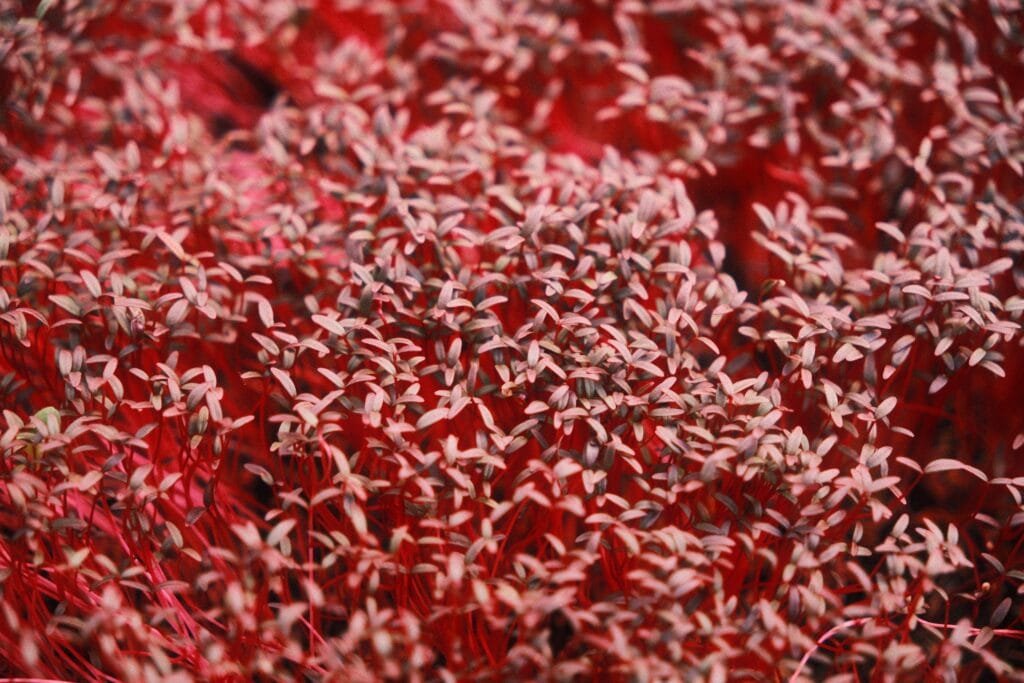
This matches a larger 2020 study of 12 microgreen species, which found that consumer acceptance was driven mainly by flavour and texture — and that the lower the astringency, sourness and bitterness, the higher the acceptability.
Put simply: microgreen juice is nutritious and nobody much wants to drink it plain.
In 2025, a team published a study in Food Chemistry X that took the obvious next step: stop drinking it straight.
They blended radish sango microgreen juice into lassi, a traditional yogurt drink. After testing many combinations, the best recipe was 9.189% microgreen juice, 60% dahi (yogurt) and 15.311% water.
The result scored 8.29 for acceptability on that same 9-point scale. Compare that to 5.0–6.4 for plain microgreen juice. The yogurt did not just hide the flavour — it made the drink genuinely likeable.
And it stayed nutritious: the optimised lassi contained 44.14 mg GAE/100 g of phenolics, 22.62 mg QUE/100 g of flavonoids, 37.91 μmol/100 g of anthocyanins and 59.32 mg/100 g of ascorbic acid (vitamin C).
One catch: it does not last long. The researchers estimated a shelf life of about 9.33 days at 5 °C based on microbial load, with the best retention of nutrients at that same cold temperature. Microgreen drinks are a make-it-and-drink-it food, not a stock-the-cupboard one.
Juice is only one way to eat microgreens without a salad.
Drying them into powder. A 2026 study dried red cabbage microgreen foam three ways. Freeze-drying took 2,880 minutes — two full days — but produced powder with the highest levels of phenolics, flavonoids, anthocyanins and antioxidant activity. Cast-tape drying finished in just 32 minutes, but the heat and light caused greater loss of those compounds. Fast or rich: you choose.
Interestingly, a separate 2025 study on broccoli microgreens found that air-fryer drying gave the highest antioxidant activity in a DPPH test — higher even than fresh samples — while microwave drying scored lowest.
Baking them into bread. A study of bread made with pea and lupin microgreens found no decrease in quercetin in the pea microgreen bread, and no decrease in genistein in the lupin version, compared with the raw plant material. Carotenoids and chlorophylls, however, were depleted by baking. Some compounds survive the oven; the green pigments mostly do not.
Snacks. Researchers have made gluten-free crackers from chickpea and pea flour with dill microgreens, reaching 28.4 g of protein per 100 g. Others replaced some flour in gluten-free cakes with sunflower microgreen powder at 4%, 8% and 12% — which raised fibre, protein, phenolics and antioxidant activity, though overall acceptance fell as more powder was added.
That trade-off keeps appearing: more microgreens means more nutrients and usually less deliciousness.
Now the honest part, and it matters.
Every study above measured compounds in a laboratory, or asked tasters for an opinion. None of them measured what happens inside a human body over time.
Among the 374 papers in the EVEC science library, a few test microgreens in people: in one, 11 healthy adults ate a single serving of broccoli microgreens; in another, middle-aged and older adults ate microgreens daily for two weeks to test whether this was practical and well tolerated. None of them tested microgreen juice, and none showed that drinking it improves health.
So the accurate summary is this: microgreen juices and powders clearly contain useful compounds, and we can measure them precisely. Whether drinking them changes your health is a question nobody has answered yet.
That is not a reason to avoid them. It is a reason to be suspicious of anyone who promises you results.
These recipes are suggestions and have not been tested.
Inspired by the Food Chemistry X study. Blend 3 tablespoons of red radish or sango microgreens, 150 g of plain yogurt, 40 ml of cold water and a teaspoon of honey. Blend for 30 seconds. Drink the same day.
For anyone unsure about the grassy taste. Blend a large handful of pea or sunflower microgreens — the two mildest options — with one frozen banana, 200 ml of milk or oat milk and a spoonful of peanut butter. The banana and fat round off any astringency.
Spread washed microgreens on a tray and dry them in an air fryer at its lowest setting until crisp, then crush into powder with a spoon. Stir into soups, pasta or yogurt. Based on the 2025 broccoli study, air-frying is a surprisingly good home substitute for a freeze-dryer. Store in a sealed jar away from light.
A note on raw microgreens: always rinse them before eating, and keep them cold.
All papers are open-access and available in full in the EVEC science library.
This article is part of the free knowledge portal of EVEC Microgreens. Wherever you are on your microgreens journey, there is a path for you:
Co-funded by the European Union.
This portal presents the microgreens methodology; the organisation behind it is EVEC Athens — the European Voluntary and Educational Center (evec.org.gr). Views and opinions expressed are those of the author(s) only and do not necessarily reflect those of the European Union or the European Commission. Neither the European Union nor the granting authority can be held responsible for them.
Open licence. Except where stated otherwise, the educational materials on this portal are licensed under CC BY 4.0 — free to use, adapt and share, including commercially, with credit. See the licence terms.
Accessibility. We aim for WCAG 2.1 AA and publish what does and does not yet meet it — see the accessibility statement. If anything here blocks you, tell us and we will send the material in a format that works for you.