Get in touch
Questions about growing, workshops, the cooperative or partnerships? Send us a message and we will reply by email.
Prefer email? Write to erasmus@evec.org.gr
EVEC Microgreens
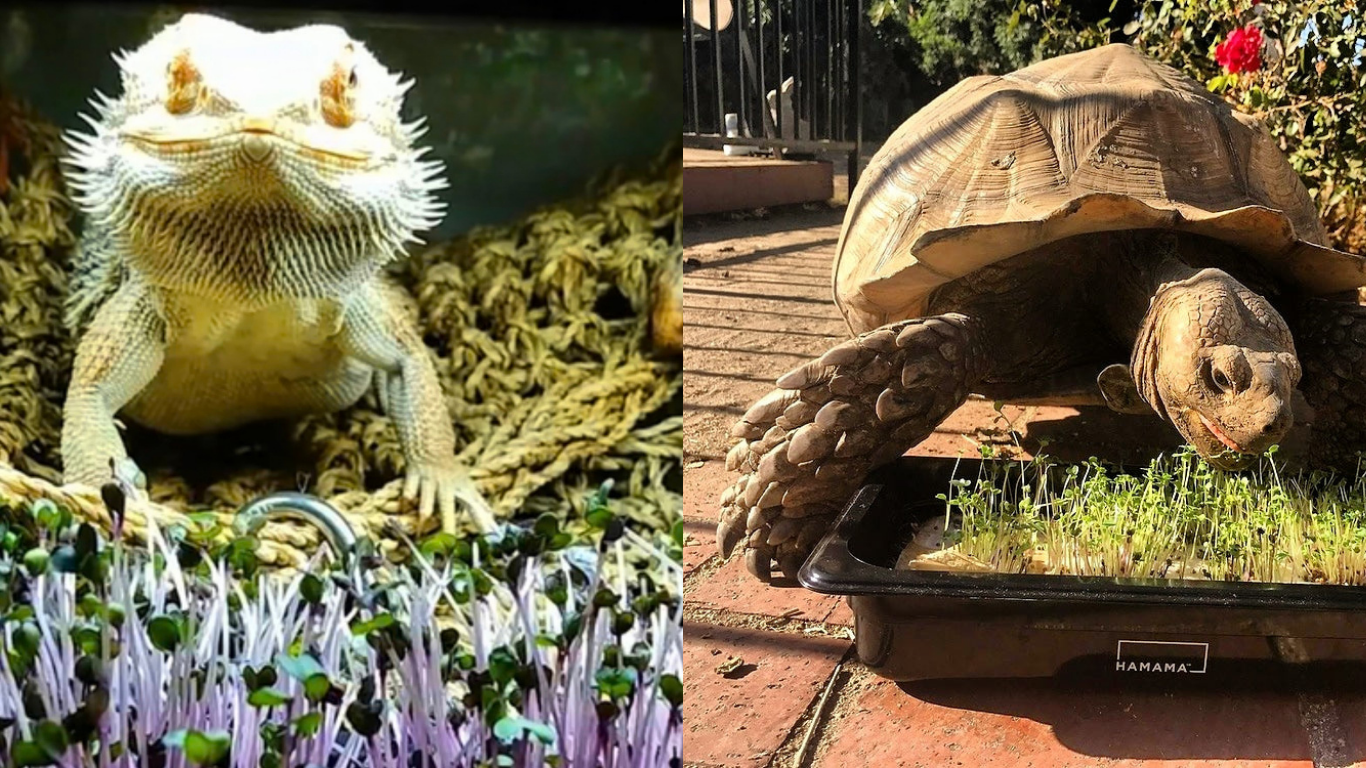
Collard, mustard, turnip, arugula and dandelion microgreens for bearded dragons, turtles and iguanas — inside the fresh-greens allowance a veterinary source actually sets, and low-oxalate by design.
Turtles | Iguanas | Bearded Dragons
Reptile keepers all develop a feeding routine. Some settle on a fixed set of leafy greens, others rotate and supplement, and every so often something new enters the rotation. Lately that has been microgreens.
They are worth considering for herbivorous and omnivorous species — but for narrower reasons than the internet usually gives, and inside a framework that matters much more than the greens themselves.
The framework, from a veterinary source. The MSD Veterinary Manual’s chapter on Nutrition in Reptiles sets out proportions for herbivorous species: “herbivorous reptile pellets should make up 25–50% of herbivorous reptile diets”, “no more than 50% of the diet should consist of fresh greens, fruits, and vegetables, and fruit should be no more than 5%”, with reptiles fed 1–4% of body weight daily on a dry-matter basis. Crucially, it also states that “vegetables with a low oxalate content should be fed to decrease the likelihood of kidney stone formation”. Microgreens live inside that fresh-greens allowance. They do not enlarge it.
Microgreens are harvested early, and their nutrient content has been measured. Xiao, Lester, Luo and Wang (2012) assayed 25 commercial microgreens and reported total ascorbic acid from 20.4 to 147.0 mg per 100 g fresh weight along with carotenoids, phylloquinone and tocopherols, concluding that the cotyledon leaves had higher nutritional densities than mature leaves in the USDA database.
For an animal that eats a small volume of food, higher density per gram is a genuine point in favour. What it is not is a health outcome. This article previously said microgreens “can contribute to stronger bones, healthier skin and better overall wellbeing”, and separately that they “support immune support and overall vitality”. We have removed both. Bone health in captive reptiles is dominated by calcium-to-phosphorus ratio, vitamin D3 and UVB provision — not by whether the greens were young or mature — and that is the conversation to have with your vet.
Shop vegetables are harvested well before they reach you. Microgreens can be cut the moment they are eaten, which means less time for degradation and more water content. Growing your own also means you know what has and has not been sprayed on them. Those are practical advantages that need no health claim attached.
Very little space is needed — a windowsill or a shelf with light and airflow. Many varieties are ready in about a week from a tray, some medium, seed and water, which makes a continuous small supply realistic for a single animal.
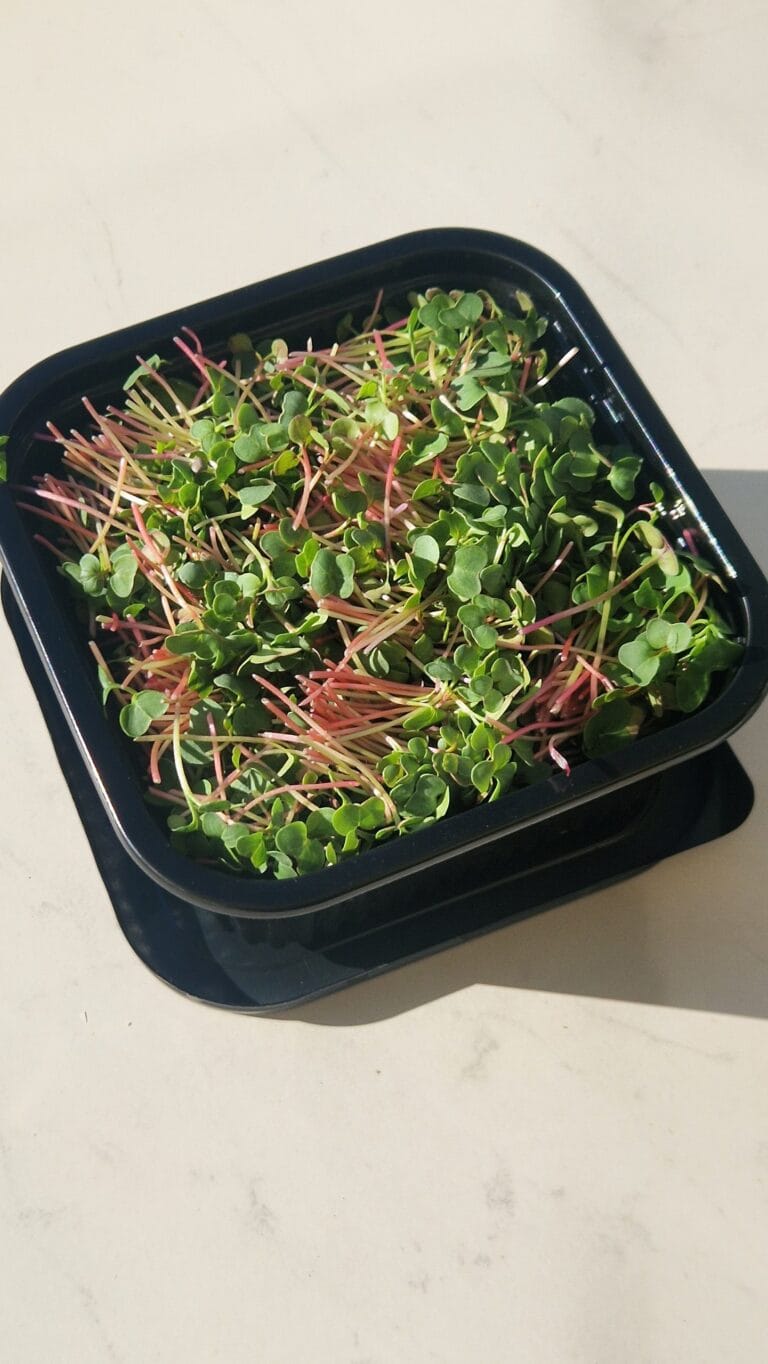
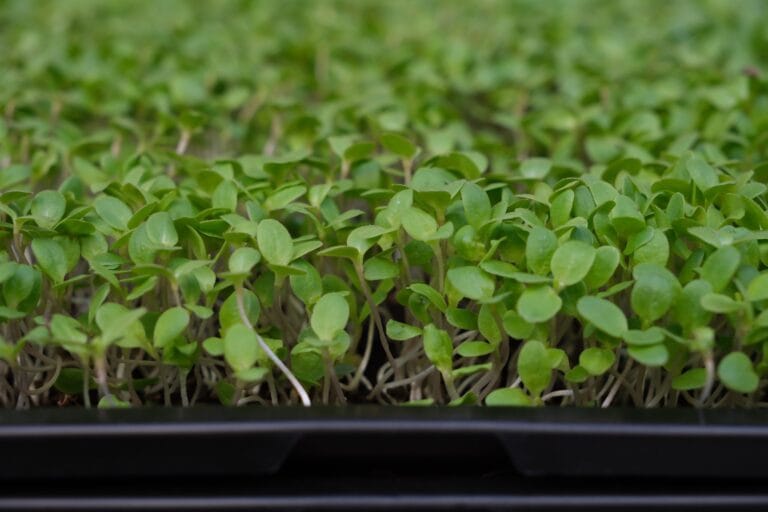
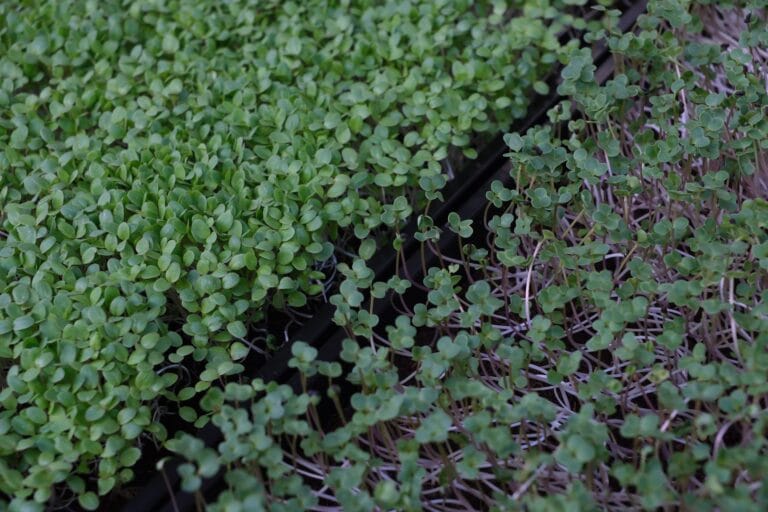
Collard greens, mustard greens, turnip greens, arugula and dandelion greens are the varieties most often grown for herbivorous reptiles. The logic is sound and worth stating explicitly, because it is the logic rather than a list that will keep you out of trouble: these are the same plants already used as staple greens for these species in their mature form, and they are low-oxalate — which is precisely the criterion the MSD Veterinary Manual gives for reducing kidney stone risk.
Being straight about the limits of that: we found no authoritative source that evaluates microgreen versions of these plants for reptiles specifically. What we can point at is the low-oxalate principle above and the fact that the mature plants are established reptile greens. Treat the list as a reasonable inference, not as a tested safe list, and check any variety you are unsure of with your vet. Spinach, chard and beet greens are the ones to keep out of the rotation on the same principle, since high oxalate is the documented concern.
Keepers do grow microgreens for their animals, and individual reptiles clearly develop preferences — one bearded dragon will take enthusiastically to a variety another ignores. That is useful to know, and it is the kind of thing owner experience is genuinely good for.
It is not, however, evidence about safety or nutrition, and this article previously blurred the two: it cited a Reddit thread as a source under a heading that promised “first-hand experience is what matters the most”. First-hand experience matters for palatability. It does not settle whether a plant is appropriate for a species. The thread has been removed, and this section now says only what anecdote can support.
Requirements differ sharply between species and between life stages — a growing bearded dragon needs a very different plant-to-insect ratio from an adult, and a herbivorous tortoise is different again. Microgreens are a variety item inside whatever ratio applies to your animal, and working out that ratio is a job for a reptile vet, not a website.
Microgreens are fresh, dense, easy to grow and simple to slot into an existing feeding routine. That is a modest and true claim, and it is the one this article now makes. If you want to try growing your own, our step-by-step planting guide is the place to start.
This article is general information for keepers, not veterinary advice. Species-specific diet questions — proportions, calcium and vitamin D3 supplementation, and anything concerning a sick animal — belong with a veterinarian experienced in reptiles.
Removed from this list: a Reddit thread and three microgreens vendor blogs. They were the only support for the health claims this article used to make, which is why those claims have been rewritten above.
This article is part of the free knowledge portal of EVEC Microgreens. Wherever you are on your microgreens journey, there is a path for you:
Co-funded by the European Union.
This portal presents the microgreens methodology; the organisation behind it is EVEC Athens — the European Voluntary and Educational Center (evec.org.gr). Views and opinions expressed are those of the author(s) only and do not necessarily reflect those of the European Union or the European Commission. Neither the European Union nor the granting authority can be held responsible for them.
Open licence. Except where stated otherwise, the educational materials on this portal are licensed under CC BY 4.0 — free to use, adapt and share, including commercially, with credit. See the licence terms.
Accessibility. We aim for WCAG 2.1 AA and publish what does and does not yet meet it — see the accessibility statement. If anything here blocks you, tell us and we will send the material in a format that works for you.