Get in touch
Questions about growing, workshops, the cooperative or partnerships? Send us a message and we will reply by email.
Prefer email? Write to erasmus@evec.org.gr
EVEC Microgreens
What the fibre evidence supports, why we could not source the satiety claim, what the University of Maryland microgreen study did and did not measure, and why greens alone will not do the job.
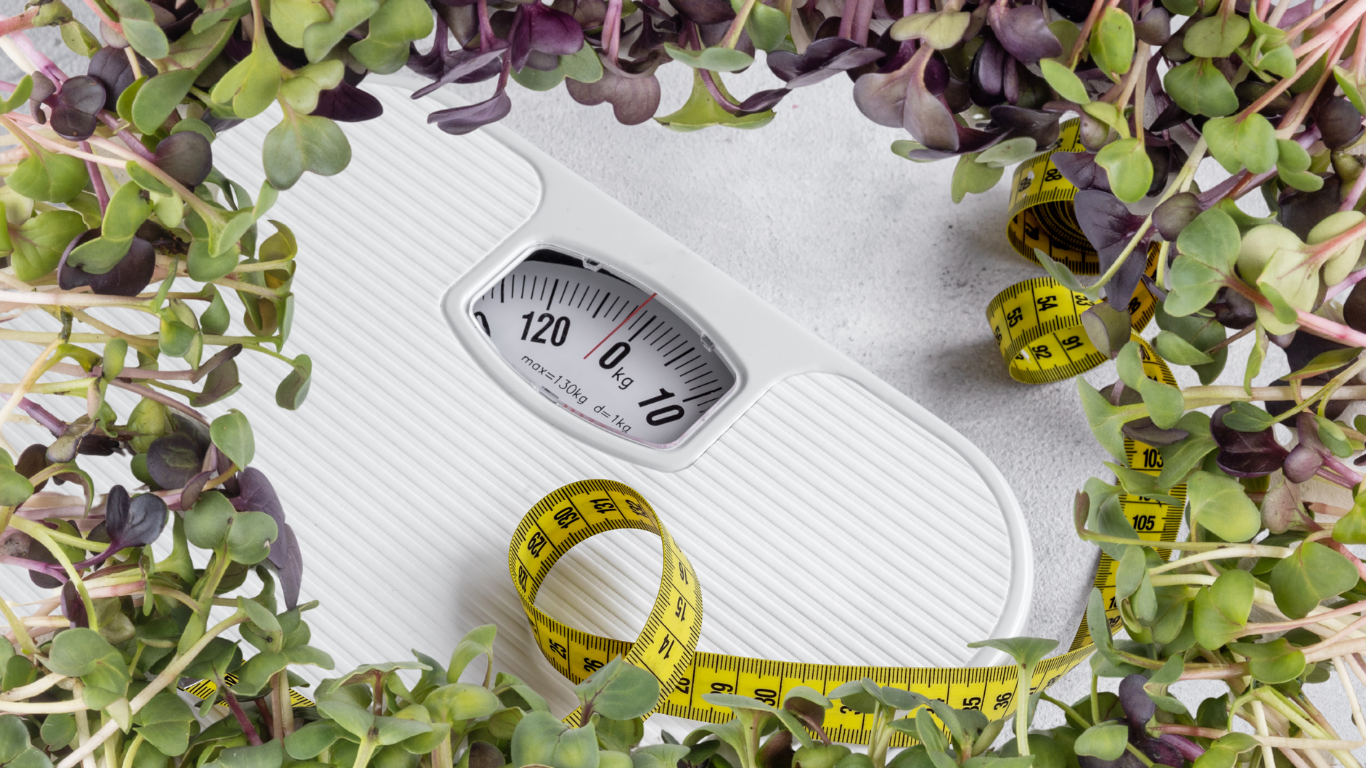
Weight loss isn’t just about eating less—it’s about eating smarter.
That’s where microgreens come in. As we discussed in our previous article, “A Balanced Diet with Microgreens: Nutritious and Tasty,” these tiny greens are a nutrient-dense, low-calorie way to add vegetables and flavour to a meal. What they are not is an appetite suppressant or a weight-loss tool in their own right. This article sets out how they can sensibly fit into a weight-conscious diet — and, where the popular claims outrun the evidence, says so plainly.
Microgreens are often described as a high-fibre food. That needs a caveat. A fresh microgreen is roughly 90% water and is eaten in gram quantities, as a garnish or one component of a salad, so the fibre in a meal comes overwhelmingly from the vegetables, pulses and grains around it. Microgreens contribute some fibre; they are not a major fibre source on their own.
Fiber is very important in weight management as it helps you feel full longer, slows digestion, and blunts the blood-sugar spikes that follow a meal (Anderson et al., 2009; Lattimer & Haub, 2010). That evidence is about total dietary fibre intake across the whole diet, not about microgreens specifically. Two microgreens that are often mentioned in this context:
Microgreens also contain antioxidant compounds, and chronic inflammation is a recognised feature of obesity and metabolic disease. We used to join those two facts into a claim that microgreens reduce inflammation and thereby improve digestion and metabolic function. That step is not supported: no human trial we could find has tested microgreens against inflammatory markers, and the closest evidence concerns broccoli sprouts rather than microgreens. López-Chillón et al. (2019) reported lower inflammatory markers in overweight adults after ten weeks of daily broccoli sprouts, but that trial was single-arm with no placebo group; and the randomised, placebo-controlled trial by Sudini et al. (2016), in adults with asthma, found no effect on airway inflammation or antioxidant gene expression.
They are also often said to help with satiety. Their texture requires more chewing, and eating more slowly is often suggested as a way to give the body time to register fullness. We have removed the words “research shows” from this sentence: we do not hold a study that tested chewing, satiety and microgreens together, so treat this as a reasonable idea rather than a demonstrated result.
And while there is no conclusive answer on which microgreens are best for weight loss, researchers at the University of Maryland and the USDA assayed 25 commercially grown microgreens for vitamin and carotenoid concentrations (Xiao et al., 2012). Red cabbage, cilantro, garnet amaranth and green daikon radish were among the highest for the specific vitamins measured, and those are the four we look at one by one in Part 2. Two things that study did not do: it did not produce an overall nutrition “score”, and it did not measure fibre or test anything to do with weight loss.
While we’ve focused on the role of microgreens in weight loss, it’s important to recognize that their benefits go far beyond getting rid of that extra weight. Thanks to their high nutritional value and diverse properties, microgreens are a useful vegetable to have in the rotation. We have deleted the paragraph that used to sit here, which promised that microgreens strengthen the immune system, improve vision, enhance skin health, raise energy levels and lift mood. None of those claims had a source, and several were stated as certainties. What can honestly be said is narrower: microgreens are a nutrient-dense, low-calorie vegetable, and eating a wider range of vegetables is good general dietary advice.
Adding microgreens to a balanced diet is a small improvement to what is on your plate — not, as this page used to say, “the first step forward in your healthy weight loss journey”. As set out above, they are not a weight-loss tool in their own right, and regulating nutrition and calorie intake alone will not do the whole job either. What matters is the broader pattern: regular exercise, hydration, mindful eating habits and, if needed, guidance from healthcare professionals for recommended supplements or medication.
Are you ready to start? If you want to see a change, check our previous articles and read Microgreens in a Weight-Conscious Diet — Part 2.
A Balanced Diet with Microgreens: Nutritious and Tasty
Julia
Xiao, Z., Lester, G. E., Luo, Y., & Wang, Q. (2012). Assessment of Vitamin and Carotenoid Concentrations of Emerging Food Products: Edible Microgreens. Journal of Agricultural and Food Chemistry, 60(31), 7644–7651.
https://doi.org/10.1021/jf300459b
Microgreens—A Comprehensive Review of Bioactive Molecules and Health Benefits
https://pmc.ncbi.nlm.nih.gov/articles/PMC9864543
Lattimer, J. M., & Haub, M. D. (2010). Effects of Dietary Fiber and Its Components on Metabolic Health. Nutrients, 2(12), 1266–1289.
https://pmc.ncbi.nlm.nih.gov/articles/PMC3257631
Anderson, J. W., Baird, P., Davis, R. H. Jr., Ferreri, S., Knudtson, M., Koraym, A., Waters, V., & Williams, C. L. (2009). Health benefits of dietary fiber. Nutrition Reviews, 67(4), 188–205.
https://pubmed.ncbi.nlm.nih.gov/19335713
López-Chillón, M. T., Carazo-Díaz, C., Prieto-Merino, D., Zafrilla, P., Moreno, D. A., & Villaño, D. (2019). Effects of long-term consumption of broccoli sprouts on inflammatory markers in overweight subjects. Clinical Nutrition, 38(2), 745–752. https://doi.org/10.1016/j.clnu.2018.03.006 — a single-arm trial with no placebo group, and in broccoli sprouts rather than microgreens.
Sudini, K., Diette, G. B., Breysse, P. N., McCormack, M. C., Bull, D., Biswal, S., Zhai, S., Brereton, N., Peng, R. D., & Matsui, E. C. (2016). A randomized controlled trial of the effect of broccoli sprouts on antioxidant gene expression and airway inflammation in asthmatics. The Journal of Allergy and Clinical Immunology: In Practice, 4(5), 932–940. https://doi.org/10.1016/j.jaip.2016.03.012 — this randomised, placebo-controlled trial found no significant effect on the outcomes it measured.
Correction note: we removed two composition figures — “40% fibre” for red buckwheat microgreens and a “70% insoluble / 30% soluble” split for red cabbage microgreens — because neither could be traced to a source we hold. We removed a paragraph promising improved vision, skin health, immunity, energy and mood, which had no source and was written as a certainty. We replaced a ResearchGate figure thumbnail with the underlying paper (Xiao et al., 2012) and corrected our description of it: it assayed vitamin and carotenoid concentrations and produced no overall “score”. We have since rewritten an opening line that said microgreens “can help control your appetite”, which the body of this article does not support, and we have added the two broccoli-sprout trials referred to above (López-Chillón et al., 2019; Sudini et al., 2016) to the sources, since the article named them without citing them. On 30 July 2026 we rewrote the closing section, which still told readers that adding microgreens to a balanced diet is “the first step forward in your healthy weight loss journey” — the opposite of what the body of this article says. See our editorial standards.
This article is part of the free knowledge portal of EVEC Microgreens. Wherever you are on your microgreens journey, there is a path for you:
Co-funded by the European Union.
This portal presents the microgreens methodology; the organisation behind it is EVEC Athens — the European Voluntary and Educational Center (evec.org.gr). Views and opinions expressed are those of the author(s) only and do not necessarily reflect those of the European Union or the European Commission. Neither the European Union nor the granting authority can be held responsible for them.
Open licence. Except where stated otherwise, the educational materials on this portal are licensed under CC BY 4.0 — free to use, adapt and share, including commercially, with credit. See the licence terms.
Accessibility. We aim for WCAG 2.1 AA and publish what does and does not yet meet it — see the accessibility statement. If anything here blocks you, tell us and we will send the material in a format that works for you.