Get in touch
Questions about growing, workshops, the cooperative or partnerships? Send us a message and we will reply by email.
Prefer email? Write to erasmus@evec.org.gr
EVEC Microgreens

Red cabbage, cilantro, amaranth, daikon and fenugreek microgreens and weight management: what dietary fibre evidence actually supports, and the fat-burning claims we removed.
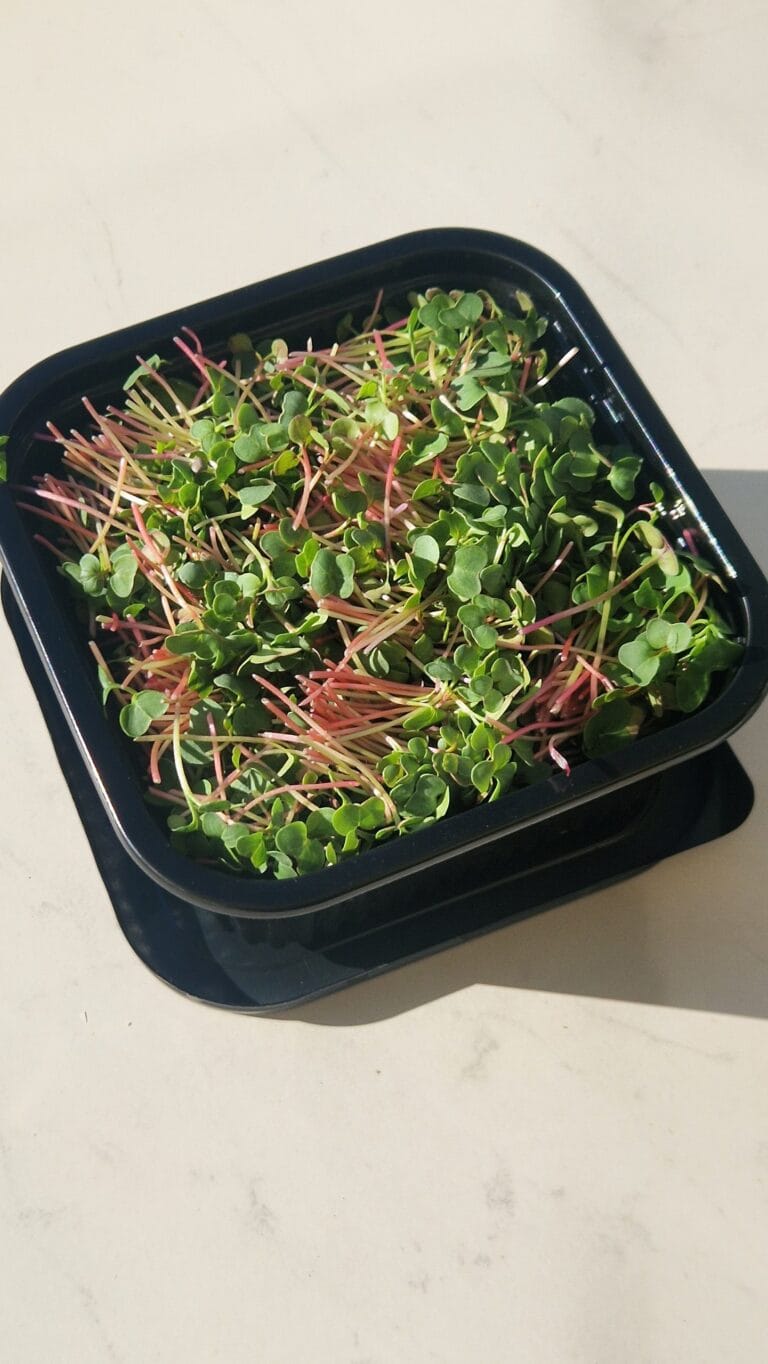
No microgreen burns fat, and no variety targets a specific fat deposit. The one mechanism with evidence behind it is a general one, and it belongs to dietary fibre rather than to microgreens: vegetables like these are bulky, low in calories and contribute fibre (Anderson and colleagues, Nutrition Reviews 2009). We are not aware of a trial that has tested microgreens against a weight outcome in people. This is the second part of our look at microgreens and weight loss. The University of Maryland assay of 25 commercially grown microgreens (Xiao et al., 2012) found red cabbage, cilantro, garnet amaranth and green daikon radish among the highest scorers for vitamin C, carotenoids, vitamin K and vitamin E — a nutrient-density finding rather than a weight-loss one, and one we examine further in microgreens vs. mature versions. Fenugreek is worth adding to the conversation too. What follows is what each one actually offers — and, just as importantly, what it does not.
What we corrected in this article. This page used to attribute specific fat-loss mechanisms to individual crops — that beta carotene “supports weight loss by targeting visceral fat”, that broccoli microgreens focus on “fat burning and detox”, that arugula boosts metabolism, that daikon curbs “insulin-related fat storage”, and that fenugreek helps manage type 2 diabetes and eases PMS and menopause symptoms. None of those had a source, several are simply not true, and the last are medical claims. They have been removed. We also dropped two sources: a Dr. Axe page and a WebMD page.
The evidence that exists here is about dietary fibre, and it applies to bulky, low-calorie vegetables as a class rather than to any particular variety. In their review for Nutrition Reviews, Anderson and colleagues (2009) report that people with high fibre intakes are at significantly lower risk of obesity among other conditions, that increased soluble fibre improves glycaemia and insulin sensitivity, and — most directly relevant here — that fibre supplementation in people with obesity significantly enhances weight loss.
That is the honest headline, and it is a headline about fibre: the work reviewed there measured fibre intake, not microgreens. The reasoning usually applied to vegetables — that they displace more energy-dense food and make a meal more filling — is plausible for microgreens, but it has not been tested in them. No microgreen burns fat, and none of them targets a particular fat deposit.
Low in calories, a source of dietary fibre, and among the highest scorers in the Maryland assay for vitamin C. That is a measured nutrient concentration (Xiao et al., 2012), not a weight-loss finding, and the assay measured what is in the plant rather than what eating it does in a person.
Cilantro microgreens are a notable source of beta carotene, a carotenoid measured in the Maryland assay and a dietary precursor of vitamin A. That is a composition measurement. It is not a weight finding: the claim this page used to make, that beta carotene targets visceral fat, has no support behind it. Cilantro also contributes polyphenols, studied for antioxidant activity.
Amaranth is naturally gluten-free, which matters for people with coeliac disease. One caution about how this is usually presented: amaranth’s reputation as a high-protein, complete-amino-acid food comes from studies of the grain. A tray of amaranth microgreens is a leafy vegetable eaten in gram quantities and is not a meaningful protein source. Reports of changes in blood lipids are in the same position: they come from animal studies of amaranth grain and oil. Those are animal experiments on a different material, and they do not establish an effect in people eating amaranth microgreens.
Low in calories and a source of fibre, so the general point above applies. The effects Anderson and colleagues describe — on glycaemia and on bowel function — are findings about dietary fibre intake in general. They are not a property measured in daikon microgreens, which are eaten in gram quantities as a garnish.
Fenugreek contains diosgenin, a steroidal saponin, and the plant has a long history of culinary and traditional use. Laboratory work on isolated diosgenin does not tell us what a tray of fenugreek microgreens does in a person. We have removed the claims that followed from that — managing type 2 diabetes, easing PMS and menopause, regulating menstrual cycles. Those are medical claims about a food, and this page is not the place for them.
Note: Fenugreek belongs to the same plant family as peanuts, and people with peanut allergies may react to it. Fenugreek is also sold as a herbal supplement with blood-sugar claims attached to it. We have not verified those claims and do not make them here, but if you take medication for diabetes it is worth raising fenugreek with a healthcare provider before making it a regular part of your diet.
Plenty of other varieties are worth adding to meals, and the reason is flavour and variety rather than any fat-loss property:
A final, honest note. Microgreens are a good addition to a varied diet. They are not a weight-loss intervention, and no vegetable overcomes an overall energy surplus. If you are trying to lose weight and want a plan that will work for you, a doctor or a registered dietitian is a better starting point than any food blog, this one included.
You’ve got this! Let microgreens follow you on every step of the way.
Julia
Removed from this list in July 2026: a Dr. Axe page and a WebMD page. Neither is a primary source. See our editorial standards.
This article is part of the free knowledge portal of EVEC Microgreens. Wherever you are on your microgreens journey, there is a path for you:
Co-funded by the European Union.
This portal presents the microgreens methodology; the organisation behind it is EVEC Athens — the European Voluntary and Educational Center (evec.org.gr). Views and opinions expressed are those of the author(s) only and do not necessarily reflect those of the European Union or the European Commission. Neither the European Union nor the granting authority can be held responsible for them.
Open licence. Except where stated otherwise, the educational materials on this portal are licensed under CC BY 4.0 — free to use, adapt and share, including commercially, with credit. See the licence terms.
Accessibility. We aim for WCAG 2.1 AA and publish what does and does not yet meet it — see the accessibility statement. If anything here blocks you, tell us and we will send the material in a format that works for you.