Get in touch
Questions about growing, workshops, the cooperative or partnerships? Send us a message and we will reply by email.
Prefer email? Write to erasmus@evec.org.gr
EVEC Microgreens
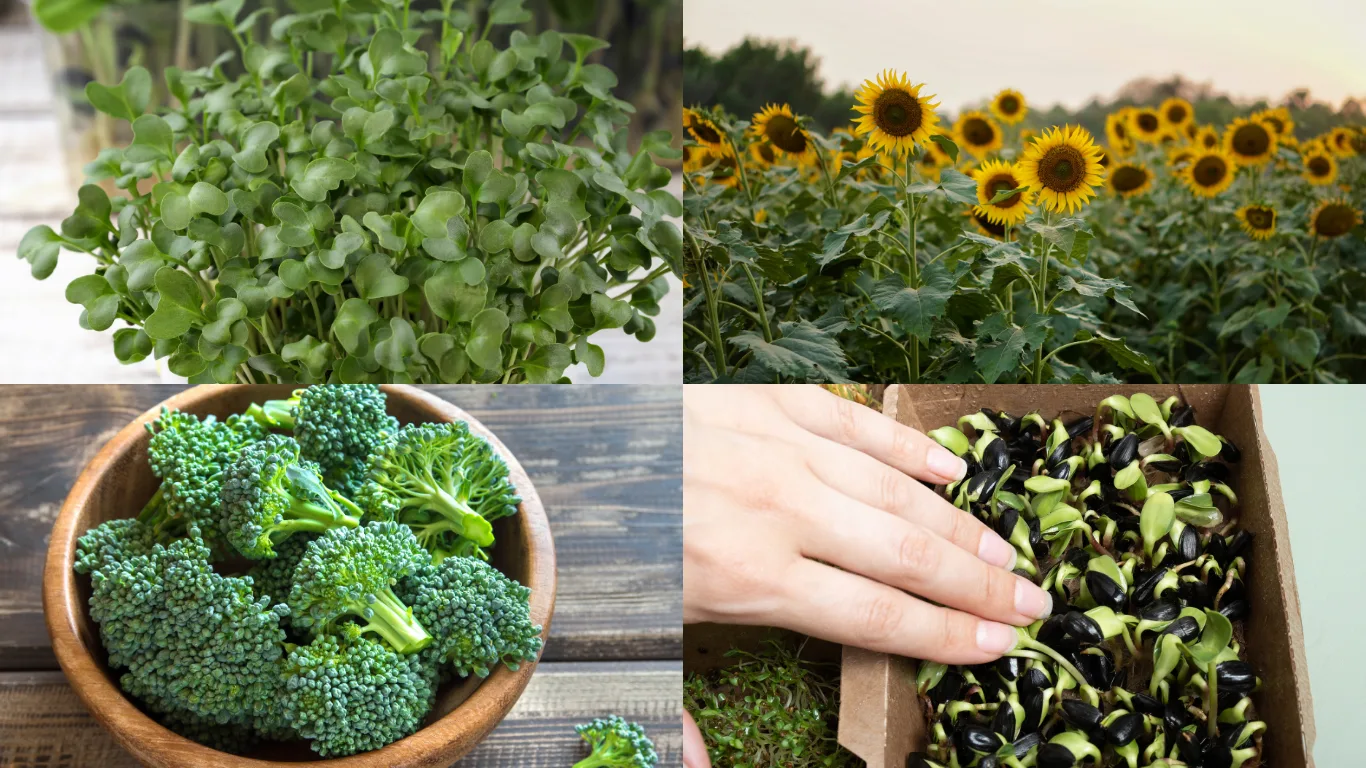
Are microgreens more nutritious than the mature vegetables? What the research says when you compare microgreens with their full-grown versions — the honest answer.
Are microgreens more nutritious than the mature vegetables they grow into? Sometimes, for some nutrients, in some crops, and only when the comparison is made gram for gram.
Weber (2017) measured broccoli microgreens against published values for the mature vegetable and found more magnesium, manganese, copper and zinc however they were grown. Ayeni (2021) compared the young foliage of tropical spinach and roselle with the field-grown mature foliage of the same crops and found it higher in phosphorus, potassium, magnesium, iron, manganese and zinc — but lower in calcium. That per-gram basis flatters microgreens, because they are eaten in far smaller amounts than the mature vegetable. What follows is what the studies on this page actually measured, and where the evidence runs out.
The 2023 review “Microgreens—A Comprehensive Review of Bioactive Molecules and Health Benefits” reports that microgreens have elevated levels of minerals such as potassium (K), phosphorus (P), calcium (Ca), zinc (Zn), iron (Fe), magnesium (Mg), and sodium (Na).
Another study, “Nutrient Content of Micro/Baby-Green and Field-Grown Mature Foliage of Tropical Spinach (Amaranthus sp.) and Roselle (Hibiscus sabdariffa L.)”, compared the young foliage of those two crops with their own field-grown mature foliage and found the young foliage higher in phosphorus, potassium, magnesium, iron, manganese and zinc — and lower in calcium. It is a two-crop study, not a general result for all microgreens.
In addition, according to a press release from the United States Department of Agriculture (USDA) and the American Chemical Society (ACS), microgreen kale has about five times more glucosinolates than mature kale. The release makes that comparison for kale specifically; it says only that nutrient levels in several other cruciferous vegetables are higher in the immature plants, without attaching a figure to them.
In what aspects do they seem to outperform mature vegetables?
Microgreens generally show higher concentrations of several essential minerals per gram of weight. Which minerals, and by how much, varies by species and growing method. Weber (2017) measured broccoli microgreens against published values for the mature vegetable and found more magnesium (Mg), manganese (Mn), copper (Cu) and zinc (Zn) however they were grown, and more phosphorus (P), potassium (K), iron (Fe), calcium (Ca) and sodium (Na) as well in the compost-grown trays. Ayeni (2021) found the micro/baby-green foliage of tropical spinach (Amaranthus sp.) and roselle higher in phosphorus, potassium, magnesium, iron, manganese and zinc than the field-grown mature foliage of the same crops — but lower in calcium, which is a reminder that the advantage is not uniform.
We have removed an illustration that claimed 25 g of broccoli microgreens provides as much iron as a whole cup of cooked spinach. No source we hold supports that equivalence, and cooked spinach is unusually iron-dense, which makes the comparison implausible.
Microgreens contain polyphenols, flavonoids, carotenoids and glucosinolates, and these compounds account for much of the colour, flavour and aroma of the young leaves. Their concentrations can be measured in the laboratory — Xiao et al. (2012) assayed vitamin and carotenoid levels across 25 commercially available microgreens. What eating them does inside the body has not been tested in microgreens specifically.
This page used to state that red cabbage microgreens contain “up to 40 times more vitamin E and almost 30 times more lutein/zeaxanthin” than mature cabbage. We have removed those figures. We could not trace them to any source we hold, and they conflict with the study the “40 times” line is usually traced back to: Xiao et al. (2012) assayed 25 commercially available microgreens and reported that green daikon radish had the highest tocopherol (vitamin E) concentration and cilantro the highest carotenoids — red cabbage was highest for vitamin C, not vitamin E.
Radish and mustard microgreens do contain glucosinolates, the compounds behind their peppery flavour. What those compounds do once eaten is still an open research question, and we no longer describe them as having “anticancer properties”.
Since they are harvested early and have little mature foliage, their “nutrition per gram” tends to be more concentrated, making them valuable when consumption volume is low.
Xiao et al. (2012) measured total ascorbic acid (vitamin C) across 25 microgreens at 20.4 to 147.0 mg per 100 g fresh weight, with red cabbage among the highest, and reported that microgreen cotyledon leaves had higher nutrient densities than the mature-leaf values in the USDA National Nutrient Database. That is a per-gram comparison against a reference database, for the specific compounds measured — not a general rule that a handful of microgreens replaces a cup of the mature vegetable.
Therefore, even though they are consumed in smaller amounts, their nutritional density tends to be higher.
Variability among species and growing conditions
Not all microgreens outperform their mature versions in the same way. Species, substrate, light, harvest timing, and other factors play a major role.
Study limitations
Many studies are based on small samples or controlled conditions, which limits how well their results apply to real world scenarios.
Actual health effects
A higher nutrient content does not automatically mean better absorption or the same biological effect. Research on human health effects remains limited.
Costs
Although microgreens offer advantages, their production can involve higher costs, which affects accessibility.
• If microgreens are grown with the goal of maximizing nutritional value, it’s best to choose species known for their comparative advantage (for example, certain cruciferous plants) and optimize growing conditions to reflect these results.
• Chefs, restaurateurs, and other food businesses can take advantage of this nutritional edge as part of their value proposition, emphasizing that microgreens are not just decorative, they also provide nutrient density.
• Where the volume of food eaten is small, microgreens can add variety and nutrients per gram, though always as a complement, not a full replacement for mature vegetables or complete meals.
• In marketing and communication, accuracy matters: it is better to say that microgreens “may contain more nutrients” rather than claim they are “completely superior,” given the available evidence and ongoing research.
Current studies support the claim that microgreens, in many species and under good growing conditions, can offer higher concentrations of certain nutrients or bioactive compounds than their mature versions.
However, the advantage depends on the species, cultivation method, harvest timing, and quality of the final product.
Ultimately, within a healthy diet, microgreens should be viewed as a complement, not a full replacement, for mature vegetables.
As always, we hope this has been helpful.
See you next time!
Carlota
Where to go next: the microgreens crop database lists the crops covered on this site, and how to grow microgreens at home is the starting point for growing them yourself. The original papers in our Science Library include other studies that compare young and mature stages of the same crop, such as The Nutritional Quality Potential of Microgreens, Baby Leaves, and Adult Lettuce.
American Chemical Society. (2023, August 15). Microgreens and mature veggies differ in nutrients, but both might limit weight gain. ACS Newsroom. https://www.acs.org/pressroom/newsreleases/2023/august/microgreens-and-mature-veggies-differ-in-nutrients-but-both-might-limit-weight-gain.html
Ayeni, A. (2021). Nutrient content of micro/baby-green and field-grown mature foliage of tropical spinach (Amaranthus sp.) and roselle (Hibiscus sabdariffa L.). Foods, 10 (11), 2546. https://pmc.ncbi.nlm.nih.gov/articles/PMC8619766/
Bhaswant, M., Shanmugam, D. K., Miyazawa, T., Abe, C., & Miyazawa, T. (2023). Microgreens—A comprehensive review of bioactive molecules and health benefits. Molecules, 28(2), 867. https://pmc.ncbi.nlm.nih.gov/articles/PMC9864543/
Samuolienė, G., Brazaitytė, A., Viršilė, A., Miliauskienė, J., Vaštakaitė-Kairienė, V., & Duchovskis, P. (2019). Nutrient levels in Brassicaceae microgreens increase under tailored light-emitting diode spectra. Frontiers in Plant Science, 10, 1475. https://europepmc.org/article/med/31798616
Weber, C. F. (2017). Broccoli microgreens: A mineral-rich crop that can diversify food systems. Frontiers in Nutrition, 4, 7. https://doi.org/10.3389/fnut.2017.00007
Xiao, Z., Lester, G. E., Luo, Y., & Wang, Q. (2012). Assessment of vitamin and carotenoid concentrations of emerging food products: edible microgreens. Journal of Agricultural and Food Chemistry, 60(31), 7644–7651. https://doi.org/10.1021/jf300459b
Correction note: we removed two nutrient multipliers (“40 times more vitamin E” and “almost 30 times more lutein/zeaxanthin” for red cabbage) and two serving-size equivalences (25 g of broccoli microgreens versus a cup of cooked spinach; a handful of red cabbage microgreens versus a full cup of mature cabbage). None could be traced to a source we hold, and the vitamin E figure conflicts with Xiao et al. (2012), which we have added as a source in its place.
We have since removed a further mineral claim — that broccoli and mustard microgreens hold up to twice the iron and calcium of their mature versions, and that amaranth and sunflower stand out for magnesium and zinc — because no source on this page measures minerals in mustard or sunflower microgreens, and the one amaranth measurement we do hold (Ayeni, 2021) found calcium lower, not higher; Weber (2017) has been added as the source for the broccoli mineral comparison.
We narrowed the “five times more glucosinolates” figure to kale, which is the crop the ACS release actually makes that comparison for, and we corrected two study titles that this page had been quoting incorrectly. We also dropped a Medical News Today article that was supporting nutritional claims: under our editorial standards we do not cite consumer health publishers for health or nutritional claims.
This article is part of the free knowledge portal of EVEC Microgreens. Wherever you are on your microgreens journey, there is a path for you:
Co-funded by the European Union.
This portal presents the microgreens methodology; the organisation behind it is EVEC Athens — the European Voluntary and Educational Center (evec.org.gr). Views and opinions expressed are those of the author(s) only and do not necessarily reflect those of the European Union or the European Commission. Neither the European Union nor the granting authority can be held responsible for them.
Open licence. Except where stated otherwise, the educational materials on this portal are licensed under CC BY 4.0 — free to use, adapt and share, including commercially, with credit. See the licence terms.
Accessibility. We aim for WCAG 2.1 AA and publish what does and does not yet meet it — see the accessibility statement. If anything here blocks you, tell us and we will send the material in a format that works for you.