Get in touch
Questions about growing, workshops, the cooperative or partnerships? Send us a message and we will reply by email.
Prefer email? Write to erasmus@evec.org.gr
EVEC Microgreens

Are microgreens actually sustainable? Their water use, food miles, packaging and land footprint compared with conventional vegetables — the honest picture.
In previous articles, we talked about urban microgreen gardens, how they can be a healthy alternative to the fast pace of city life, a way to strengthen local trade, and a tool to reconnect people with nature. We also mentioned microgreens’ potential as community and wellness spaces, as well as their positive contribution to the environment, though we didn’t forget about the challenges that still remain.
In today’s article, we want to take a closer look at precisely that: whether microgreens truly represent an advantage in terms of environmental sustainability, and what challenges accompany their production and distribution.
In a world increasingly aware of ecological impact, microgreens have gained attention. As we know, they grow quickly, require little space, and can be produced within cities themselves, reducing the need for transportation, among other benefits.
Throughout this article, we’ll analyze the pros and cons in terms of ecology and sustainability, as well as the main challenges they face.
Water use
Microgreens are widely said to need far less water than traditional crops. The figure most often quoted for that claim — 158 to 236 times less water — is narrower than it looks, and worth stating precisely. Weber (2017) extrapolated it from experimental data for broccoli microgreens, compared against the water needed to grow a nutritionally equivalent amount of field-grown broccoli in California’s Central Valley. It is a single-crop, single-region extrapolation, not a general result for microgreens as a class, and equivalent water-footprint data has not been published for most other species. We make the same point in our article on cereal microgreens.
Their short growth cycle and closed growing systems also make irrigation easier to control, which limits water waste.
Efficient use of space
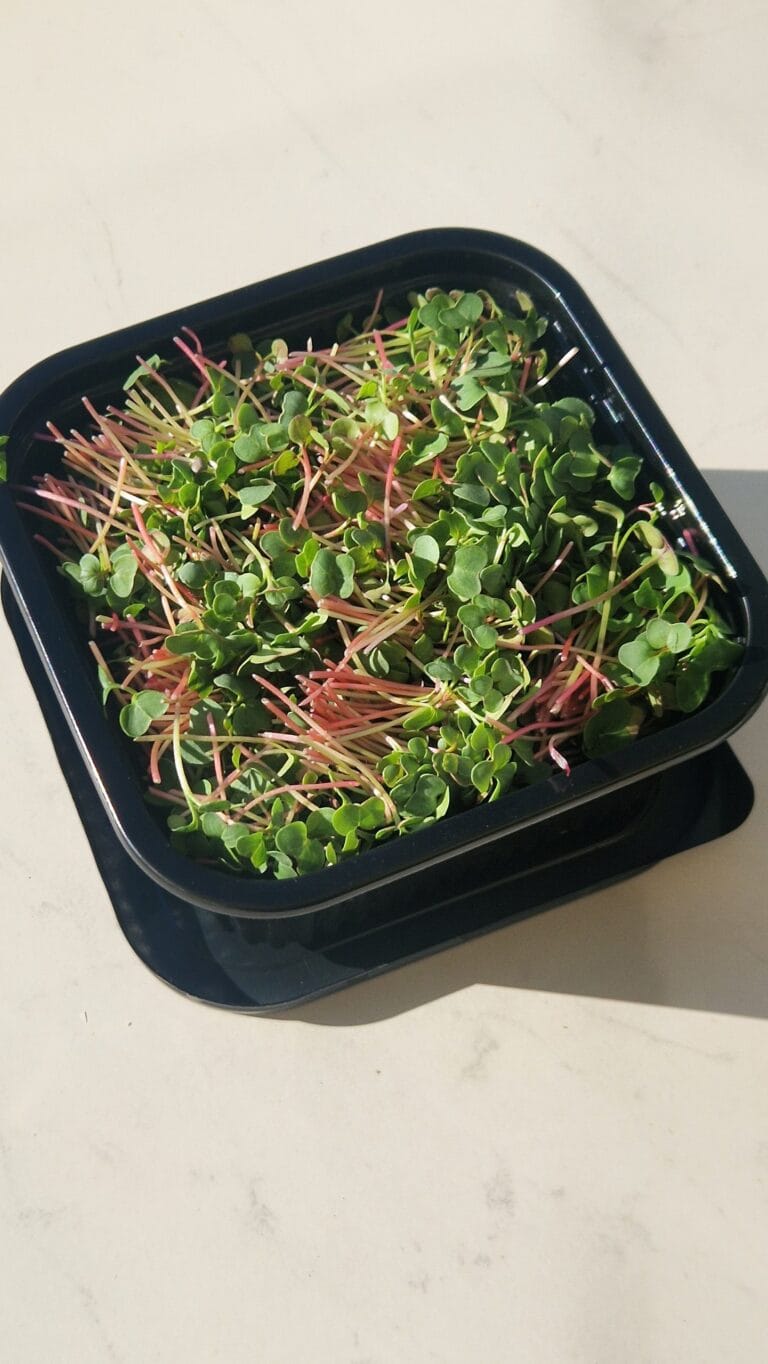
Microgreens require little substrate, small planting trays, and can be grown on rooftops, apartment balconies, or even in offices, as is our case. This makes them especially suitable for densely populated cities, reducing the need for large agricultural areas.
Reduced transportation
Since they’re grown within cities, near the final consumer, microgreens can help shorten transportation distances, reducing pollution, time loss, and waste. This, in turn, helps cut emissions associated with transport and prolonged storage.
Energy consumption
While water and space efficiency are clear benefits, there’s the challenge of energy consumption (lighting, climate control…). For example, indoor growing requires LED lights, ventilation, and environmental control, which can increase the carbon footprint if not powered by renewable energy sources.
Short shelf life and waste
As we mentioned in previous articles, microgreens have a very short shelf life after harvest, posing challenges for storage and packaging. Waste linked to this can reduce their environmental advantages if not properly managed.
Economic costs
Infrastructure, climate control, packaging, and energy consumption can increase economic costs. This raises questions about the financial sustainability of certain production models and their viability in specific settings.
Despite these challenges, there are several good practices we can adopt to mitigate them:
• Use renewable energy for lighting and ventilation systems, ensuring that water efficiency isn’t offset by a high energy footprint.
• Design production systems close to consumers to minimize transport, long term storage, and waste.
• Choose sustainable packaging materials, avoiding single use options and favoring reusable or compostable ones.
• Monitor resource usage (water, energy…) to quantify efficiency and make necessary adjustments, artificial intelligence can be a powerful tool for this.
In conclusion, microgreens are a great opportunity to move toward more sustainable food production. Their efficient use of space, fast growth cycle, and potential to reduce water and transportation needs make them strong allies for the environment.
That said, their ecological footprint will depend on how resources, energy, and waste are managed.
See you in the next article. Chao!
Carlota
Weber, C. F. (2017). Broccoli microgreens: A mineral-rich crop that can diversify food systems. Frontiers in Nutrition, 4, 7. https://doi.org/10.3389/fnut.2017.00007
Oh, S., & Lu, C. (2022). Vertical farming – smart urban agriculture for enhancing resilience and sustainability in food security. The Journal of Horticultural Science and Biotechnology. Advance online publication. https://www.tandfonline.com/doi/full/10.1080/14620316.2022.2141666
Parkes, M. G., Azevedo, D. L., Cavallo, A. C., Domingos, T., & Teixeira, R. F. M. (2023). Life cycle assessment of microgreen production: Effects of indoor vertical farm management on yield and environmental performance. Scientific Reports, 13, Article 11324. https://www.nature.com/articles/s41598-023-38325-0
Dubey, S., et al. (2024). Microgreens production: Exploiting environmental and cultural factors for enhanced agronomical benefits. Plants, 13(18), 2631. https://www.mdpi.com/2223-7747/13/18/2631
Correction note, 30 July 2026: this page said that “microgreen production can use between 158 and 236 times less water than comparable mature vegetables”, attributed only to “a recent study”. That generalised a broccoli-specific finding to microgreens as a whole, and contradicted our own article on cereal microgreens, which already flagged the limitation. The figure is now attributed to Weber (2017) and scoped to what that paper actually covers. What Weber measured was the mineral content of home-grown broccoli microgreens; the water figure is an extrapolation from those data against field-grown broccoli in California’s Central Valley, and “nutritionally equivalent” there means an equivalent amount of eight minerals, not equivalent nutrition in general. See our editorial standards.
This article is part of the free knowledge portal of EVEC Microgreens. Wherever you are on your microgreens journey, there is a path for you:
Co-funded by the European Union.
This portal presents the microgreens methodology; the organisation behind it is EVEC Athens — the European Voluntary and Educational Center (evec.org.gr). Views and opinions expressed are those of the author(s) only and do not necessarily reflect those of the European Union or the European Commission. Neither the European Union nor the granting authority can be held responsible for them.
Open licence. Except where stated otherwise, the educational materials on this portal are licensed under CC BY 4.0 — free to use, adapt and share, including commercially, with credit. See the licence terms.
Accessibility. We aim for WCAG 2.1 AA and publish what does and does not yet meet it — see the accessibility statement. If anything here blocks you, tell us and we will send the material in a format that works for you.