Get in touch
Questions about growing, workshops, the cooperative or partnerships? Send us a message and we will reply by email.
Prefer email? Write to erasmus@evec.org.gr
EVEC Microgreens
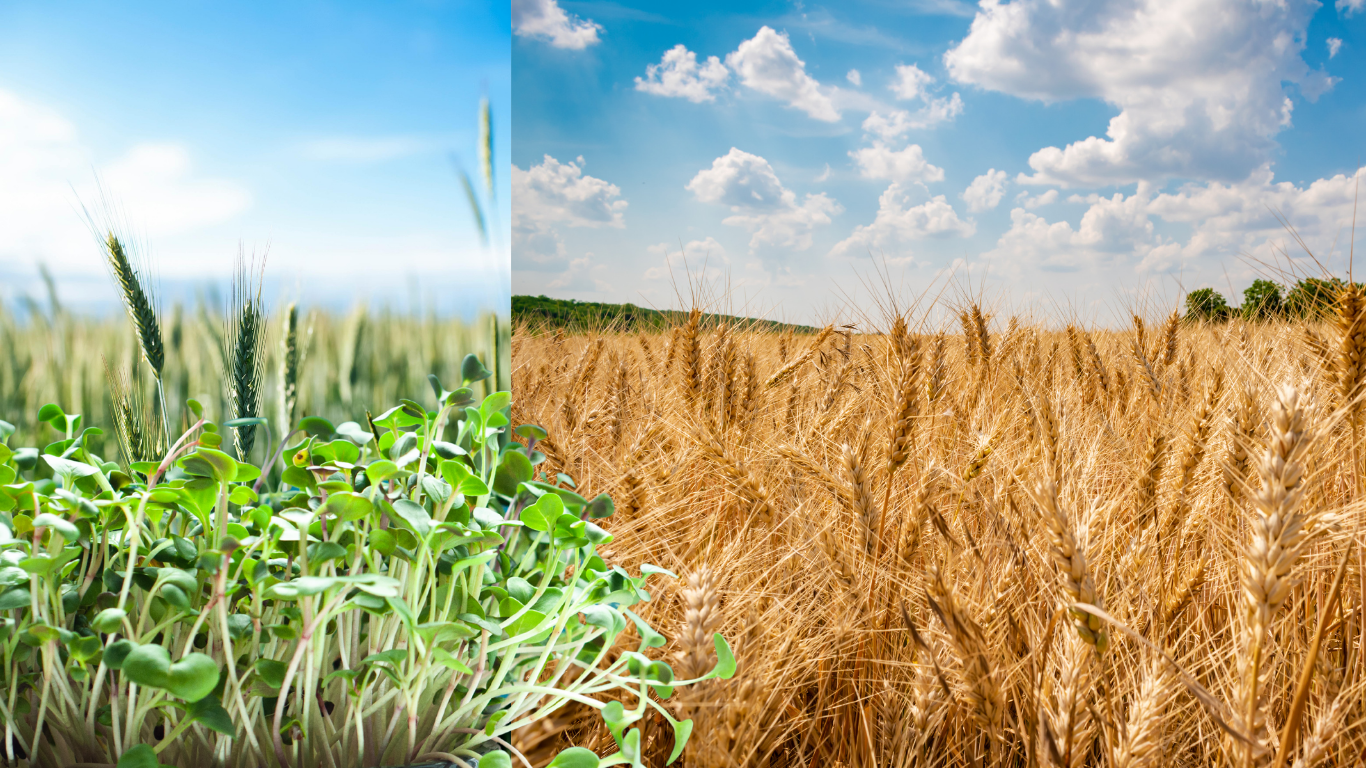
Wheat microgreens show 262% more protein than mature grain on a dry-weight basis, while red amaranth shows 86% less. What the evidence does and does not support.
Cereal microgreens carry more of some nutrients than the mature grain in some species — and fewer in others. A 2025 review in the Journal of Cereal Science tabulated roughly 262% more protein and about ten times more total minerals in wheat microgreens than in mature wheat grain, on a dry-weight basis, while the same review recorded 86% less protein in red amaranth microgreens than in the mature seed. Wheat, barley, oat, rye and their relatives are less familiar than the brassicas most growers start with, and the claims made for them are worth examining closely.
The starting point is an article on the science portal News-Medical by Priyanjana Pramanik, a science communicator with a background in wildlife biology who is dedicated to science outreach and conservation. In this publication, she raised the question of whether cereal microgreens could become the next sustainable superfood.
And that’s exactly what we’ll be talking about today, cereal microgreens.
Cereals and pseudocereals, such as wheat, oats, amaranth (as you know, we’ve been growing amaranth in our office for a few months now and we love it), and quinoa, have been an essential part of the human diet for millennia. Research has also measured their composition at a much earlier stage: not as mature grains, but as microgreens, when the plant is only about 10 to 21 days old.
During this period, the seed uses its energy reserves to grow, and the composition of the seedling differs from that of the dry seed. Whether this makes its starches easier for people to absorb has not been tested in cereal microgreens, and we make no claim about it here. What has been measured is composition: concentrations of vitamins, minerals, antioxidants and protein, which in several species are reported higher than in the mature grain, and in at least one species lower.
When it comes to nutrients, Pramanik explains that recent studies highlight how microgreens concentrate:
In the specific case of wheat microgreens, one review tabulated roughly 262% more protein and about ten times more total minerals (ash) than mature wheat grain — but two caveats matter. The figures are dry-weight values, so comparing a fresh microgreen with a dry grain by weight would badly overstate the difference; and they pool measurements from separate studies rather than one controlled experiment. Treat them as indicative rather than precise. Nor does every species follow the pattern: in the same review, red amaranth microgreens showed an 86% reduction in protein compared with the mature seed.
And beyond nutrition, microgreens have another strategic advantage we’ve often talked about: they can be grown quickly and efficiently. Their production adapts well to systems such as vertical farming and hydroponics, saving land and shortening harvest times. On water, be careful with the numbers you will see quoted: the striking figure of 158–236 times less water is an extrapolation by Weber (2017) from experimental data for broccoli microgreens, set against the water needed to grow a nutritionally equivalent amount of field-grown broccoli in California’s Central Valley. Equivalent water-footprint data for cereal microgreens has not yet been published.
That suits food supply in cities, and in regions with limited fertile soil.
However, despite these advantages, cereal microgreens also face important limits:
Whether cereal microgreens could contribute to diets in which particular nutrients are scarce remains an open question. The composition data exist; what does not exist is a trial testing whether adding them to a diet changes anyone’s nutritional status. As Priyanjana Pramanik points out, what is needed is stronger scientific evidence, solutions to the production hurdles, and consumer trust.
What today is a niche crop in urban farms and on office desks could become a more common ingredient. Whether it delivers more nutrients for less environmental cost than the alternatives is a question the published data does not yet answer for cereal species.
See you next time, friends!
Carlota
Popular-science article that prompted this piece: Pramanik, P. (2025, 5 September). Can cereal microgreens become the next sustainable superfood? News-Medical. Read it ↗
This article is part of the free knowledge portal of EVEC Microgreens. Wherever you are on your microgreens journey, there is a path for you:
Co-funded by the European Union.
This portal presents the microgreens methodology; the organisation behind it is EVEC Athens — the European Voluntary and Educational Center (evec.org.gr). Views and opinions expressed are those of the author(s) only and do not necessarily reflect those of the European Union or the European Commission. Neither the European Union nor the granting authority can be held responsible for them.
Open licence. Except where stated otherwise, the educational materials on this portal are licensed under CC BY 4.0 — free to use, adapt and share, including commercially, with credit. See the licence terms.
Accessibility. We aim for WCAG 2.1 AA and publish what does and does not yet meet it — see the accessibility statement. If anything here blocks you, tell us and we will send the material in a format that works for you.