Get in touch
Questions about growing, workshops, the cooperative or partnerships? Send us a message and we will reply by email.
Prefer email? Write to erasmus@evec.org.gr
EVEC Microgreens
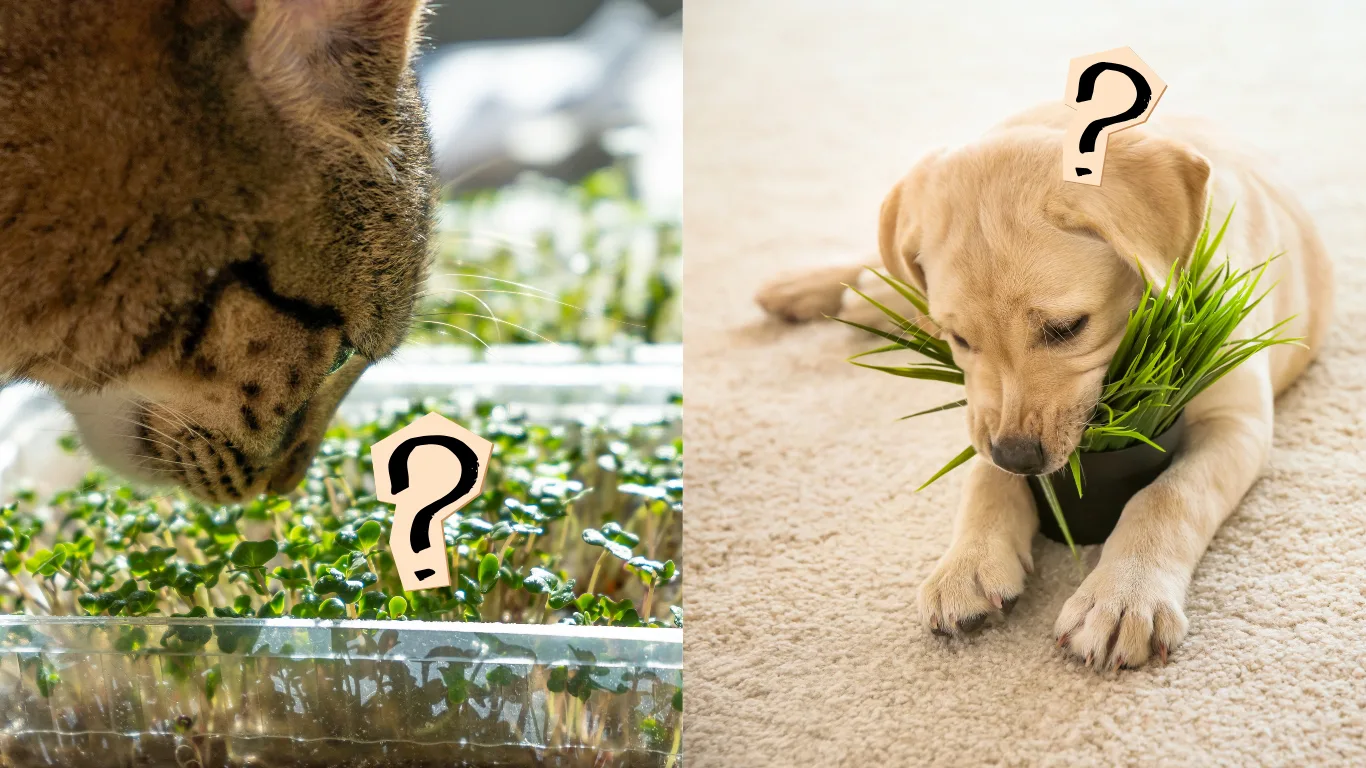
Which microgreens suit cats and dogs, which are documented as toxic (allium, nightshade seedlings, rhubarb), and why we removed the old feeding percentages and the anti-cancer claim.
Can cats eat microgreens? Some of them, in small amounts, as an occasional treat — barley grass, sunflower, peas, lettuce and catnip are the varieties usually offered. Others are genuinely unsafe for cats and dogs: allium, nightshade seedlings and rhubarb have documented toxicity. This guide separates the two, and is explicit about where the popular advice runs ahead of the evidence. Our companion piece asks the broader question, are microgreens safe for pets.
Disclaimer: this article is general information for owners, not veterinary advice. Talk to your vet before introducing any new food, especially if your pet is young, pregnant, elderly, or has a condition affecting digestion, the kidneys or the thyroid.
What we corrected in this article. An earlier version gave exact feeding limits (“up to 5% of a cat’s diet”, “around 10% of your dog’s diet”) and claimed that the broccoli compound sulforaphane — which it spelled “sulphorane” — has “anti-cancer” properties. We could not trace the percentages to any veterinary or scientific source, so they are gone. The anti-cancer claim is not supported by the canine research we could find, and that research is summarised honestly below. Several plants on the old avoid list also had no authoritative source behind them; they are now separated from the ones that do.

Cats are obligate carnivores, so greens are enrichment and variety rather than nutrition they depend on. These are the varieties most often offered, with what can and cannot be said about each.
How much? We are not going to invent a number. Offer a small pinch alongside a complete, species-appropriate diet, introduce it slowly, and stop if you see vomiting, loose stools or loss of appetite. For a proportion suited to your individual animal, ask your vet — that is a question about your cat’s body weight, age and health, not something a website can answer.
Do not feed these — the toxicity is documented.
Commonly listed as “avoid”, but we could not source it. Mustard, cabbage, radish and brussels sprout microgreens appear on avoid lists across the hobby internet, generally on the grounds that they are pungent and may cause gas or loose stools. That is a tolerance argument, not a toxicity finding, and we found no authoritative source establishing it. We are keeping them off the recommended list as a precaution and labelling the reason honestly: strongly flavoured brassicas are a plausible cause of digestive upset, and there is no reason a cat needs them.
Avocado is often listed too. The relevant hazard in avocado is persin, and it is not a microgreen crop in any case — nobody grows avocado microgreens — so it has been dropped from this list rather than repeated.
For any plant not named here, the ASPCA maintains a searchable Toxic and Non-Toxic Plants database covering dogs, cats and horses. It is the right first check.
How much? As with cats, we have removed the figure that used to sit here. A complete dog food is formulated to be complete; anything you add on top displaces part of it. Start with a small pinch or a teaspoon mixed into a meal, watch how your dog handles it, and ask your vet what proportion is sensible for your animal’s size and health.
The documented hazards are the same three as for cats: the allium family, nightshade seedlings and rhubarb, sourced above to the Merck Veterinary Manual and the ASPCA. Brassicas such as kale and broccoli are worth discussing with your vet if your dog has a thyroid condition.
The rest of the old avoid list — amaranth, quinoa, watercress, buckwheat, oregano, parsley and sorrel — carried no source, and we are not going to assert toxicity we cannot demonstrate. Two of them deserve a specific correction:
Once you know which varieties are on the safe list, “can cats eat microgreens” turns into a question of method. Wash thoroughly, start with a very small amount mixed into food, and introduce one new variety at a time so that if something disagrees with your pet you know what it was. Microgreens are an occasional supplement, never a meal replacement.
A tray left where your pet can graze is a good enrichment option, and cats and dogs do chew on greens of their own accord. You can also tuck a few into an enrichment toy to sniff out. Growing your own gives you control over what has and has not been sprayed on them.
One last piece of housekeeping: the previous version of this article ended with “microgreens have been scientifically proven to bring a lot of benefits”. The research on microgreens is mostly compositional analysis plus a small number of animal and human studies — good reason to think they are nutritious food, not proof of health outcomes in pets. We have taken the sentence out.
This article is general information for pet owners, not veterinary advice. Species-specific and animal-specific diet questions — including how much of anything to feed — belong with your veterinarian.
The vendor and hobby-blog links that used to appear here have been removed. They were the only support for the feeding percentages and the anti-cancer claim, and they are not adequate sourcing for pet safety guidance.
This article is part of the free knowledge portal of EVEC Microgreens. Wherever you are on your microgreens journey, there is a path for you:
Co-funded by the European Union.
This portal presents the microgreens methodology; the organisation behind it is EVEC Athens — the European Voluntary and Educational Center (evec.org.gr). Views and opinions expressed are those of the author(s) only and do not necessarily reflect those of the European Union or the European Commission. Neither the European Union nor the granting authority can be held responsible for them.
Open licence. Except where stated otherwise, the educational materials on this portal are licensed under CC BY 4.0 — free to use, adapt and share, including commercially, with credit. See the licence terms.
Accessibility. We aim for WCAG 2.1 AA and publish what does and does not yet meet it — see the accessibility statement. If anything here blocks you, tell us and we will send the material in a format that works for you.