Get in touch
Questions about growing, workshops, the cooperative or partnerships? Send us a message and we will reply by email.
Prefer email? Write to erasmus@evec.org.gr
EVEC Microgreens
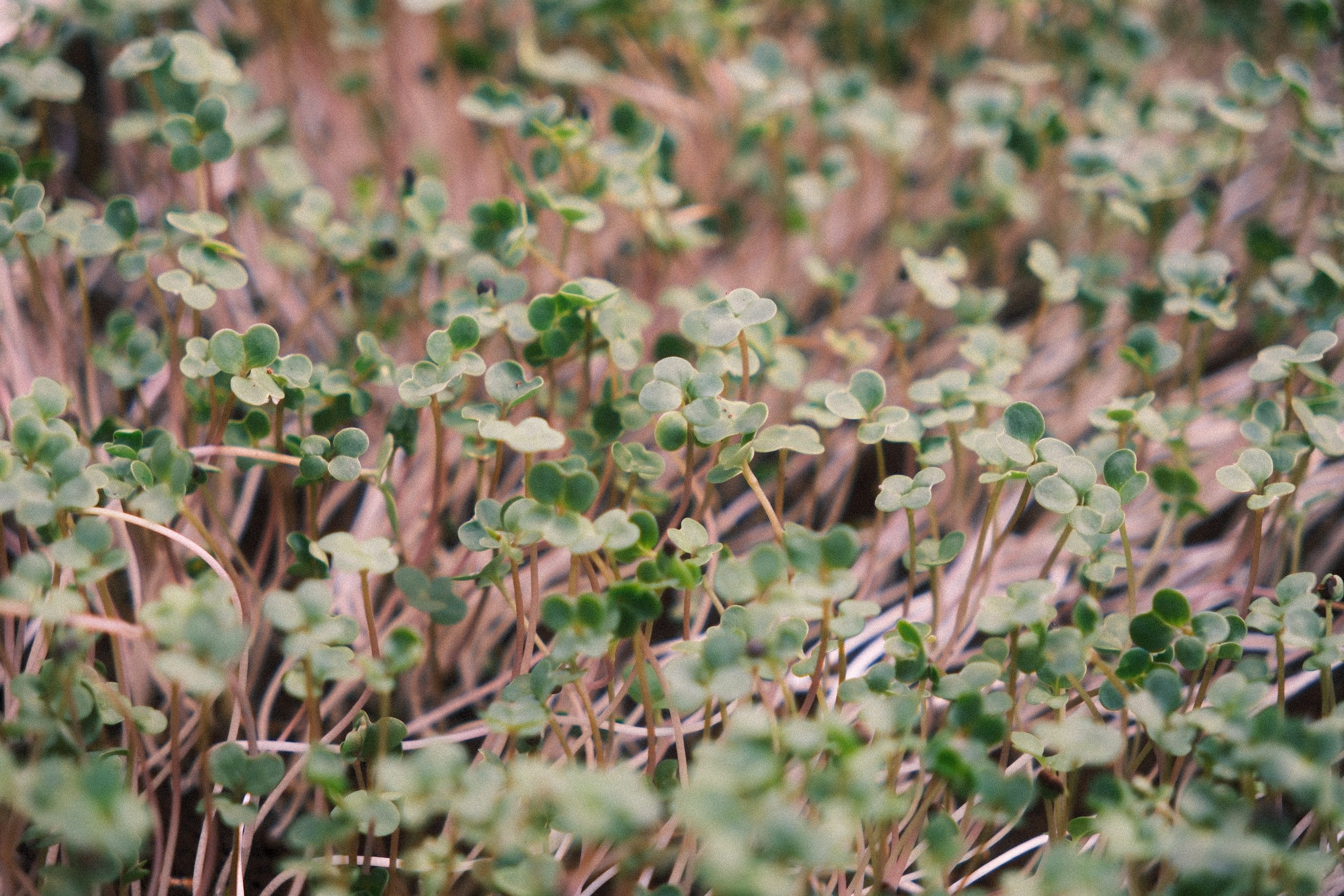
Shiso, mizuna and tatsoi microgreens: flavour, kitchen uses, three recipes, and what the published composition data does and does not cover for each crop.
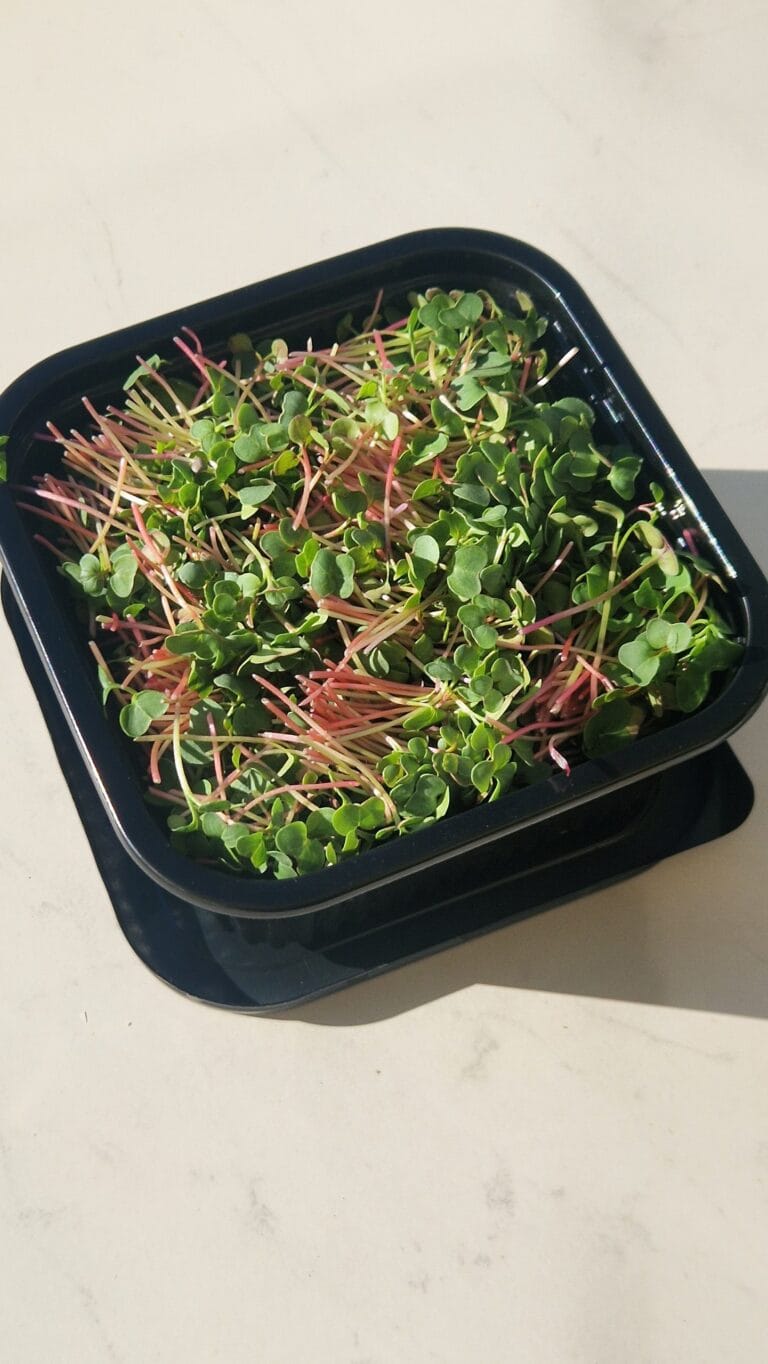
Beyond the familiar lettuce, radish, broccoli and sunflower, a smaller group of species stands out for its unusual flavors and culinary uses. This article covers three of them: shiso, mizuna, and tatsoi.
Red shiso is a highly popular microgreen in Asian cuisine thanks to its citrusy, floral, and slightly minty aroma. Its use has spread internationally due to its versatility in salads, bowls, sushi, and gourmet dishes. Shiso microgreens have also been analysed in the laboratory for rosmarinic acid — a phenolic compound — and for antioxidant activity measured in a test tube, which is a property of the extract rather than a demonstrated effect in people (Lee et al., 2023).
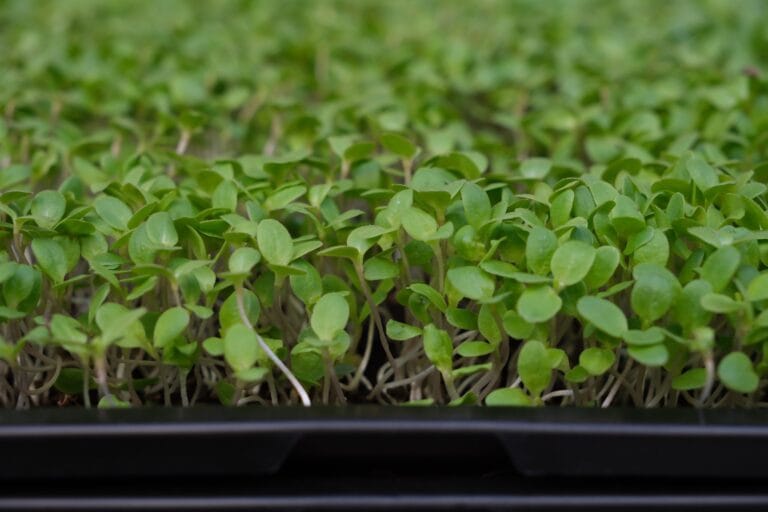
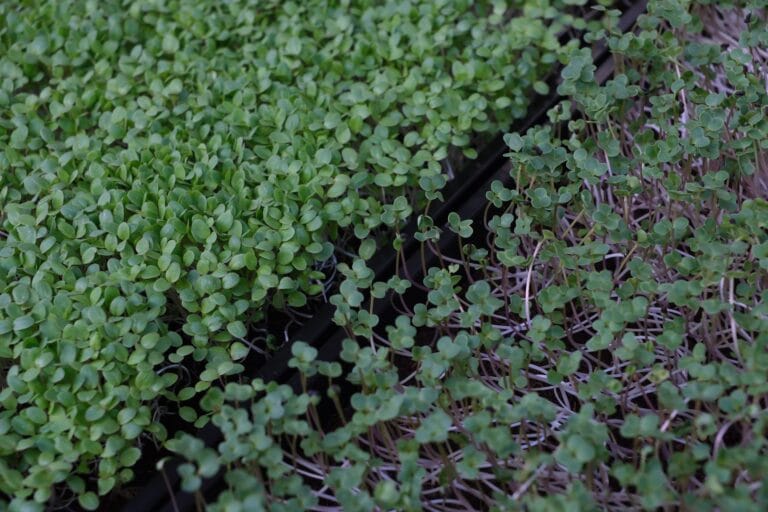
Among the Asian microgreens with a long history, mizuna and tatsoi also stand out. Both are valued for their mild, slightly peppery flavor, and both have been profiled for nutrient content in published studies — though not, as it turns out, by the same one.
Here is what the published data actually covers, crop by crop. Mizuna was one of seventeen species in a Frontiers in Plant Science study of microgreen yield and mineral profile; that study measured nitrogen, nitrate, phosphorus, potassium, calcium, magnesium, sulphur, sodium, iron, zinc, manganese, copper and boron — minerals only, no antioxidants — and found composition to depend heavily on the species (Di Gioia et al., 2023). Tatsoi was not among those seventeen. For tatsoi we rely on a separate trial of four species — coriander, green basil, purple basil and tatsoi — run as an iodine-biofortification experiment: the plants were treated with potassium iodide, and the researchers measured antioxidant activity by three assays (ABTS, FRAP and DPPH) and identified ten phenolic acids and twenty-three flavonoids (Giordano et al., 2023). Iodine is the only mineral that trial addresses, so it does not give a general mineral profile for tatsoi. Both are composition measurements: they describe what is in the plant, not a demonstrated effect on anyone’s nutrition.
Beyond each specific species, studies have measured higher concentrations of particular vitamins, minerals and antioxidant compounds in microgreens than in the mature plant, gram for gram. That result holds for specific compounds in specific species rather than across the board, so it is not a general rule that every microgreen beats every mature vegetable on every nutrient.
These exotic microgreens follow that same pattern: high nutritional density per unit of weight.
Exotic microgreens are rapidly entering the world of high end international cuisine, both for their flavor and presentation. Their uses range from sophisticated dressings, creative plate garnishes, and aromatic toppings to functional components for bowls, fusion salads, sandwiches, and gourmet cooking.
Ingredients:
Preparation:
A fresh, elegant bowl where shiso is the star.
Ingredients:
Preparation:
Tatsoi brings a fresh, mild, and slightly sweet touch that pairs perfectly with the acidity of the apple and lime.
Ingredients:
Preparation:
Perfect as a light main dish or a side.
Exotic microgreens like shiso, mizuna, and tatsoi offer interesting and functional alternatives for those who seek not only to decorate their dishes but also to enhance sensory diversity and culinary creativity.
Their growing presence in modern cuisine and in trendy restaurants in the world’s most cosmopolitan cities consolidates their position as “new generation microgreens”: exotic and visually striking.
Carlota
Di Gioia, F., Hong, J. C., Pisani, C., Petropoulos, S. A., Bai, J., & Rosskopf, E. N. (2023). Yield performance, mineral profile, and nitrate content in a selection of seventeen microgreen species. Frontiers in Plant Science, 14, 1220691. https://doi.org/10.3389/fpls.2023.1220691 — includes mizuna and shiso; does not include tatsoi; measures minerals and nitrate, not antioxidants.
Giordano, M., Ciriello, M., Formisano, L., El-Nakhel, C., Pannico, A., Graziani, G., Ritieni, A., Kyriacou, M. C., Rouphael, Y., & De Pascale, S. (2023). Iodine-biofortified microgreens as high nutraceutical value component of space mission crew diets and candidate for extraterrestrial cultivation. Plants, 12(14), 2628. https://doi.org/10.3390/plants12142628 — the tatsoi source: an iodine-biofortification trial in coriander, green basil, purple basil and tatsoi that measured antioxidant activity (ABTS, FRAP, DPPH) and profiled phenolic acids and flavonoids. Iodine, applied as potassium iodide, is the only mineral involved; the study does not report a general mineral profile.
Lee, S., Yeo, H. J., Lee, S. Y., Kim, S. R., Park, S. U., & Park, C. H. (2023). The effect of light and dark treatment on the production of rosmarinic acid and biological activities in Perilla frutescens microgreens. Plants, 12(8), 1613. https://doi.org/10.3390/plants12081613 — the shiso source: rosmarinic acid and laboratory antioxidant assays.
Correction note, July 2026. This page previously stated that published yield and mineral data show mizuna and tatsoi supply “essential minerals and antioxidant compounds”, citing Di Gioia (2023) and a handout hosted by Idaho State University. That was wrong on both counts: Di Gioia et al. measured minerals and nitrate only, with no antioxidant measurement, and tatsoi was not one of the seventeen species tested. The claim has been rewritten to name which source covers which crop. Four sources were dropped: aboutmicrogreens.com, a commercial blog cited for nutrition; verdeszagros.es, a shop listing cited for shiso’s antioxidant content; latorreagricola.com, a seed retailer post cited for a popularity ranking, whose link is now dead; and the Idaho State University handout, which profiles a commercial grower’s range — amaranth, broccoli, buckwheat, pea, radish and sunflower — and covers none of the three crops in this article. The popularity claim it supported has been removed rather than re-sourced. See our editorial standards.
Second correction note, 30 July 2026. The replacement citation above was itself described inaccurately. Giordano et al. (2023) was summarised here as having “measured mineral content together with total phenols and antioxidant activity”. It did not. It is an iodine-biofortification trial in which potassium iodide was the only mineral applied and iodine the only mineral measured, alongside antioxidant assays (ABTS, FRAP, DPPH) and a phenolic and flavonoid profile of coriander, green basil, purple basil and tatsoi. Tatsoi is genuinely one of the four species, so the citation stands; only our description of what it measured was wrong, and it has been corrected in the body text and in the source list. No source was dropped. See our editorial standards.
Studies from our Science Library that concern shiso, mizuna and tatsoi microgreens, in plain language with links to the original research. This list updates automatically as new studies are added.
No plain-language write-up for this crop yet — the peer-reviewed studies are listed further down this page, or browse the full Science Library.
Recipes and kitchen ideas from our cookbook team that use shiso, mizuna and tatsoi microgreens.
No recipes for this crop yet — the cookbook has plenty to start with.
Growing a different crop next? Every variety has a guide like this one in the Varieties database.
Our research archive holds 20 peer-reviewed studies on exotic microgreens. They are free to read and download, and each one credits its original authors.
This article is part of the free knowledge portal of EVEC Microgreens. Wherever you are on your microgreens journey, there is a path for you:
Co-funded by the European Union.
This portal presents the microgreens methodology; the organisation behind it is EVEC Athens — the European Voluntary and Educational Center (evec.org.gr). Views and opinions expressed are those of the author(s) only and do not necessarily reflect those of the European Union or the European Commission. Neither the European Union nor the granting authority can be held responsible for them.
Open licence. Except where stated otherwise, the educational materials on this portal are licensed under CC BY 4.0 — free to use, adapt and share, including commercially, with credit. See the licence terms.
Accessibility. We aim for WCAG 2.1 AA and publish what does and does not yet meet it — see the accessibility statement. If anything here blocks you, tell us and we will send the material in a format that works for you.