Get in touch
Questions about growing, workshops, the cooperative or partnerships? Send us a message and we will reply by email.
Prefer email? Write to erasmus@evec.org.gr
EVEC Microgreens
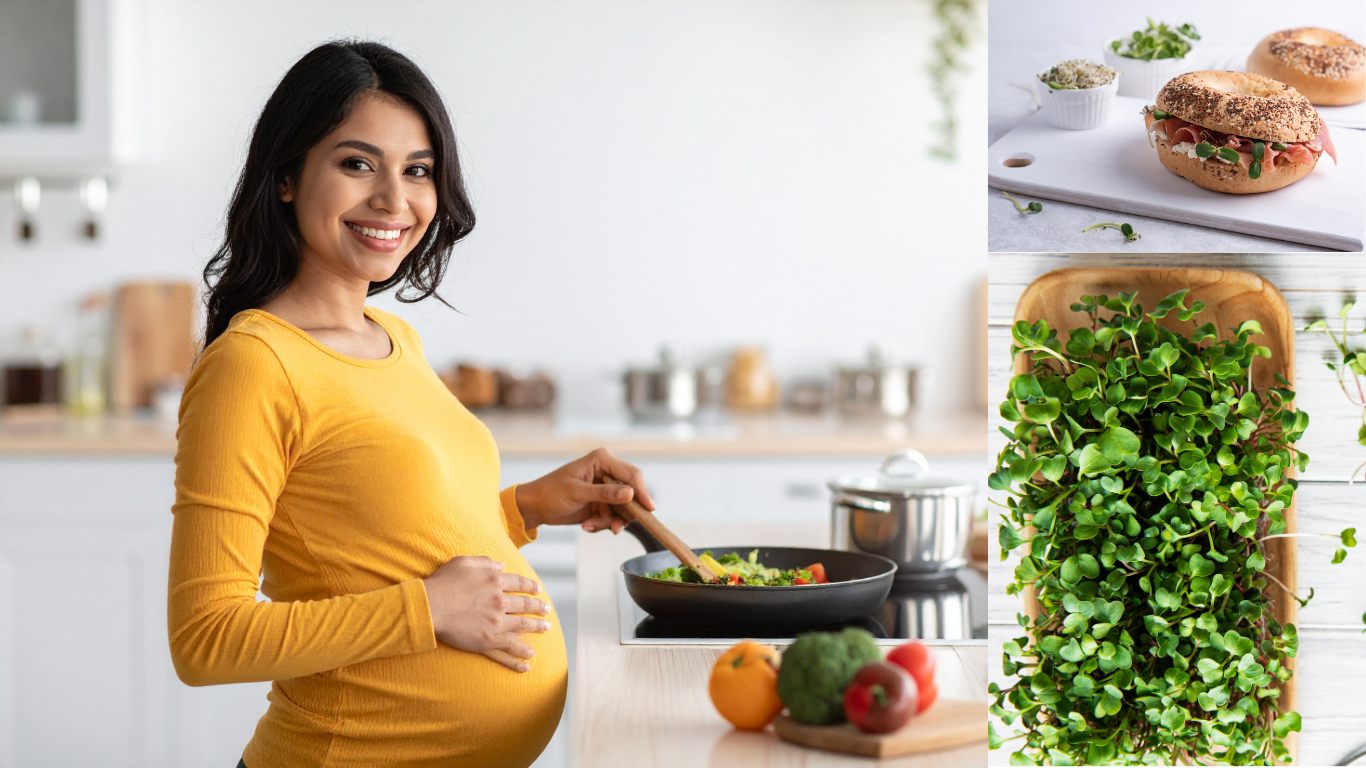
Five simple microgreens recipes for pregnancy, with the food-safety handling notes attached — cooked eggs and prawns, washed greens, and what we cannot claim.
This is the fourth and final article in our series on microgreens during pregnancy: five dishes that make microgreens easy to include in everyday meals. They work just as well outside pregnancy. Part I covers the nutrients, Part II the varieties, and Part III the safety guidance.
Read this before you cook: two of the five dishes below use microgreens raw. Microgreens are a raw, ready-to-eat green, so the NHS advice to wash fruit and vegetables thoroughly before eating — to remove soil, which can carry bacteria — applies to them. Whenever you have any doubt about how a batch was grown, handled or stored, cook it instead. Part III of this series sets out the full handling guidance, including the difference between microgreens and raw sprouts. This page is general food-safety information, not medical advice.
Ingredients
• Rice
• Vegetables: carrot and peas
• Prawns or shrimp
• Diced ham
• Eggs
• Soy sauce
• Olive oil
• A handful of kale microgreens, added at the end
Important!
Kale microgreens stirred in at the end keep their texture and color. We have removed the nutrient figures this recipe used to quote for them: we could not find published composition data for kale microgreens specifically, and repeating numbers from the mature vegetable would not be honest. Stirring them into a hot pan at the end is also the safer way to eat them, which is reason enough.
Ingredients
• Whole grain bread (a very Spanish option is to spread a bit of olive oil on the bread, it’s delicious, try it!)
• Sliced or mashed avocado
• Cooked or baked turkey breast
• A hard or semi-hard pasteurized cheese (such as gouda, cheddar or mozzarella)
• Sliced tomato
• A generous handful of washed sunflower microgreens
A quick option for snacks or when there isn’t time to cook. On the cheese: the NHS advises that mould-ripened soft cheeses with a white coating — brie, camembert, chèvre — and soft blue-veined cheeses such as Danish blue, gorgonzola and roquefort must be thoroughly cooked before eating in pregnancy, whether pasteurised or not, and that anything made from unpasteurised milk should be avoided or thoroughly cooked. A pasteurized hard or semi-hard cheese keeps this sandwich straightforward.
The microgreens here go in raw, so wash them thoroughly first. We have dropped the claim that this sandwich’s avocado provides “healthy fats for the baby’s nervous system development” — that is a causal claim about fetal development we have no source for — and the specific vitamin E and magnesium figures we previously attributed to sunflower microgreens, which we could not find published data for either.
Ingredients
• 1 cup plant based milk or natural yogurt
• 1 banana
• Half a cup of pineapple or mango
• A handful of washed pea microgreens
• 1 tablespoon of oats or chia seeds
Refreshing, quick and a good breakfast when appetite is unpredictable. This is the other raw-microgreen recipe on the page, so wash the pea shoots well; if you would rather not eat them raw at all, this is the dish to skip. If you use yogurt, choose a pasteurized one — the NHS lists unpasteurised yoghurt among the foods to avoid.
We previously said this smoothie provides folate, fiber and plant-based protein from the pea microgreens. We have removed that: we found no published folate figures for pea microgreens, and a garnish-sized handful is a few grams of food either way.
Ingredients
• A handful of washed broccoli microgreens
• Green leaves to taste (spinach, arugula or lettuce), washed thoroughly
• Half an avocado
• 1 boiled egg, cooked through
• Half to one cup of cooked lentils or chickpeas
• A drizzle of olive oil
• A squeeze of lemon or a few tomato pieces
This is the dish where the nutrition actually has something behind it. EFSA’s Panel concluded that a cause and effect relationship has been established between dietary vitamin C intake and increasing non-haem iron absorption — so putting a vitamin C source (the lemon, the tomato) in the same bowl as the plant-based iron in lentils or chickpeas is a combination with real substantiation, not a folk rule. Broccoli microgreens are also the one variety in this series with published mineral data: Weber measured higher phosphorus, potassium, calcium, magnesium, manganese, zinc, iron, sodium and copper concentrations in compost-grown broccoli microgreens than in the mature vegetable.
What we are not saying is that this salad prevents anemia. Improving iron absorption from a meal and preventing a diagnosed deficiency are different things, and the second one belongs to your midwife or doctor. Boil the egg through, and wash every raw leaf in the bowl.
Ingredients
• 4 carrots
• 2 potatoes
• 2 leeks
• 2 zucchinis
• 1 tablespoon olive oil
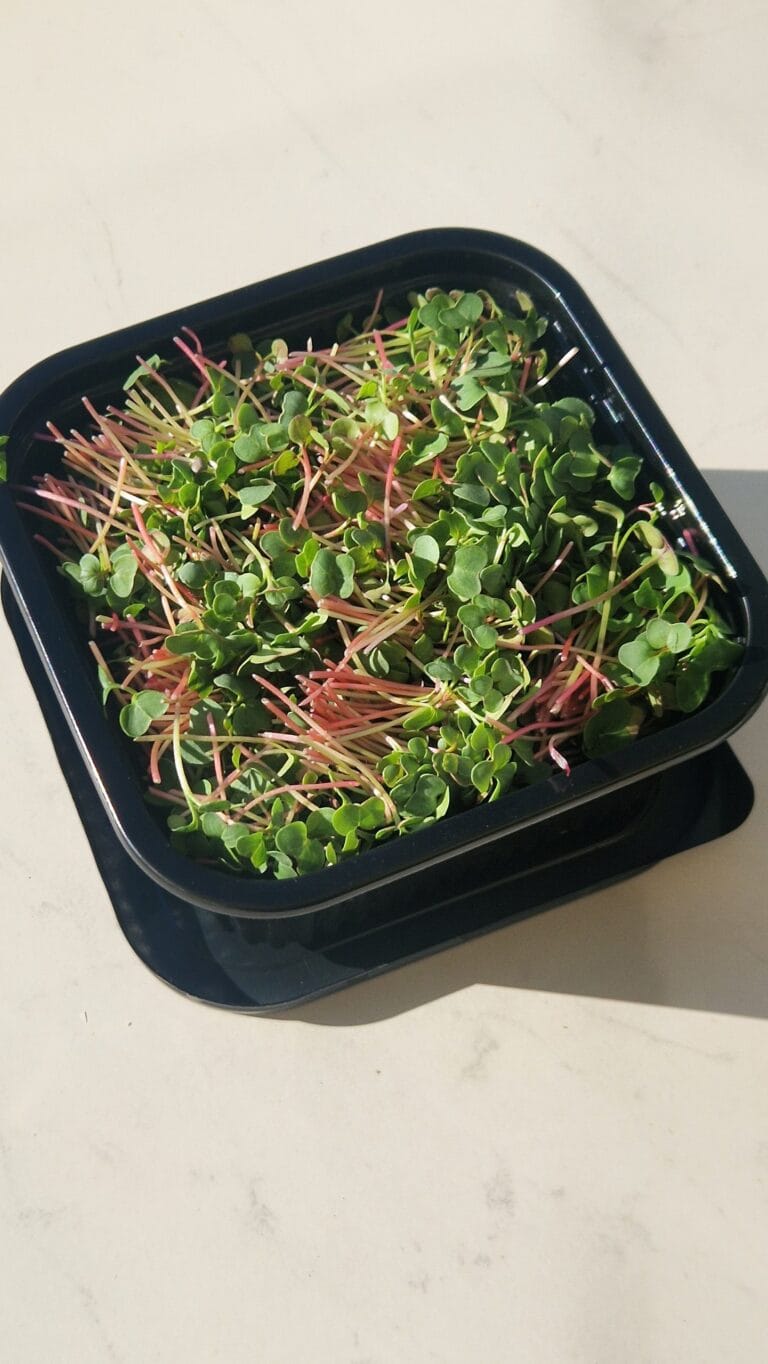
• A handful of chopped radish microgreens
• Salt and pepper to taste
A light dinner, and the easiest of the five to make safe: stir the chopped radish microgreens into the hot purée rather than scattering them on top, and they are cooked. They add a peppery lift that turns an ordinary vegetable purée into something worth eating twice.
One correction here as well. This recipe used to describe radish microgreens as a source of vitamin C and iron. In the largest published survey of microgreen vitamin content, green daikon radish came top of the 25 varieties tested for vitamin E, not vitamin C — red cabbage led on vitamin C.
Five dishes across kale, sunflower, pea, broccoli and radish microgreens: a fried rice, a sandwich, a smoothie, a salad and a purée. The handling notes are not optional extras — cook the prawns and the eggs through, heat cold cured meats, choose pasteurized dairy, and wash every raw green. Three of the five dishes cook the microgreens or let you cook them, which in pregnancy is the safer route.
That closes the series. If you have not read Part III on safety, it is the instalment that matters most.
We hope you give these recipes a try, whether you’re pregnant or not. You can share them with us on social media, we’d love to see your creations and how you enjoy them.
Social Media:
• Instagram: @evec.microgreens
• Facebook: evec.microgreens
• TikTok: @evec.microgreens
See you in the next article!
Carlota
This article is general food-safety and nutrition information, not medical advice. Dietary needs in pregnancy are individual — always follow the guidance of your doctor or midwife.
This article is part of the free knowledge portal of EVEC Microgreens. Wherever you are on your microgreens journey, there is a path for you:
Co-funded by the European Union.
This portal presents the microgreens methodology; the organisation behind it is EVEC Athens — the European Voluntary and Educational Center (evec.org.gr). Views and opinions expressed are those of the author(s) only and do not necessarily reflect those of the European Union or the European Commission. Neither the European Union nor the granting authority can be held responsible for them.
Open licence. Except where stated otherwise, the educational materials on this portal are licensed under CC BY 4.0 — free to use, adapt and share, including commercially, with credit. See the licence terms.
Accessibility. We aim for WCAG 2.1 AA and publish what does and does not yet meet it — see the accessibility statement. If anything here blocks you, tell us and we will send the material in a format that works for you.