Get in touch
Questions about growing, workshops, the cooperative or partnerships? Send us a message and we will reply by email.
Prefer email? Write to erasmus@evec.org.gr
EVEC Microgreens
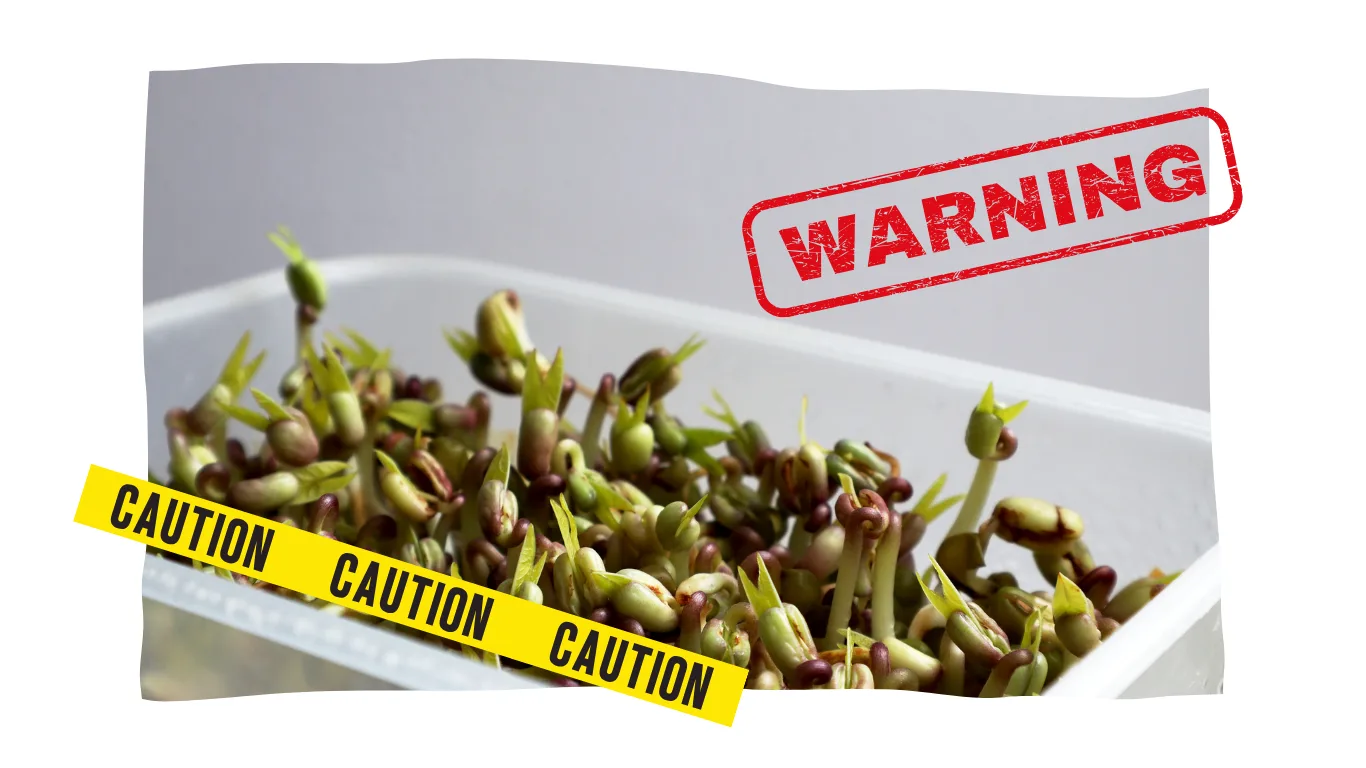
Where microgreens fall short: what the food-safety reviews actually found, Pythium that cost 74% of a tray, a shelf life measured in days, and the price problem.
The disadvantages of microgreens come down to four things: contamination risk, a short shelf life after cutting, a small amount of nutrition per serving, and a price that post-harvest deterioration keeps high. The safety risk is narrower than it is usually told: a 2020 review by researchers at the USDA and the University of Maryland found that microgreens had been the subject of seven recalls but had not been associated with any foodborne illness outbreak. What follows is what the published research measured on each point — and where a claim had no measurement behind it, why we dropped it rather than keep it. On the nutrition question specifically, see our comparison of microgreens and their mature versions.
One of the main drawbacks of microgreens is their vulnerability to microbiological contamination. Like sprouts, they are generally eaten raw and grown in warm, humid conditions — conditions that also suit pathogenic bacteria such as Escherichia coli and Salmonella.
The honest version of this risk is narrower than the way it is usually told. A 2020 review by researchers at the USDA and the University of Maryland found that microgreens had not been associated with any foodborne illness outbreak, but had been the subject of seven recalls. The potential is real; the outbreak record is not there. A review of food safety along the microgreen farm-to-fork chain reaches the same place: because microgreens are a young crop with little incident history, the sensible way to assess their risk is by comparison with sprouts and by identifying control points in production, not by counting outbreaks.
If proper hygiene practices are not maintained, whether in the substrate, irrigation, or handling, the final product can pose a risk to consumer health.
In addition, fungi and molds are frequent problems in production, as we’ve discussed in previous articles. Penn State Extension reports damping-off as the one disease issue it has actually encountered in its hydroponics teaching production, caused by Rhizoctonia or Botrytis species and favored by warm, humid conditions; its practical advice is to water in a way that keeps leaves and stems dry, and to weigh the wish to seed densely against the risk of disease.
Pythium species do the same job from below. In a greenhouse trial at the University of Connecticut, arugula and mustard grown in propagation trays and inoculated with Pythium aphanidermatum and Pythium dissotocum lost 74.4% of their shoot dry weight compared with uninoculated plants — not a total loss, but three quarters of the crop gone. In a separate hydroponic experiment in the same study, infected plants were at least 28% smaller.
We have dropped one claim this article used to make: that poor ventilation specifically encourages mold. Warm, humid conditions certainly do, and dense seeding raises the risk, but we could find no published measurement isolating ventilation as the cause, so we are not going to state it as a fact.
Another negative aspect of microgreens, one we’ve also mentioned before, is their short shelf life after harvest. The 2020 review is blunt about it: rapid quality deterioration soon after harvest is described as one major limitation on the growth of the whole industry. Once cut, microgreens dehydrate, wilt, decay and rapidly lose certain nutrients.
The commercial consequence follows directly from the biology, and the same review states it plainly: the speed of deterioration keeps prices high and restricts commerce to local sales. A fast, refrigerated supply chain is not an optional refinement here — it is the condition for selling the crop at any distance at all.
Although numerous studies highlight the high content of vitamins, antioxidants, and minerals in microgreens, their small size and low weight limit the total amount of nutrients obtained per serving. This is arithmetic rather than a research finding: a concentration per 100 g says nothing useful until you multiply it by the few grams that actually go on a plate. Microgreens should not be seen as substitutes for mature vegetables, but as a complement within a balanced diet.
From a commercial standpoint, microgreens also face challenges related to consumer acceptance. Their high price, which the shelf-life research links directly to post-harvest deterioration, limits accessibility. Their delicate appearance and short shelf life raise reasonable doubts about practicality compared with conventional vegetables.
What the published consumer research actually shows is more specific than the usual generalizations. In a test of twelve microgreen species, appearance was widely appreciated — but acceptance was decided by flavor and texture, and in particular by astringency, sourness and bitterness: the lower those three, the higher the acceptability. Mibuna and cress scored lowest; Swiss chard and coriander highest.
This article used to say that microgreens are mainly aimed at younger buyers and at people following healthy or organic lifestyles. We removed that. It came from microgreens businesses describing their own customers, and we found no consumer survey behind it.
Although microgreens represent an innovative trend with multiple nutritional and culinary benefits, their production and commercialization also pose significant challenges. The main drawbacks are related to food safety, limited shelf life, sanitary risks, and a certain level of consumer skepticism.
As the market grows, research, consumer education, and improved hygiene practices will be essential for microgreens to become part of everyday diets.
See you in the next article!
Carlota
This article was re-sourced in July 2026; it previously rested on five gardening blogs and microgreens businesses. Every claim above now points to a peer-reviewed paper or a university extension service, and where we could not find one, we say so instead of keeping the claim. Removed in July 2026: epicgardening.com, microgreensworld.com, peoplesfarm.com, producegrower.com and startmicrogreens.com. This is the page our Science Library calls “the deliberately sceptical piece”, and it was sourced from exactly the kind of publisher the Library warns readers about. See our editorial standards.
This article is part of the free knowledge portal of EVEC Microgreens. Wherever you are on your microgreens journey, there is a path for you:
Co-funded by the European Union.
This portal presents the microgreens methodology; the organisation behind it is EVEC Athens — the European Voluntary and Educational Center (evec.org.gr). Views and opinions expressed are those of the author(s) only and do not necessarily reflect those of the European Union or the European Commission. Neither the European Union nor the granting authority can be held responsible for them.
Open licence. Except where stated otherwise, the educational materials on this portal are licensed under CC BY 4.0 — free to use, adapt and share, including commercially, with credit. See the licence terms.
Accessibility. We aim for WCAG 2.1 AA and publish what does and does not yet meet it — see the accessibility statement. If anything here blocks you, tell us and we will send the material in a format that works for you.